

'Now I am become Death, the destroyer of worlds': who was atom bomb pioneer Robert Oppenheimer?
- Written by: Darius von Guttner Sporzynski, Historian, Australian Catholic University
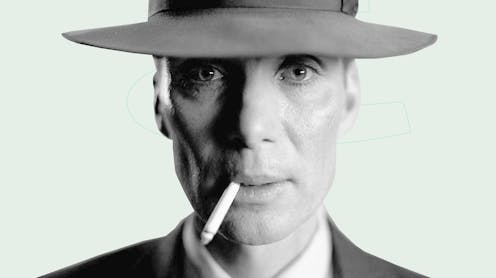
Robert Oppenheimer is often placed next to Albert Einstein as the 20th century’s most famous physicist.
He will forever be the “father of the atomic bomb” after the first nuclear weapon was successfully tested on July 16, 1945 in the New Mexican desert. The event brought to his mind words from a Hindu scripture: “Now I am become Death, the destroyer of worlds”.
Robert Oppenheimer speaks those famous words.Who was Robert Oppenheimer?
Born in 1904 in an affluent New York family, Oppenheimer graduated from Harvard majoring in chemistry in 1925.
Two years later, he completed his PhD in physics at one of the world’s leading institutions for theoretical physics, the University of Göttingen, Germany. He was 23 and enthusiastic to the point of alienating others.
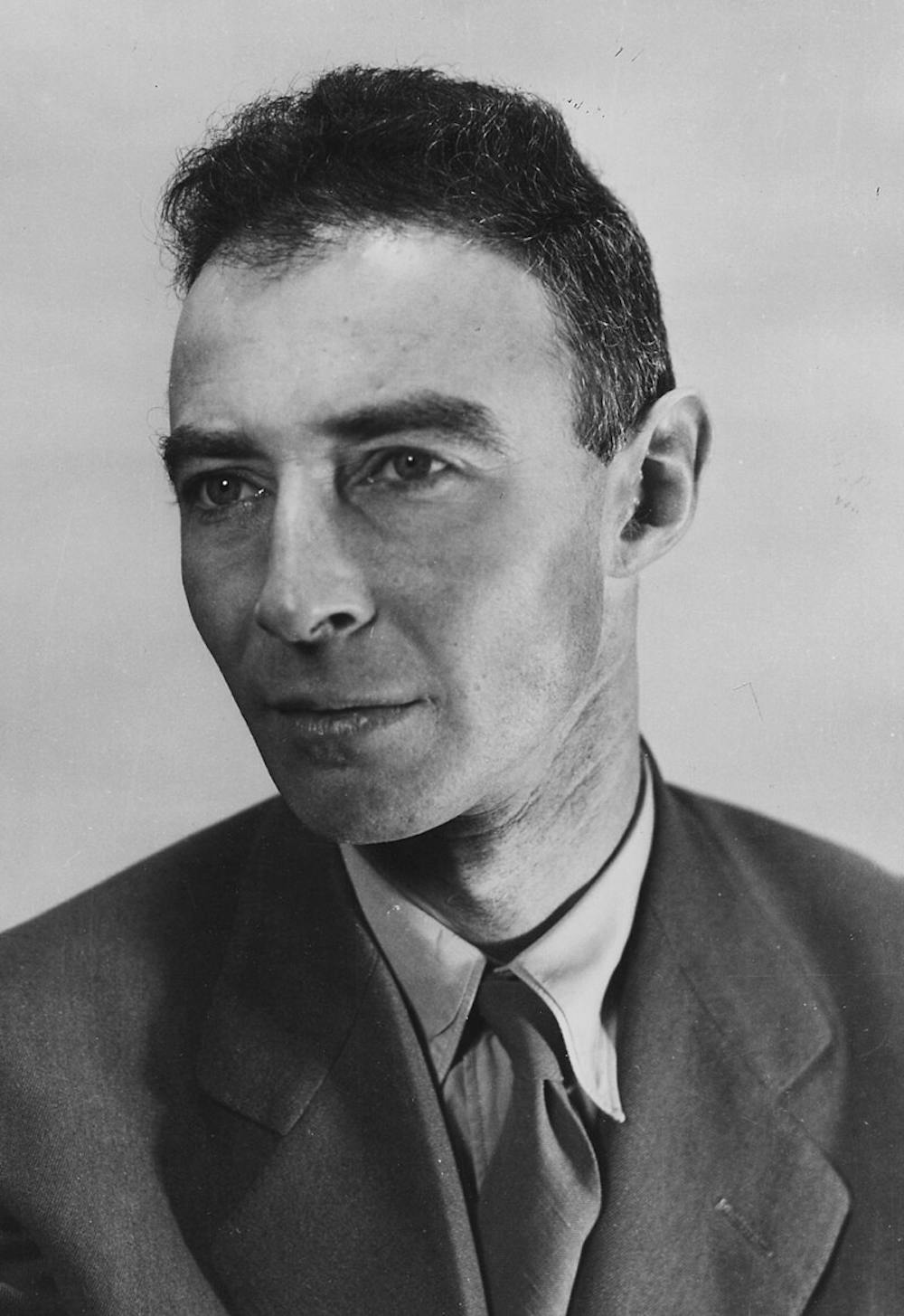
Throughout his life, Oppenheimer would be judged either as an aloof prodigy or an anxious narcissist. Whatever his contradictions as an individual, his eccentricities did not limit his scientific achievements.
Before the outbreak of the second world war, Oppenheimer worked at the University of California, Berkeley, and the California Institute of Technology. His research concentrated on theoretical astronomy, nuclear physics and quantum field theory.
Although he confessed to being uninterested in politics, Oppenheimer openly supported socially progressive ideas. He was concerned with the emergence of antisemitism and fascism. His partner, Kitty Puening, was a left-leaning radical and their social circle included Communist Party members and activists. Later, these associations will mark him as a communist sympathiser.
As a researcher, Oppenheimer published and supervised a new generation of doctoral students. One of these was Willis Lamb, who in 1955 was awarded the Nobel Prize in physics. The Nobel Prize eluded Oppenheimer three times.
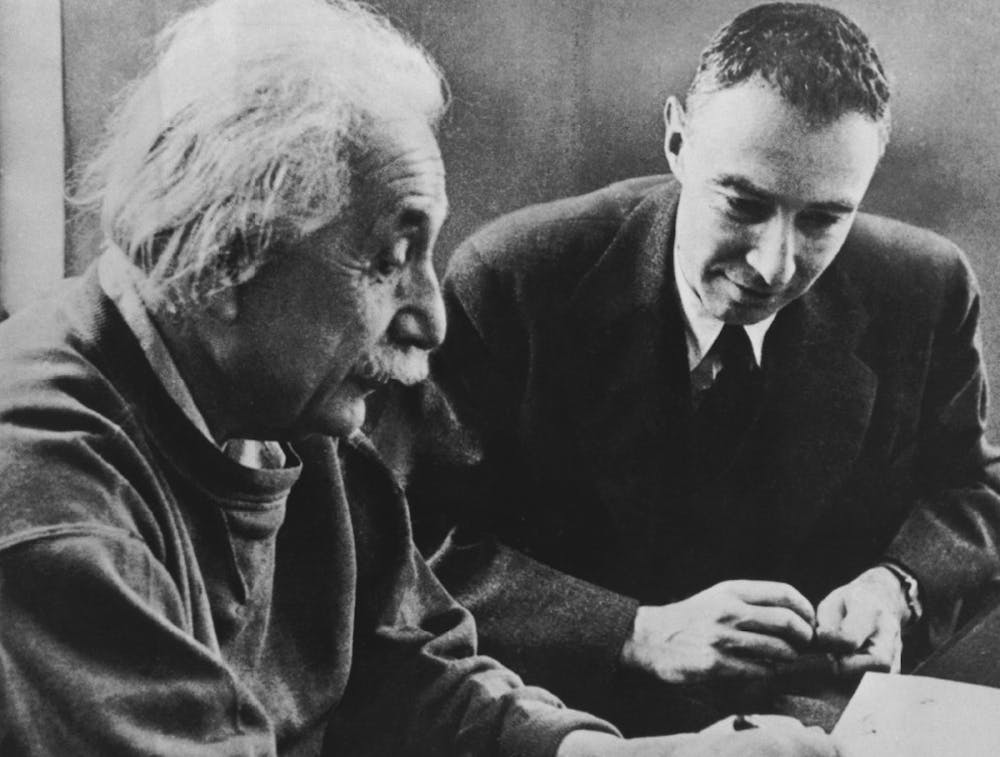 Albert Einstein and Robert Oppenheimer, c. 1950.
Wikipedia
Albert Einstein and Robert Oppenheimer, c. 1950.
Wikipedia
The second world war
Two years after Germany and Soviet Russia attacked Poland, the United States entered WWII. Oppenheimer was recruited to work on the infamous Manhattan Project. His ideas about chain reaction in an atomic bomb gained recognition among the US defence community. He started his work by assembling a team of experts. Some of them were his students.
In 1943, despite his left-wing political views, lack of high-profile career and no experience in managing complex projects, Oppenheimer was appointed director of the Los Alamos National Laboratory in New Mexico. He was enthusiastic. He seemed to have “reserves of uncommitted strength” recalled physicist Isidor Isaac Rabi. His task was to develop atomic weapons.
Los Alamos Laboratory expanded rapidly as the project grew in complexity, with the personnel exceeding 6,000. His ability to master the large-scale workforce and channel their energy towards the needs of the project earned him respect.
He proved to be more than just an administrator by being involved in the interdisciplinary team across theoretical and experimental stages of the weapons development.
The nuclear test
On July 16, 1945 the nuclear test, code named Trinity, took place.
The first atomic bomb was successfully detonated at 5:29 am in the Jornada del Muerto desert. As his chief assistant, Thomas Farrell, recounted:
There came this tremendous burst of light followed shortly thereafter by the deep growling roar of the explosion.
Oppenheimer later recalled that “a few people laughed, a few people cried, most people were silent”. What he knew for sure was that the world would not be the same.
It was too late for the atomic bombs to be used against Germany in the war – the Nazis had capitulated on May 8. Instead, US President Harry Truman decided to use the bomb against Germany’s ally, Japan.
Shortly after the atomic bombs were dropped on the Japanese cities of Hiroshima and Nagasaki in August 1945, Oppenheimer confronted the US secretary of war, Henry Stimson, demanding that nuclear weapons were banned.
Similarly, when speaking with Truman, Oppenheimer talked about his feeling of having blood on his hands. Truman rejected Oppenheimer’s emotional outburst. The responsibility for the use of the atomic bombs, after all, rested with the commander in chief (himself).
Truman’s rebuttal did not prevent Oppenheimer from advocating for the establishment of controls on the nuclear arms race.
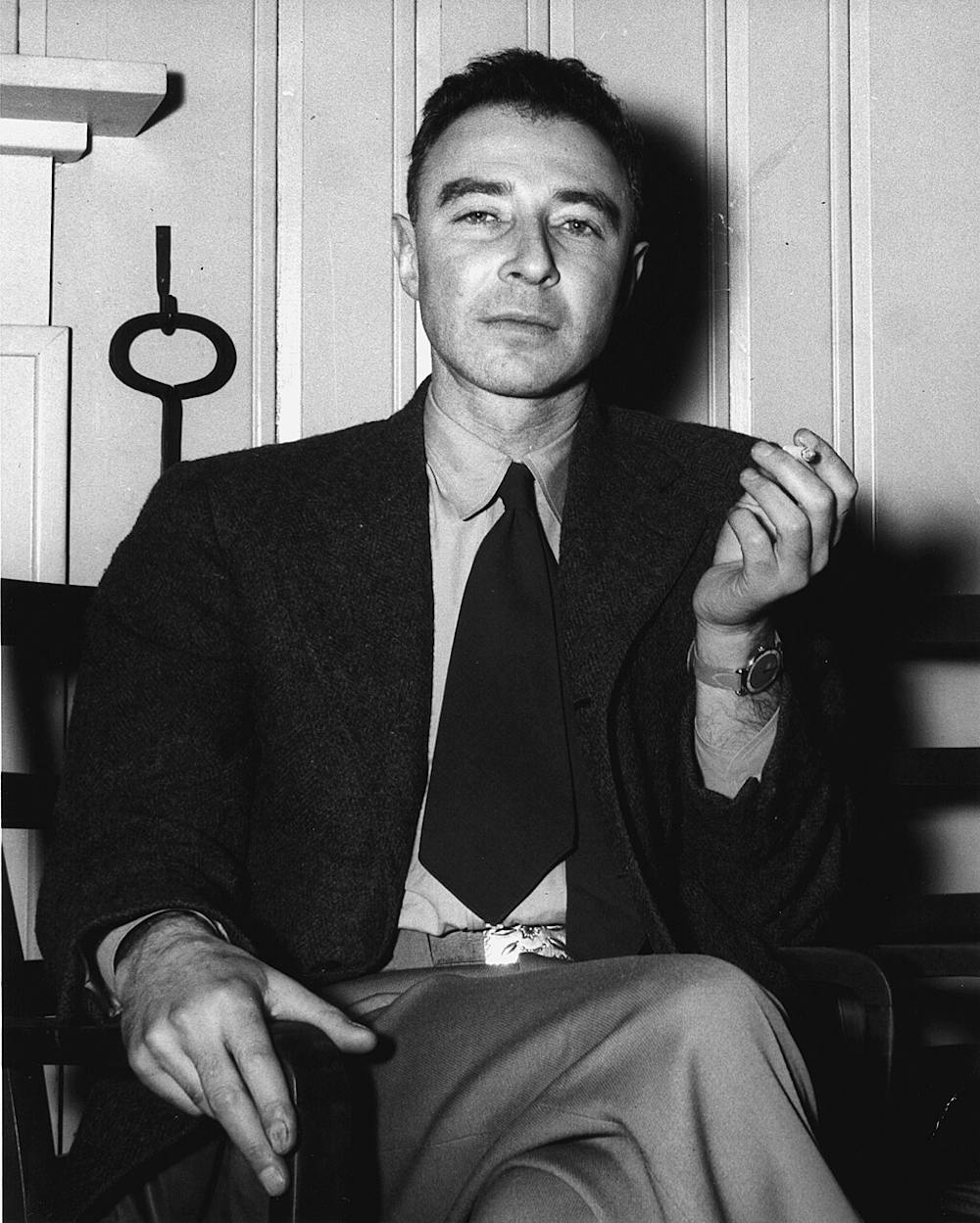 J Robert Oppenheimer and his signature cigarette.
Wikipedia
J Robert Oppenheimer and his signature cigarette.
Wikipedia
Arms control
In the postwar years, Oppenheimer settled in Princeton, New Jersey, at the Institute for Advanced Study. He read widely. He collected art and furniture. He learned languages. His well-paid position enabled his pursuit of a deeper understanding of humanity though the examination of ancient scriptures. He argued for the unity of purpose between the sciences and humanities.
Oppenheimer’s patronage supported and encouraged other scientists in their research. But his chief concern was the unavoidable arms race. He advocated for the establishment of an international body that would control the development of nuclear energy and its usage.
In 1947, a civilian agency called the Atomic Energy Commission began its work. Oppenheimer urged strongly for international arms control.
The Soviet Union’s first atomic bomb test in August 1949 took the US by surprise and pushed American researchers to develop a hydrogen bomb. The US government hardened its position. In 1952, Truman refused to reappoint Oppenheimer as the adviser to the Atomic Energy Commission.
After 1952, Oppenheimer’s advocacy against the first test of the hydrogen bomb resulted in the suspension of his security clearance. The investigation that followed in 1954 exposed Oppenheimer’s past communist ties and culminated in his security clearance being revoked.
McCarthyism and academic freedom
In the era of Joseph McCarthy’s witch-hunts, his fellow scientists considered Oppenheimer as a martyr of the cause of academic freedom. “In England”, commented Wernher von Braun, a former Nazi turned American pioneer of rocket technology, “Oppenheimer would have been knighted”.
After 1954, Oppenheimer did not cease to advocate for freedom in the pursuit of knowledge. He toured internationally with talks about the role of academic freedom unrestrained by political considerations. He argued that the sciences and the humanities are not separate human endeavours but interlocked and inseparable.
Oppenheimer died at the age of 62 on February 18, 1967.
Authors: Darius von Guttner Sporzynski, Historian, Australian Catholic University


 Daily Bulletin


