

Organisms without brains can learn, too – so what does it mean to be a thinking creature?
- Written by: Thomas White, Senior lecturer, University of Sydney
The brain is an evolutionary marvel. By shifting the control of sensing and behaviour to this central organ, animals (including us) are able to flexibly respond and flourish in unpredictable environments. One skill above all – learning – has proven key to the good life.
But what of all the organisms that lack this precious organ? From jellyfish and corals to our plant, fungi and single-celled neighbours (such as bacteria), the pressure to live and reproduce is no less intense, and the value of learning is undiminished.
Recent research on the brainless has probed the murky origins and inner workings of cognition itself, and is forcing us to rethink what it means to learn.
Learning about learning
Learning is any change in behaviour as a result of experience, and it comes in many forms. At one end of the spectrum sits non-associative learning. Familiar to anyone who has “tuned out” the background noise of traffic or television, it involves turning up (sensitising) or dialling down (habituating) one’s response with repeated exposure.
Further along is associative learning, in which a cue is reliably tied to a behaviour. Just as the crinkling of a chip packet brings my dog running, so too the smell of nectar invites pollinators to forage for a sweet reward.
Read more: Bees can do so much more than you think – from dancing to being little art critics
Higher still are forms like conceptual, linguistic and musical learning, which demand complex coordination and the ability to reflect on one’s own thinking. They also require specialised structures within the brain, and a large number of connections between them. So, to our knowledge, these types of learning are limited to organisms with sufficient “computing power” – that is, with sufficiently complex brains.
The presumed relationship between brain complexity and cognitive ability, however, is anything but straightforward when viewed across the tree of life.
This is especially true of the fundamental forms of learning, with recent examples reshaping our understanding of what was thought possible.

Who needs a brain?
Jellyfish, jelly-combs, and sea anemones stand among the earliest ancestors of animals, and share the common feature of lacking a centralised brain.
Nonetheless, the beadlet anemone (Actinia equina) is able to habituate to the presence of nearby clones. Under normal circumstances it violently opposes any encroachment on its territory by other anemones. When the intruders are exact genetic copies of itself, however, it learns to recognise them over repeated interactions, and contain its usual aggression.
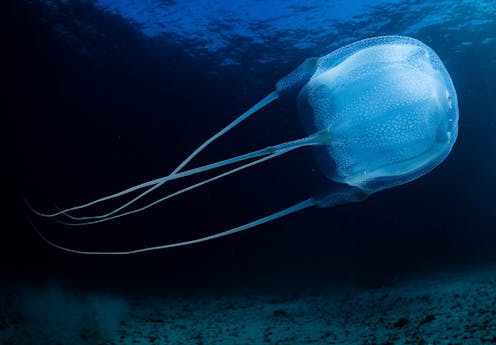
A recent study has now shown box jellyfish too are avid learners, and in an even more sophisticated manner. Though they possess only a few thousand neurons (nerve cells) clustered around their four eyes, they are able to associate changes in light intensity with tactile (touch) feedback and adjust their swimming accordingly.
This allows for more precise navigation of their mangrove-dominated habitats, and so improves their odds as venomous predators.
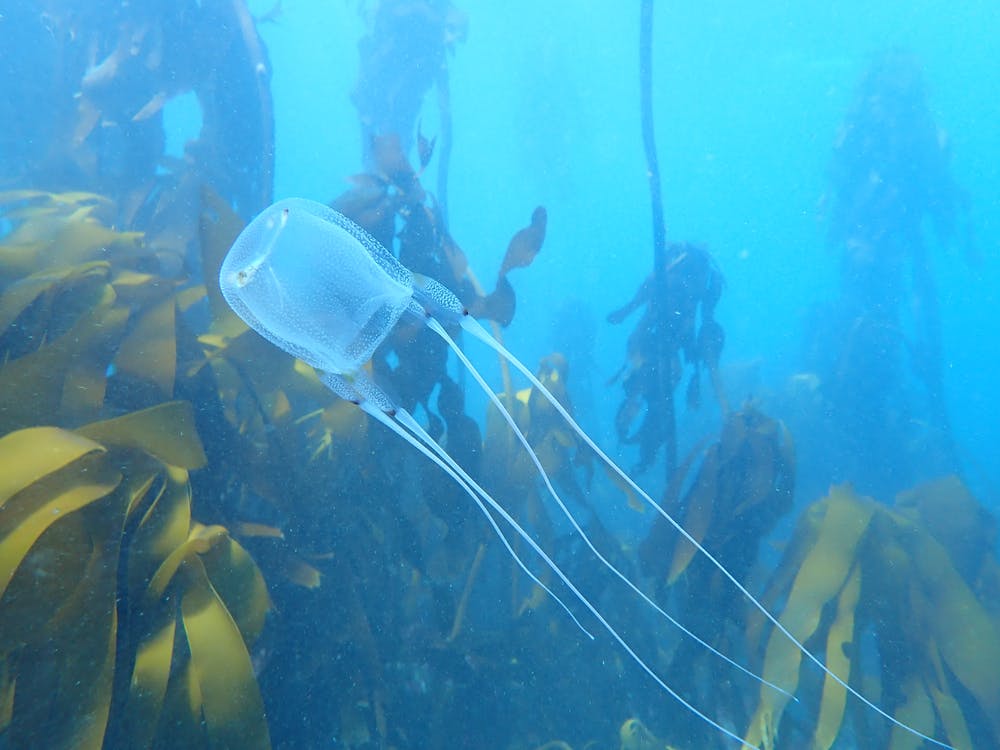 The highly venomous box jellyfish have recently joined the ranks of brainless organisms that demonstrate an ability to learn.
Shutterstock
The highly venomous box jellyfish have recently joined the ranks of brainless organisms that demonstrate an ability to learn.
Shutterstock
No neurons, no problem
Stretching our instincts further, evidence now abounds for learning in organisms that lack even the neuronal building blocks of a brain.
Slime moulds are single-celled organisms that belong to the protist group. They bear a passing resemblance to fungi, despite being unrelated. Recently (and inaccurately) popularised on TV as zombie-making parasites, they also offer a striking case study in what the brainless can achieve.
Elegant experiments have documented a suite of cognitive tricks, from remembering routes to food, to using past experience to inform future foraging, and even learning to ignore bitter caffeine in search of nutritious rewards.
Plants too can be counted among the brainless thinkers. Venus flytraps use clever sensors to remember and tally up the touches of living prey. This allows them to close their traps and begin digestion only when they’re sure of a nutritious meal.
In less gruesome examples, the shameplant (Mimosa pudica) curls and droops its leaves to protect itself from physical disturbance. This is an energetically costly activity, however, which is why it can habituate and learn to ignore repeated false alarms. Meanwhile, the garden pea can seemingly learn to associate a gentle breeze, itself uninteresting, with the presence of essential sunlight (though this finding has not gone unchallenged).
These results have driven calls to consider plants as cognitive and intelligent agents, with the ensuing debate spanning science and philosophy.
Read more: Can plants think? They could one day force us to change our definition of intelligence
 If you touch the leaves of a shameplant, they will close and droop, reopening a few minutes later.
Shutterstock
If you touch the leaves of a shameplant, they will close and droop, reopening a few minutes later.
Shutterstock
Thinking big
Learning, then, is not the sole province of those with a brain, or even the rudiments of one. As evidence of cognitive prowess in the brainless continues to accumulate, it challenges deep intuitions about the biology of sensation, thought, and behaviour more generally.
The implications also reach beyond science into ethics, as with recent advances in our understanding of nociception, or pain perception. Do fish, for example, feel pain, despite not having the requisite brain structures like those of primates? Yes. What about insects, with an even simpler arrangement of an order-of-magnitude fewer neurons? Probably.
And if such organisms can learn and feel, albeit in ways unfamiliar to us, what does it say about how we treat them in our recreational, research and culinary pursuits?
Above all else, these curious and diverse forms of life are a testament to the creative power of adaptive evolution. They invite us to reflect on our often-assumed seat at the apex of the tree of life, and remind us of the inherent value in studying, appreciating and conserving lives very different from our own.
Authors: Thomas White, Senior lecturer, University of Sydney


 Daily Bulletin


