

Stone Age herders transported heavy rock tools to grind animal bones, plants and pigment
- Written by: Maria Guagnin, Postdoctoral Researcher, Max Planck Institute of Geoanthropology
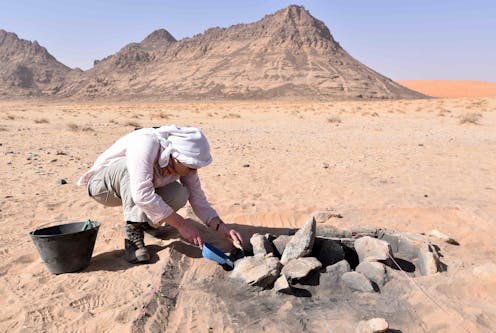
About 7,000 years ago, a small group of people sat around a fire, next to a small lake in what is now the Nefud Desert of northern Saudi Arabia.
We found some of the tools they left behind – and on close inspection of the tools, we discovered these Stone Age herders were busy grinding animal bones, wild plants and pigments while their meat was cooking.
Our results are published in a new paper in PLOS ONE.
Herders and artists
Our earlier research has shown that between 10,000 and 6,000 years ago much of Arabia was far wetter and greener than it is today.
Grasslands spread, and trees and shrubs grew near water sources. Lakes formed and provided water. Herders lived around these lakes and led their cattle, sheep and goats to the best pastures.
These Stone Age herders were also skilled artists. They carved thousands of images into rock surfaces on cliffs and boulders, documenting their daily lives.
The rock art shows Stone Age people hunting gazelles, wild donkeys and ibex, and it also shows their most precious possession: their cattle.
Stone Age camp sites
Archaeological sites from this period consist of collections of small fireplaces. The herders seem to have been extremely mobile, moving around the landscape with their herds, searching for pasture and water.
On these routes they made small camps near lakes, returning to the same places again and again as the years passed and the seasons turned.
A few years ago, we discovered one such camp at Jebel Oraf, near the Jubbah Oasis, in the Nefud Desert of Northern Saudi Arabia.
On the shores of a small, ancient lake, we discovered 170 small fireplaces. We excavated 17 of these fireplaces and radiocarbon dating showed that most of them are between 7,200 and 6,800 years old.

What surprised us was that the small camps were full of grinding tools. Most of them had been broken into smaller pieces, and then placed on top of the fire. Some had had holes drilled into them to attach a rope to help carry them.
Although people were moving a lot, they took heavy grinding stones weighing up to three kilograms with them. It’s not clear how the grinding stones were transported – either they were carried by people or perhaps they were strapped to their cattle. Regardless, these grinding tools seem to have been very important to them.
Today the Jubbah Oasis is extremely arid and for archaeologists that means organic remains don’t survive. This made it very difficult to find out what the purpose of these grindstones was.
There are no plant remains in the archaeological sites, and animal bones only survive in small fragments. So, we turned to microscopic analysis in order to help determine the function of the grinding tools.
Microscopic traces
In experiments we find that grinding different materials, such as bone, pigment, or plants, leaves distinctive microscopic marks on the surface of the grinding tools. These marks, including striations, fractures, rounding of individual quartz grains and different types of polish, can be seen with a microscope.
We looked at the Stone Age grinding tools to identify similar traces, and from them to determine what materials were ground.
Our microscopic study showed the grindstones were used for a range of different purposes.
Some were used to process bones. We know the fires were used to cook the meat of cattle, sheep and goats, and of game such as oryx and ostrich.
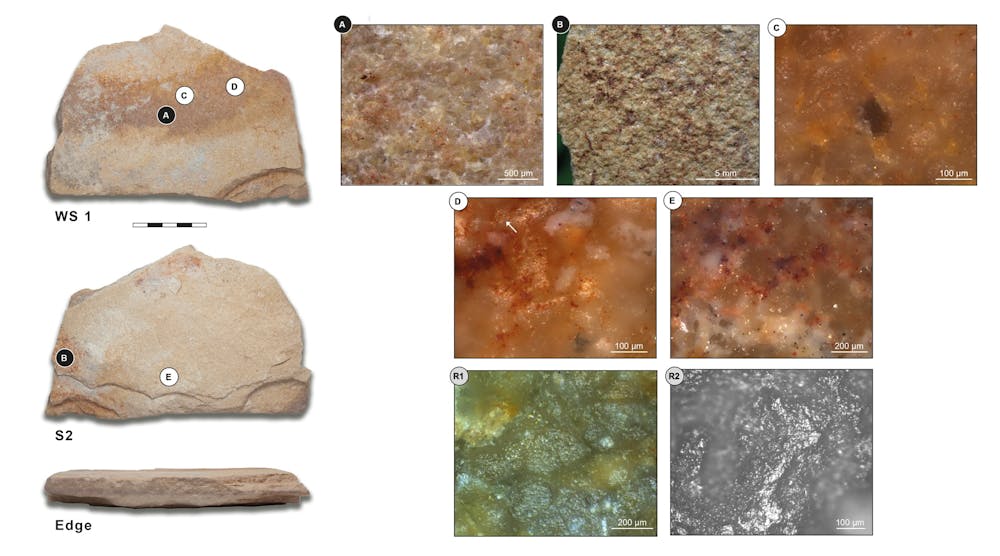 A stone grinding tool showing microscopic traces of plant and pigment processing.
Giulio Lucarini, CC BY
A stone grinding tool showing microscopic traces of plant and pigment processing.
Giulio Lucarini, CC BY
We think the herders broke open animal bones to get to the marrow. Bone marrow is high in fat, and this would have helped them to get extra nutrition.
Our analysis also showed they ground plants. None of the actual plant remains have survived, so we don’t know if they ground wild plants to make simple breads, or if they pounded plant fibres to make baskets or rope.
Both would have been important for their lifestyle. They moved a lot and bread would have been easy to preserve and carry around. Baskets and rope would have been used for storage and transport and also to construct simple, transportable shelters.
The grinding tools also showed pigment was processed. Red shale, a rock found in nearby mountains, can be used like a crayon or ground into red powder and mixed into paint.
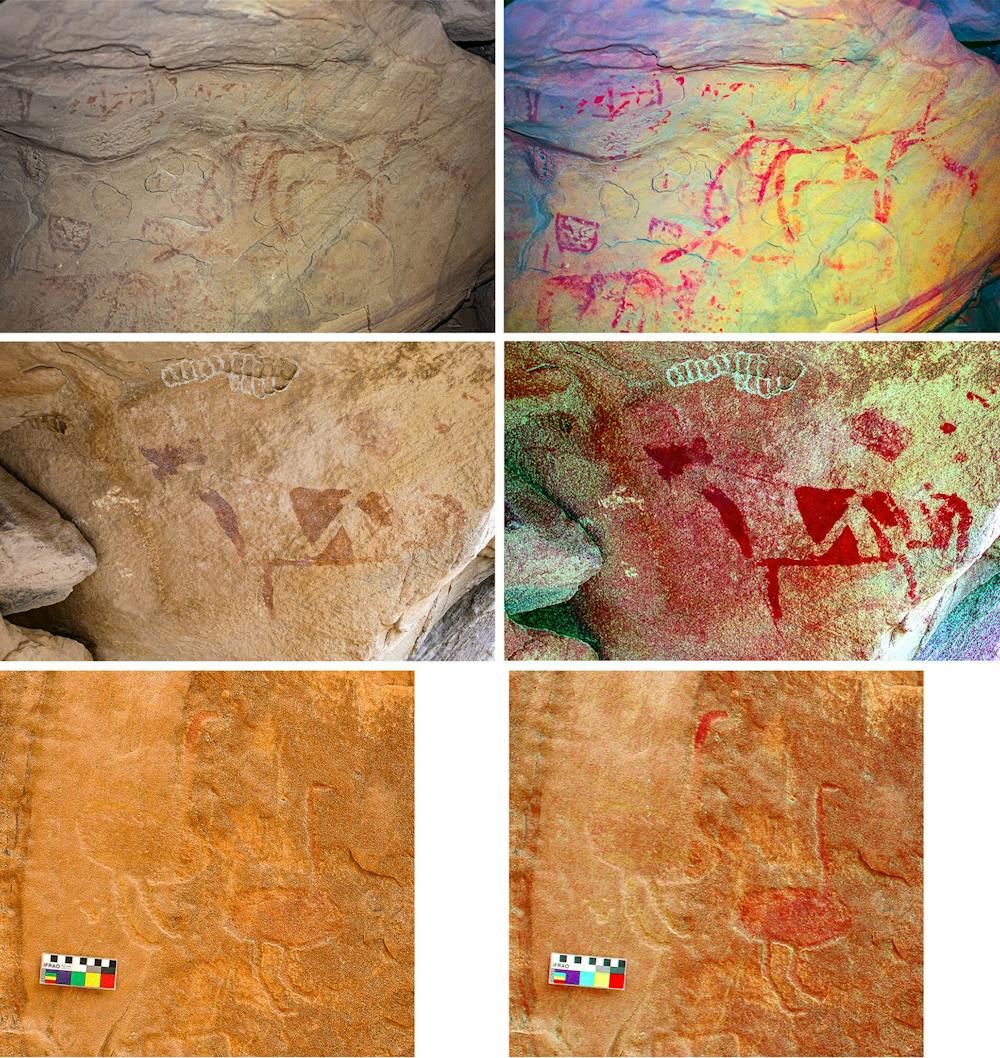 Painted rock art from northern Saudi Arabia hints at the importance of pigment processing.
Maria Guagnin, CC BY
Painted rock art from northern Saudi Arabia hints at the importance of pigment processing.
Maria Guagnin, CC BY
Painted rock art doesn’t often survive. Over the centuries it is washed off by rain and wind.
Only one painted rock art site from the Neolithic survives near Jebel Oraf. It shows cattle with beautiful long horns.
The grinding stones are now evidence that painted art may once have been a lot more widespread.
Valuable tools
Our analysis of the grinding marks also showed the tools were often used for different materials over time. They were clearly valuable and used as much as possible.
At the end they were broken into smaller pieces. In some cases we were able to piece back together up to 12 fragments. We’re still not sure why the discarded tools were placed on the fire – perhaps they used them to cook or to dry their meat.
Grinding stones appear to have been an important tool for mobile herders 7,000 years ago. Although they would have been hard to carry, these tools allowed Stone Age herders to produce food resources and plant materials that were vital to their highly mobile lives.
Read more: Enigmatic ruins across Arabia hosted ancient ritual sacrifices
Authors: Maria Guagnin, Postdoctoral Researcher, Max Planck Institute of Geoanthropology


 Daily Bulletin


