

Slime after slime: why those biofilms you slip on in rivers are vitally important
- Written by: Paul McInerney, Senior Research Scientist, CSIRO
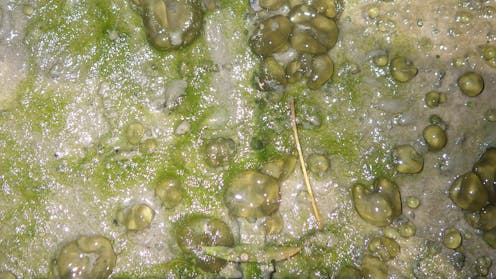
You might have noticed it after sliding on a rock in a Melbourne creek. Or it could have been wading through a Northern Territory waterhole. It’s slime, and our rivers are full of it. That’s a good thing.
Wherever there are hard surfaces like snags and rocks in our rivers, you’ll find slime. Or, as ecologists call it, biofilm. Biofilms consist of communities of microorganisms that include algae, cyanobacteria, bacteria, fungi and protozoa. Together, they’re fixed in a matrix of natural polymers made by bacteria and other tiny creatures. It’s this matrix which gives the slippery, slimy texture we encounter when swimming in rivers.
Biofilms play an important role in our freshwater ecosystems. They underpin healthy rivers by forming the base of freshwater food webs.
Our new research explores how these common but unsung communities change over time. We found that biofilms are most nutritious when new – less than six weeks old. After that, their food value declines.
Why are biofilms important?
Without slime, rivers would lack a fundamental source of food for animals. That sounds like a big statement, but it’s true.
Algae take energy from the sun and convert it into new biomass through photosynthesis. Bacteria and fungi break down organic debris, from dead leaves to dead fish, and recycle the nutrients. Tiny invertebrate grazers such as zooplankton and macroinvertebrates feed on biofilms. In turn, they become food for larger predators such as fish, platypus and turtles.
Not all biofilms offer the same quality of food. And different communities of biofilm grow under different physical conditions.
Read more: Life on Earth was nothing but slime for a 'boring billion' years
When the water level goes up in a river, rocks and dead trees at the surface are submerged and biofilms colonise this new habitat. It happens very quickly. Bacteria arrive first, followed by algae in the next few weeks.
Biofilms undergo natural changes in community composition over time, influenced by physical disturbance (such as scouring when water flow is high, or sedimentation from low flows) or chemical changes, such as additional nutrients from runoff.
These disturbances often lead to periods of collapse and recolonisation by new organisms. Biofilms are thought to become a poorer source of food for animals as they get older. That’s because older biofilm communities become dominated by cyanobacteria and filamentous algae, which aren’t as nutritious as a food for animals.
So what makes good slime?
For the discerning invertebrate, the best biofilm is one containing lots of algae – especially diatoms and green algae. These are rich sources of omega 3 fatty acids, molecules essential for animal growth and reproduction. (That’s why the food supplement industry likes to sell us products rich in omega 3s).
 Mayfly nymphs, such as this Offadens spp. (Baetidae) scrape algae and fine detritus from submerged rocks, wood and macrophytes in rivers.
Chris Davey, CC BY-ND
Mayfly nymphs, such as this Offadens spp. (Baetidae) scrape algae and fine detritus from submerged rocks, wood and macrophytes in rivers.
Chris Davey, CC BY-ND
Having high quality food is one thing. But the food also needs to be easy to get. In the study of food webs, we often use a theory called ecological energetics. Put simply, this suggests the success of an animal population is limited by how hard it is for individuals to obtain sufficient food for growth and reproduction.
You might have long-chain omega 3 fatty acids present, but buried under a pile of less edible microorganisms and detritus. The effort may simply not be worth the reward.
To date, we have a poor understanding of when biofilms hit their peak food value for animals. That’s what we set out to find.
What did we find?
Many of our rivers are regulated by dams and weirs. That means we can alter water levels to cover rocks and snags with water and trigger growth of new biofilms.
If we know how long it takes for biofilms to reach optimum quality, we can manage water levels to improve food value and benefit both biofilm grazers and the fish that eat them.
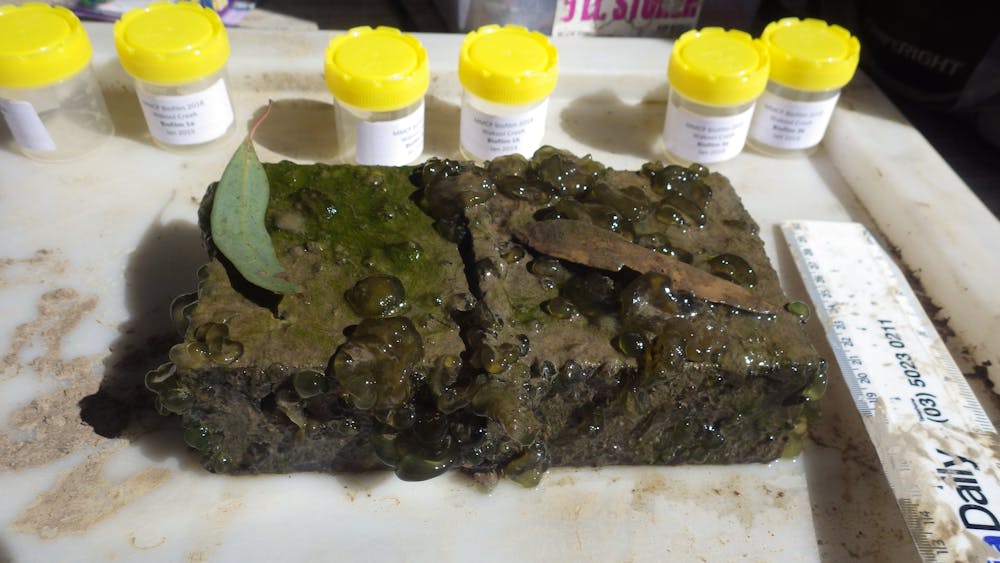
In our study, we sank wooden redgum blocks 20 centimetres under the surface of three rivers. Then we sampled the biofilm for 73 days, taking DNA to assess how the proportions of algae, cyanobacteria and fungi varied over time.
We developed a novel approach to assess food value, accounting for both quality of fatty acid profiles and their availability in space.
What did we find? Food value for animals peaked between 24 and 43 days after the blocks were submerged.
After 43 days, the food value of biofilms declined. Filamentous algae and cyanobacteria numbers increased as the biofilms aged, while green algae and diatoms abundance decreased. The amount of slimy-feeling natural polymers also increased over time, making our once-delicious biofilms even less nutritious.
So what does this mean? Water agencies are increasingly using environmental flows to support freshwater fish and animal populations. A widely used application for environmental water is to raise water levels in rivers and weirs to inundate new hard surfaces to grow new biofilms.
Now we know that after six weeks the food value of biofilms for animals declines – and that can help managers find the best ways of using environmental water to produce a biofilm bonanza for invertebrates and everything that eats them.
Read more: Unlocking the secrets of bacterial biofilms – to use against them
Authors: Paul McInerney, Senior Research Scientist, CSIRO


 Daily Bulletin


