

Legal in one state, a crime in another: laws banning hate symbols are a mixed bag
- Written by: Keiran Hardy, Senior Lecturer, Griffith Criminology Institute, Griffith University
Queensland has now joined several other states in outlawing extremist hate symbols.
Far-right and neo-Nazi groups pose a significant ongoing threat to national security, in Australia and globally. It is crucial to counter their hateful ideology, which has no place in Australian society.
However, banning specific symbols and gestures is a tricky thing to do.
So with each state going its own way, how are these laws working together? And importantly, how will we know if they’re effective?
Read more: Would a law banning the Nazi salute be effective – or enforceable?
What are the laws across the country?
Over the last 16 months, Victoria, NSW and Tasmania have enacted laws banning the public display of Nazi symbols and salutes. Victoria was the first; it chose initially to ban only the Nazi Swastika .
Last week, it expanded this to include any symbols used by the Nazi party, including paramilitary arms like the SS.
New South Wales and Tasmania ban “Nazi symbols”, which is likely broader than the Victorian law. The courts will have a bigger say in whether something qualifies as one.
This should be simple enough for the most recognisable, such as the Swastika or Schutzstaffel (SS), but the question will be trickier if the law is enforced more broadly.
For example, neo-Nazi groups often use numbers like 14 (to indicate a 14-word white supremacist slogan) or 88 for “Heil Hitler” (because H is the 8th letter of the alphabet). The Anti-Defamation League maintains a large database of these sorts of hate symbols.
It is unclear which could provide the basis for a charge under NSW and Tasmanian law.
In Tasmania, the same law bans Nazi gestures. That was the first Australian law to criminalise the Sieg Heil salute, followed by Victoria.
Neo-Nazi groups use the salute in public places to intimidate, spread fear, raise their profile and recruit new members.
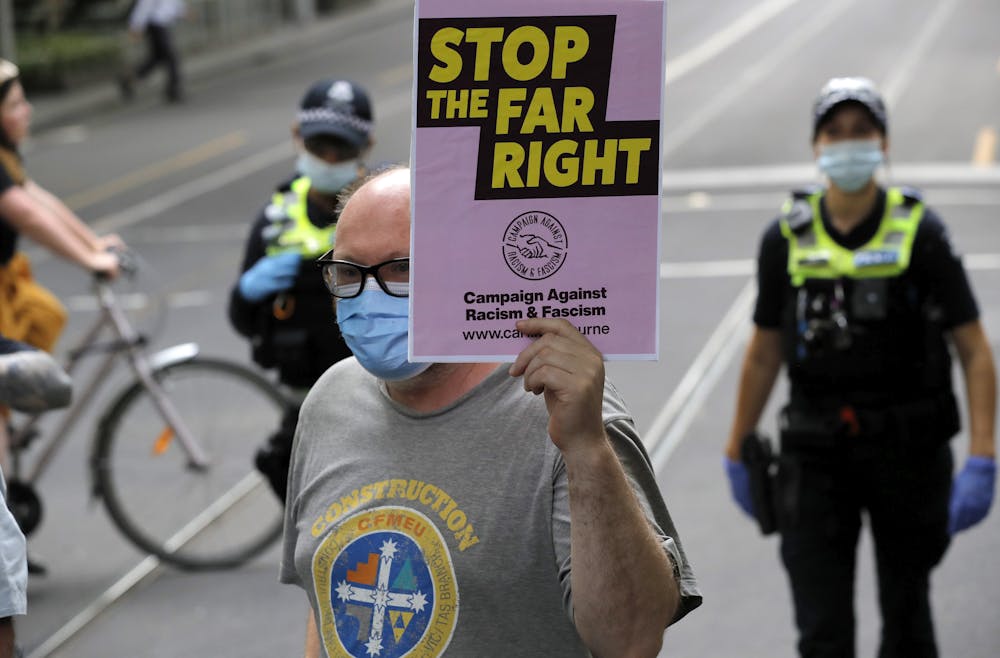
These laws all target public displays of Nazi ideology. This would include, for example, hanging a Nazi flag from a bridge, or waving Swastika signs at a neo-Nazi rally, but not letterbox drops or possessing Nazi paraphernalia at home.
All the laws include exemptions where symbols are displayed for legitimate religious, artistic, legal, historical, or educational purposes.
The federal government has also put forward its own national ban laws, but those are yet to pass parliament.
How do Queensland’s laws compare?
In two key ways, Queensland’s laws take a broader approach.
First, the laws do not list any prohibited symbols. In fact, they do not mention anything about the Nazi party or its symbols. Instead, a list will be made and updated in regulations.
This will, in theory, allow the Queensland government to adapt to new hate symbols as the need arises. But it’s unusual to give the executive so much power in determining the scope of a crime.
No one knows, at this point, what the laws will actually ban. It is a crucial aspect of the rule of law that laws state clearly when conduct is a crime.
To ban a symbol or gesture, the Attorney-General must first consult with the chair of the Crime and Corruption Commission and the Human Rights and police commissioners.
She can recommend a symbol be listed if she is satisfied that it is “widely known” to represent an ideology of “extreme prejudice”.
Read more: Does Australia need new laws to combat right-wing extremism?
Given the large numbers of hate symbols used by extremist groups, with varying degrees of public knowledge about them, seeking clear advice on this question could prove difficult.
Second, Queensland’s approach is not limited to public displays. It includes publishing and public distribution. The main question is whether a member of the public might reasonably feel menaced, harassed or offended.
This will give law enforcement tools to address a wider range of behaviours, such as handing out neo-Nazi flyers in public, but it raises some difficult questions.
It is not clear, for example, whether publication would include posting on social media, or whether public distribution would include letterbox drops, as the content cannot be seen from a public place.
 Under Queensland’s laws, Attorney-General Shannon Fentiman must consult with a number of advisory bodies before banning a symbol.
Darren England/AAP
Under Queensland’s laws, Attorney-General Shannon Fentiman must consult with a number of advisory bodies before banning a symbol.
Darren England/AAP
Whether members of the community might feel menaced, harassed or offended will be clear where a group uses recognisable Nazi symbols, hate speech and physical intimidation in public spaces. But it will be a trickier question elsewhere.
For example, a lot of far-right content online is more subtle, spreading effectively through memes and humour.
How consistent are the laws?
Victoria, Tasmania and NSW’s laws are broadly consistent, with Queensland as a clear outlier.
However, there are key differences.
For example, it will now be an offence to display a Nazi tattoo in Queensland and NSW, but not in Victoria and Tasmania.
The penalties also vary significantly, ranging from three months imprisonment in Tasmania (or six months for a repeat offence in a short time), to six months in Queensland, to 12 months in NSW and Victoria.
These inconsistencies are not necessarily a bad thing.
One of the benefits of a federal system is that states can create different laws and later fall in line if best practice emerges.
But it does suggest a degree of experimentation, with no consensus on the most effective approach.
How will we know if the laws are effective?
In any state, neo-Nazi groups may simply avoid prosecution under these laws by adapting the symbols, slogans and gestures they use.
For example, they already use the “OK” hand symbol to indicate white power. It would be difficult, even under Queensland’s approach, to ban this otherwise mundane gesture.
However, if the groups are prevented from using their most recognisable and intimidating symbols, it will rob them of key recruitment tools and reduce their ability to spread fear and hatred.
A group of white supremacists using the OK hand symbol and signs saying 14 and 88 is still intimidating, but less so than the same group using the Swastika and Sieg Heil salute.
In addition, the laws will allow police to disrupt and arrest those who pose a threat to our communities. This will need to be done in a way that does not escalate tensions at a public rally or protest.
In any case, the criminal law serves a moral purpose as well as a practical one. These developing laws send a clear signal that Nazi ideology has no place in Australian society.
Authors: Keiran Hardy, Senior Lecturer, Griffith Criminology Institute, Griffith University


 Daily Bulletin


