

My favourite fictional character: Maggie O'Farrell's rebel Esme Lennox refuses to be the 'perfect victim' – even in an asylum
- Written by: Amy Walters, PhD candidate, English Literature, Australian National University
“It’s a common turn of phrase to speak of getting lost in a book … a book can also be where one finds oneself,” writes Rebecca Mead.
There are books that seem to comprehend us just as much as we understand them, or even more. There are books that grow with the reader as the reader grows, like a graft to a tree.
After a teacher introduced her to George Eliot, Middlemarch became the book of Mead’s life (eventually resulting in her bibliomemoir, The Road to Middlemarch).
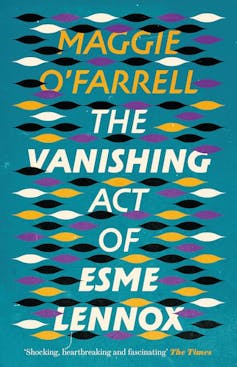
When I was 16, The Vanishing Act of Esme Lennox by British writer Maggie O’Farrell became the book of my life.
Set between the 1930s and the late 20th century, the novel is inspired by the real-life stories of incarcerated women that emerged in the aftermath of the Thatcher government’s policy of deinstitutionalisation.

 Like all Maggie O’Farrell’s novels, The Vanishing Act offers a profound literary encounter.
Sophie Davidson/Hachette
Despite these punishments, Esme continues her campaign of disobedience as an adolescent. She hides her embroidery down the side of the sofa in attempt to buy herself time to read. She has the audacity to leave home without a hat and to play Chopin loudly on the piano. And at a ball, she is discovered in an armchair with “one leg slung over the arm, a book in her lap, her legs wide apart under her skirt”.
On occasion, she literally fights back. While walking home from school on a foggy winter evening, Esme is surprised by a family acquaintance, Jamie Dalziell, the scion of a wealthy local family and the object of Esme’s mother’s matrimonial hopes.
Believing she is about to be attacked, Esme belts him “round the head with all the combined weight of her books”. Jamie, momentarily offended that Esme did not recognise him, quickly recovers and pressures her to go out with him, but she refuses, reminding him “it’s up to me” and declaring that she’d “rather stick pins in my eyes”.
Read more:
In The Marriage Portrait, Maggie O'Farrell distorts the historical record to suit modern sensibilities
Restoring agency to the literary ‘mad woman’
But Esme’s rebellion cannot continue forever. As she gets older, she finds her individual agency is no match for the weight of societal expectation. Following her incarceration, she develops her “vanishing act”, a creative strategy that allows her to rebel inwardly, while protecting her from the punitive gaze of the asylum authorities.
It is most important to keep yourself very still. Even breathing can remind them that you are there, so only very short, very quick breaths. Just enough to stay alive. And no more … Think yourself stretched and thin, beaten to transparency. Concentrate. Really concentrate. You need to attain a state so that your being, the bit of you that makes you what you are, that makes you stand out, three-dimensional in a room, can flow out from the top of your head.
Like all Maggie O’Farrell’s novels, The Vanishing Act offers a profound literary encounter.
Sophie Davidson/Hachette
Despite these punishments, Esme continues her campaign of disobedience as an adolescent. She hides her embroidery down the side of the sofa in attempt to buy herself time to read. She has the audacity to leave home without a hat and to play Chopin loudly on the piano. And at a ball, she is discovered in an armchair with “one leg slung over the arm, a book in her lap, her legs wide apart under her skirt”.
On occasion, she literally fights back. While walking home from school on a foggy winter evening, Esme is surprised by a family acquaintance, Jamie Dalziell, the scion of a wealthy local family and the object of Esme’s mother’s matrimonial hopes.
Believing she is about to be attacked, Esme belts him “round the head with all the combined weight of her books”. Jamie, momentarily offended that Esme did not recognise him, quickly recovers and pressures her to go out with him, but she refuses, reminding him “it’s up to me” and declaring that she’d “rather stick pins in my eyes”.
Read more:
In The Marriage Portrait, Maggie O'Farrell distorts the historical record to suit modern sensibilities
Restoring agency to the literary ‘mad woman’
But Esme’s rebellion cannot continue forever. As she gets older, she finds her individual agency is no match for the weight of societal expectation. Following her incarceration, she develops her “vanishing act”, a creative strategy that allows her to rebel inwardly, while protecting her from the punitive gaze of the asylum authorities.
It is most important to keep yourself very still. Even breathing can remind them that you are there, so only very short, very quick breaths. Just enough to stay alive. And no more … Think yourself stretched and thin, beaten to transparency. Concentrate. Really concentrate. You need to attain a state so that your being, the bit of you that makes you what you are, that makes you stand out, three-dimensional in a room, can flow out from the top of your head.
 Esme’s ‘vanishing act’ allows her to rebel inwardly, protected from the punitive gaze of the asylum’s authorities.
Hans Eiskonen/Unsplash
It may seem odd to valorise Esme’s wilful self-absence in light of contemporary feminism’s emphasis on women’s strength and agency, and our awareness of the effects of trauma. But while her vanishing act resembles traumatic dissociation, it remains wilful and subversive. And it permits Esme to subtly undermine the authority of the asylum’s doctors and nurses and reject their image of her as degraded and helpless.
This is conveyed most powerfully in the novel’s closing pages, which speak back to the degradation of the “mad woman” through centuries of literature, from Jane Eyre onwards. I don’t want to give the ending away, so I’ll just say that when the asylum closes, Esme makes her unceremonious return to the “community” with vengeance in her heart.
There is a poignancy in Esme’s refusal to embody the mythical “perfect victim” – who is devoid of desire, hatred or blame. For my part, I will always cherish the way the older Esme is first introduced, staring through her cell window to conjure an entirely imagined freedom:
If Esme cares to gaze into the distance – that is to say, at what lies beyond the metal grille – she finds that, after a while, something happens to the focusing mechanism of her eyes. The squares of the grille will blur and, if she concentrates long enough, vanish. There is always a moment before her body reasserts itself, readjusting her eyes to the proper reality of the world, when it is just her and the trees, the road, and beyond. Nothing in between.
Authors: Amy Walters, PhD candidate, English Literature, Australian National University
Esme’s ‘vanishing act’ allows her to rebel inwardly, protected from the punitive gaze of the asylum’s authorities.
Hans Eiskonen/Unsplash
It may seem odd to valorise Esme’s wilful self-absence in light of contemporary feminism’s emphasis on women’s strength and agency, and our awareness of the effects of trauma. But while her vanishing act resembles traumatic dissociation, it remains wilful and subversive. And it permits Esme to subtly undermine the authority of the asylum’s doctors and nurses and reject their image of her as degraded and helpless.
This is conveyed most powerfully in the novel’s closing pages, which speak back to the degradation of the “mad woman” through centuries of literature, from Jane Eyre onwards. I don’t want to give the ending away, so I’ll just say that when the asylum closes, Esme makes her unceremonious return to the “community” with vengeance in her heart.
There is a poignancy in Esme’s refusal to embody the mythical “perfect victim” – who is devoid of desire, hatred or blame. For my part, I will always cherish the way the older Esme is first introduced, staring through her cell window to conjure an entirely imagined freedom:
If Esme cares to gaze into the distance – that is to say, at what lies beyond the metal grille – she finds that, after a while, something happens to the focusing mechanism of her eyes. The squares of the grille will blur and, if she concentrates long enough, vanish. There is always a moment before her body reasserts itself, readjusting her eyes to the proper reality of the world, when it is just her and the trees, the road, and beyond. Nothing in between.
Authors: Amy Walters, PhD candidate, English Literature, Australian National University


 Daily Bulletin


