

The Solar System used to have nine planets. Maybe it still does? Here’s your catch-up on space today
- Written by: Sara Webb, Lecturer, Centre for Astrophysics and Supercomputing, Swinburne University of Technology
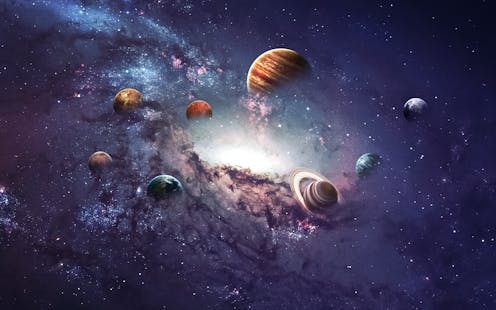
Some of us remember August 24 2006 like it was yesterday. It was the day Pluto got booted from the exclusive “planets club”.
I (Sara) was 11 years old, and my entire class began lunch break by passionately chanting “Pluto is a planet” in protest of the information we’d just received. It was a touching display. At the time, 11-year-old me was outraged – even somewhat inconsolable. Now, a much older me wholeheartedly accepts: Pluto is not a planet.
Similar to Sara, I (Rebecca) vividly remember Pluto’s re-designation to dwarf status. For me, it wasn’t so much that the celestial body had been reclassified. That is science, after all, and things change with new knowledge. Rather, what got to me was how the astronomy community handled the PR.
Even popular astronomers known for their public persona stumbled through mostly unapologetic explanations. It was a missed opportunity. What was poorly communicated as a demotion was actually the discovery of new exciting members of our Solar System, of which Pluto was the first.
The good news is astronomers have better media support now, and there’s a lot of amazing science to catch up on. Let’s go over what you might have missed.

A throwback to a shocking demotion
Pluto’s fate was almost certainly sealed the day Eris was discovered in 2005. Like Pluto, Eris orbits in the outskirts of our Solar System. Although it has a smaller radius than Pluto, it has more mass.
Astronomers concluded that discovering objects such as Pluto and Eris would only become more common as our telescopes became more powerful. They were right. Today there are five known dwarf planets in the Solar System.
The conditions for what classifies a “planet” as opposed to a “dwarf planet” were set by the International Astronomical Union. To cut a long story short, Pluto wasn’t being targeted back in 2006. It just didn’t meet all three criteria for a fully fledged planet:
- it must orbit a star (in our Solar System this would be the Sun)
- it must be big enough that gravity has forced it into a spherical shape
- it must be big enough that its own gravity has cleared away any other objects of a similar size near its orbit.
The third criterion was Pluto’s downfall. It hasn’t cleared its neighbouring region of other objects.
So is our Solar System fated to have just eight planets? Not necessarily. There may be another one waiting to be found.
Read more: I've always wondered: why are the stars, planets and moons round, when comets and asteroids aren't?
Is there a Planet Nine out there?
With the discovery of new and distant dwarf planets, astronomers eventually realised the dwarf planets’ motions around the Sun didn’t quite add up.
We can use complicated simulations in supercomputers to model how gravitational interactions would play out in a complex environment such as our Solar System.
In 2016, California Institute of Technology astronomers Konstantin Batygin and Mike Brown concluded – after modelling the dwarf planets and their observed paths – that mathematically there ought be a ninth planet out there.
Their modelling determined this planet would have to be about ten times the mass of Earth, and located some 90 billion kilometres away from the Sun (about 15 times farther then Pluto). It’s a pretty bold claim, and some remain sceptical.
One might assume it’s easy to determine whether such a planet exists. Just point a telescope towards where you think it is and look, right? If we can see galaxies billions of light years away, shouldn’t we be able to spot a ninth planet in our own Solar System?
Well, the issue lies in how (not) bright this theoretical planet would be. Best estimates suggest it sits at the depth limit of Earth’s largest telescopes. In other words, it could be 600 times fainter than Pluto.
The other issue is we don’t know exactly where to look. Our Solar System is really big, and it would take a significant amount of time to cover the entire sky region in which Planet Nine might be hiding. To further complicate things, there’s only a small window each year during which conditions are just right for this search.
That isn’t stopping us from looking, though. In 2021, a team using the Atacama Cosmology Telescope (a millimetre-wave radio telescope) published the results from their search for a ninth planet’s movement in the outskirts of the Solar System.
While they weren’t able to confirm its existence, they provided ten candidates for further follow-up. We may only be a few years from knowing what lurks in the outskirts of our planetary neighbourhood.
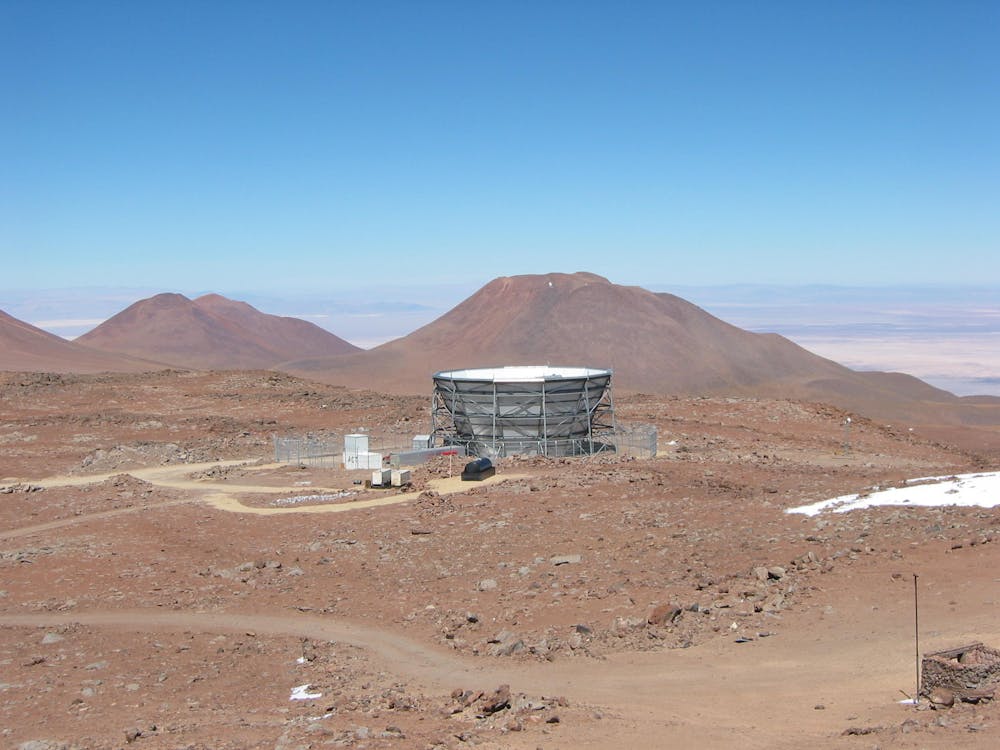 The ACT sits at an altitude of 5,190 meters in Chile’s Atacama desert. Here, the lack of atmospheric water vapour helps to increase its accuracy.
NIST/ACT Collaboration
The ACT sits at an altitude of 5,190 meters in Chile’s Atacama desert. Here, the lack of atmospheric water vapour helps to increase its accuracy.
NIST/ACT Collaboration
Finding exoplanets
Even though we have telescopes that can reveal galaxies from the universe’s earliest years, we still can’t easily directly image planets outside of our Solar System, also called exoplanets.
The reason can be found in fundamental physics. Planets emit very dim red wavelengths of light, so we can only see them clearly when they’re reflecting the light of their star. The farther away a planet is from its star, the harder it is to see.
Astronomers knew they’d have to find other ways to look for planets in foreign star systems. Before Pluto was reclassified they had already detected the first exoplanet, 51 Pegasi B, using a radial velocity method.
This gas giant world is large enough, and close enough to its star, that the gravitational tug of war between the two can be detected all the way from Earth. However, this method of discovery is tedious and challenging from Earth’s surface.
So astronomers came up with another way to find exoplanets: the transit method. When Mercury or Venus pass in front of the Sun, they block a small amount of the Sun’s light. With powerful telescopes, we can look for this phenomenon in distant star systems as well.
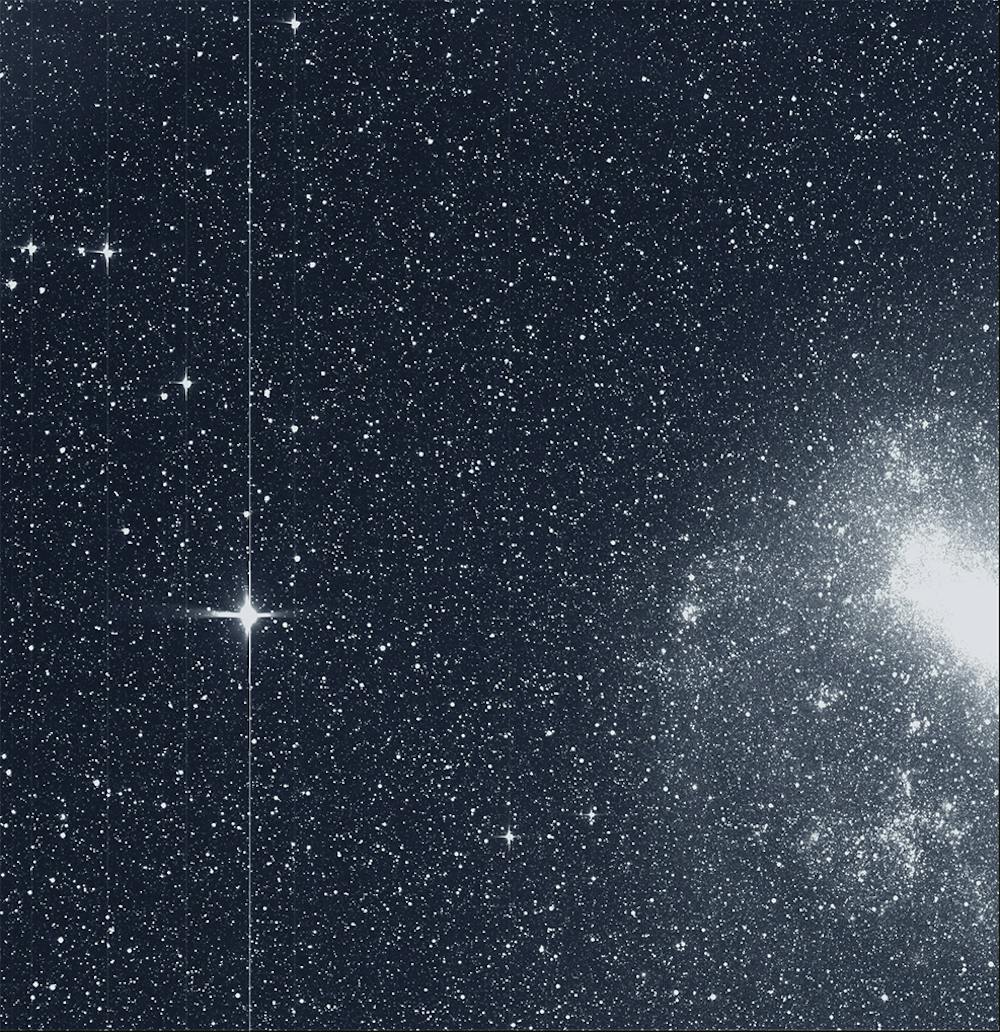 In August, the TESS telescope took this snapshot of the Large Magellanic Cloud (right) and the bright star R Doradus (left).
NASA/MIT/TESS
In August, the TESS telescope took this snapshot of the Large Magellanic Cloud (right) and the bright star R Doradus (left).
NASA/MIT/TESS
We do this via the Kepler space telescope and the Transiting Exoplanet Survey Satellite (TESS). Both have observed tens of thousands of stars and discovered thousands of new planets – dozens of which are about the same size as Earth.
But these observatories can only tell us a planet’s size and distance from its star. They can’t tell us if a planet might be hosting life. For that we’d need the James Webb Space Telescope.
Looking for life
The James Webb Space Telescope (JWST) has just wrapped up its first year and a half of science. Among its many achievements is the detection of molecules in the atmospheres of exoplanets, a feat made possible by the transit method.
One of these exoplanets, WASP-17, is also known as a “hot Jupiter”. It seems to have been plucked from a page in a sci-fi novel, with evidence for quartz nanocrystals in its clouds.
Read more: 10 times this year the Webb telescope blew us away with new images of our stunning universe
Meanwhile, the super-Earth K2-18b (a Kepler find) shows signs of methane and carbon dioxide. But while such discoveries are amazing, the magic ingredient necessary for life still eludes us: water vapour.
The field of planetary studies is evolving and 2024 looks promising. Maybe JWST will finally produce signs of water vapour in an exoplanet atmosphere. Who knows, we might even have a ninth planet surprise us all, filling the void left by Pluto.
Stay tuned for exciting science to come.
 Small bodies on the very fringes of our Solar System are essentially invisible to us – but advanced new techniques and technologies are changing this.
NASA/Jasmin Moghbeli
Small bodies on the very fringes of our Solar System are essentially invisible to us – but advanced new techniques and technologies are changing this.
NASA/Jasmin Moghbeli
Authors: Sara Webb, Lecturer, Centre for Astrophysics and Supercomputing, Swinburne University of Technology


 Daily Bulletin


