

Hidden women of history: Olympias, who took on an emperor, dodged a second marriage and fought for her faith
- Written by: Sarah Gador-Whyte, Research Fellow in Biblical and Early Christian Studies, Australian Catholic University
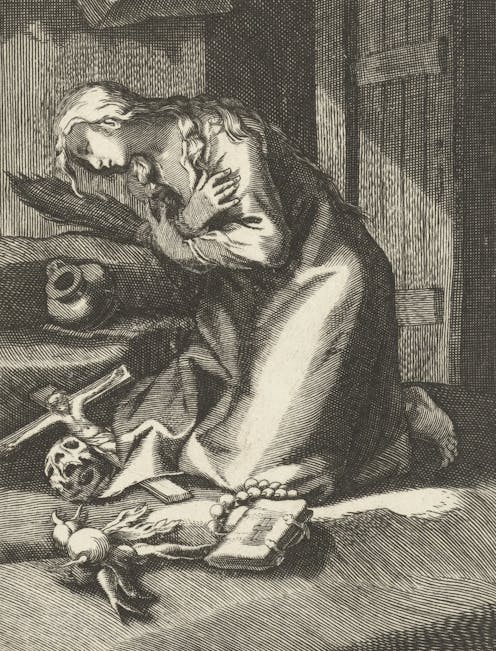
Olympias was born to a wealthy family in the fourth-century CE, probably in the capital city of the Roman empire: Constantinople (now Istanbul).
Not to be confused with the mother of Alexander the Great (who lived around 800 years earlier), this Olympias is remembered in various texts as a patron of the church and a champion of female ascetics, a determined advocate for her friends, and a faithful and dedicated Christian.
A sad fact about the early Christian period is that very few texts written by women survive. Olympias was well educated and acquainted with bishops and even the emperor. We know she wrote letters to some of these men, but only the men’s letters to her remain.
There are stories about her life as well, and some about her monastery and her bodily remains after her death, but most of these were also written by men. Nevertheless, these sources can give us insight into the life of a formidable woman who opposed the emperor and fought for her way of life and her faith.
Read more: Hidden women of history: Enheduanna, princess, priestess and the world's first known author
A husband chosen
When Olympias was born, in the second half of the fourth century, the Roman Empire was rapidly becoming more Christian. The emperor Constantine (306-337) had converted to Christianity in 312, legalising the religion a year later and promoting it through patronage of the church. His nephew, the emperor Julian (361-363), briefly tried to restore the empire to Roman religion (“paganism”) but his reign was short and his religious campaign unsuccessful.
Olympias was orphaned as a child. When she was between the ages of 12 and 15, her guardian chose a suitable husband for her. Nebridius was the prefect of the city of Constantinople, roughly equivalent to a city mayor. This was his second marriage. According to some sources, his son from his first marriage was older than Olympias. She is unlikely to have had much say in the match.
Olympias’s family was wealthy and she would have taken a substantial dowry with her on marrying. The law decreed Nebridius had to keep that fortune safe for her as a dowry for a second husband in case of his death. And indeed, Nebridius lived less than two years after their marriage. Olympias was now a widow and probably only about 17.
When she was widowed, according to an anonymous Life of Olympias, the emperor Theodosius tried to marry her off to a relative of his named Elpidius. Her extensive wealth - she owned property all over the empire including palaces in Constantinople – made her quite a catch.
But Olympias refused, apparently declaring
if the Lord Jesus Christ had wanted me to live with a man, he would not have taken away my first husband.
A celibate life
She told the emperor she wanted to live a celibate life as a monastic rather than marry again.

This, at least, is the way the Life presents it. We cannot be certain this is an accurate representation of Olympias’s interactions with the emperor. Given the life she went on to lead, it seems clear she had a particular devotion to God and a strong desire to live an ascetic, celibate life.
But there are other reasons in this period why a young widow might not want to marry again. Mortality rates for women in childbirth were high, as were infant mortality rates. If she married again, she might die in childbirth, or her child might die soon after.
There were good theological reasons to remain unmarried too. There were debates in the early church about whether a second marriage counted as adultery and many theologians encouraged women to remain a univira – a “one-man woman”.
Perhaps Olympias was also keen to maintain some financial independence. Another marriage would bring her squarely under the authority of another man. Perhaps she hoped by remaining a widow she could use her wealth as she saw fit.
If this was her aim, she was disappointed. When Olympias refused to marry Elpidius, the emperor Theodosius commanded the prefect of the city, Clementius, be guardian of all her possessions until Olympias turned 30.
Read more: Mythbusting Ancient Rome -- did all roads actually lead there?
A determined young woman
The Life gives Olympias a pithy reply in which she says she is glad to be relieved from the burden of her wealth and begs Clementius to distribute her wealth to the poor and the churches.
This fifth century CE text presents Olympias as a determined young woman who is not afraid to advocate for herself and fight to live her chosen way of life.
A few years later, Theodosius relented when he saw how dedicated Olympias was to the ascetic life, restoring her fortune. This enabled Olympias to establish a monastery or holy house for women in Constantinople.
She built it right next to the cathedral church of Hagia Sophia (Holy Wisdom) and lived there with many other female ascetics. The proximity of the monastery to the church is likely one of the reasons that Olympias became such close friends with the bishop John Chrysostom. John, who became archbishop (Patriarch) of Constantinople, was given the name “Chrysostom” (“Golden-Mouth”) because he preached fabulous sermons. Over 700 of his sermons survive.
 An early Byzantine mosaic from the Cathedral of Hagia Sophia depicting Saint John Chrysostom.
Wikimedia Commons
An early Byzantine mosaic from the Cathedral of Hagia Sophia depicting Saint John Chrysostom.
Wikimedia Commons
Olympias was ordained a deaconess by the archbishop Nectarius when only around 30. (It was unusual to be made a deaconess before the age of 60.) Such a role gave Olympias the authority to act for, and on behalf of, women in the church, as the guide and protector of the women who came to join her in her holy house.
She used her wealth and new status as deaconess to support the poor and the works of the church, becoming a strong advocate for Chrysostom. She became a patron and friend of other bishops too.
When Gregory of Nyssa, theologian and bishop in Cappadocia, wrote a commentary on the Song of Songs, around the year 394, he dedicated it to Olympias. She had suggested he should write it:
You have enjoined upon me, both in person and by your letters, a study of the Song of Songs, and I have undertaken it because it is suited to your holy life and your pure heart.
Read more: Why Hagia Sophia remains a potent symbol of spiritual and political authority
An advocate for her friend
When Chrysostom was sent into exile, for reasons that remain a bit unclear, he wrote regularly to Olympias. Seventeen of his letters to her survive, more than from him to any other person. She kept advocating for him and was angry with those who had deserted him.
Chrysostom told her Jesus’ friends had also deserted him. He was impressed by Olympias’s perseverance even under suffering – her ill health didn’t stop her from being a “tower”, a “haven” and a “wall of defence”.
Perhaps he was referring to the protection Olympias gave to monks who had been banished for their support of Chrysostom. When an ally was imprisoned, Chrysostom wrote to Olympias to strategise about how to get him released.
These actions, protecting the supporters of the exiled bishop, were ultimately Olympias’s downfall. She was persecuted, wrongfully accused of causing a fire in the city and sent into exile to Nicomedia (modern Izmit, Turkey) where she died, probably in 409.
A significant figure
Although she died in exile, Olympias was a significant figure who fought against the mould women were supposed to fit into, supporting a lot of people along the way.
The anonymous Life describes her as practising hospitality in a similar way to the Old Testament patriarch Abraham, fighting for self-control like Joseph, suffering patiently and faithfully like Job and being martyred like the legendary early Christian, Thecla.
In the seventh century, a woman named Sergia became the leader of Olympias’s monastery in Constantinople. Sergia wrote about finding Olympias’s bones in the wreckage of another monastery and bringing them back to her own.
When a later Patriarch anointed the remains, Sergia says, they bled until his hands were full of blood.
This rather frightening miracle had a big impact on the assembled audience. Sergia records many people were cured of diseases by Olympias’s remains after this bloody episode.
Such miracle stories, which seem so strange to us, show Olympias’s continued importance in the monastery she founded and the city which was her home.
Authors: Sarah Gador-Whyte, Research Fellow in Biblical and Early Christian Studies, Australian Catholic University


 Daily Bulletin


