

Using photos to create 3D models is helping us understand – and protect – complex marine environments
- Written by: Professor James J Bell, Professor of Marine Biology, Te Herenga Waka — Victoria University of Wellington
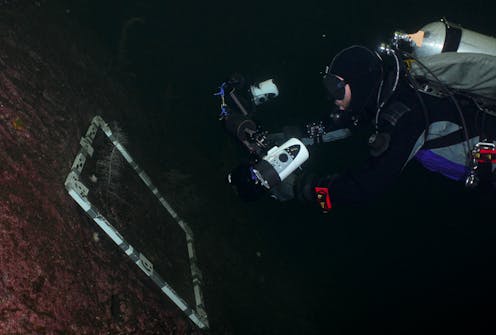
Measuring the impact of different events, such as marine heatwaves, on the abundance of marine organisms is not easy. Biological communities naturally change over time and between different locations.
Scientists need to untangle these natural changes from those caused by humans and come up with a new approach to do this.
Marine biologists have traditionally monitored underwater cliffs or coral reefs by estimating population sizes in just a small area of those environments.
One traditional method involves laying a tape measure on the reef and determining what was under the tape at regular intervals. Another is to take pictures of “quadrats” – squares of a known area – and working out the area covered by different organisms later.
However, these methods only provide an estimate for a very small area of the total reef, covering a limited proportion of the animals and plants present.
They also provide limited information on the three-dimensional (3D) reef complexity and structure created by reef organisms, such as corals and sponges, which are key to supporting high biodiversity.
Our new research shows how modern photographic methods can be used to measure coral reef habitat complexity, and the 3D nature of reefs.
This information was then used to assess the impacts of changes from coral-dominated reefs to sponge-dominated reefs on the spaces available for fish and other organisms to live.
Here’s how it works.
An art and a science
Photogrammetry – a technique where 3D information is extracted from photographs – is both an art and science. The process involves taking a large number of images of an object or area from different angles. Using specialised algorithms we can then analyse and convert these pictures into 3D digital models.
These models can be appropriately scaled to real-world dimensions, allowing accurate measurements of organisms.
While photogrammetry is not new, its application to marine science has increased in recent years. It is completely changing the way we can monitor marine environments and measure human impacts.
However, there are many other ways broader photogrammetric tools can be used, from estimating the size of whales to developing realistic simulations or virtual reality experiences for education.
Our recently published study from Indonesia used photogrammetry to estimate the potential impacts of changes from coral-dominated to sponge-dominated tropical reefs on reef structural complexity.
Read more: The Irish lough that offers a window into the deep sea
The study compared the structural complexity of coral and sponge-dominated areas of a coral reef. By using photogrammetry, we were able to better understand the different factors that contributed to the coral’s structural complexity in a way that would not be possible from traditional 2D photographs.
This study found sponge-dominated reefs had fewer of the smallest spaces for fish and other organisms to live, whereas coral-dominated reefs had fewer larger spaces.
This information is important. The smallest spaces on coral reefs are occupied by small fish and other species that feed animals higher up the food chain. As coral reefs lose these small refuge spaces, they also lose the ability to support biodiversity.
Going bigger
While the Indonesian study examined only small sections of the reef, the use of photogrammetry for monitoring and mapping marine ecosystems is expanding rapidly.
Thanks to modern hardware and software solutions, it is now possible to rapidly create models for much larger areas. And thanks to high-resolution photography, even the smallest animals can be identified in the models.
These models are complementing the use of traditional sampling methods that only estimate the abundances of organisms in a small area of a reef. But we also have the potential to now sample entire reefs.
As models of reefs derived from photogrammetry are 3D, there are many different new sources of information that can be collected, such as accurate surface areas and volumes of organisms.
For many organisms, like sponges and corals, surface areas and volumes are more important in measuring their ecological importance than just the amount of reef they cover.
An example of the Fiordland underwater environment rendered through a game engine, and ready to be used for VR applications.Moreover, 3D models of large areas can be oriented and scaled or geo-referenced, essentially creating all the characteristics of a typical map. This makes finding previously surveyed areas much easier.
The overall result is better characterisation of marine communities. This makes it easier to monitor and visualise changes, and the effects of different factors, such as marine heatwaves.
Finally, scaled 3D representations can be created for complex organisms, meaning growth and shape changes can be more accurately measured. This provides a greater understanding of how environmental change affects organisms.
Visualising changes in biodiversity
Virtual reality has long been used to provide access to marine environments without getting wet. This has been done largely for education, outreach and training opportunities.
But 3D models created from photogrammetry provide new and exciting opportunities to engage the public. People can now interact with the environment, experiencing new worlds and points of view, while learning and increasing their environmental consciousness.
The application of 3D models derived from underwater photogrammetry has great potential for the monitoring of marine environments and detecting the impact of humans.
These models represent a transformative shift in the way information is gathered in marine ecosystems. As technology develops further they will support more extensive marine monitoring and more effective management.
An example of a 3D model of Breaker Bay Reef in Wellington, New Zealand.Authors: Professor James J Bell, Professor of Marine Biology, Te Herenga Waka — Victoria University of Wellington


 Daily Bulletin


