

First Peoples’ land overlaps with 130 imperilled bird species – and their knowledge may be vital to saving them
- Written by: Amanda Lilleyman, Adjunct associate, Charles Darwin University
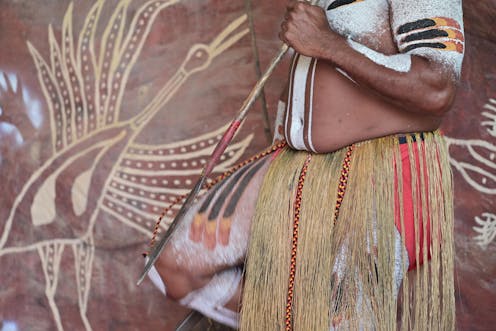
Australia’s First Peoples have a strong and continuing connection to the land. Their determination to maintain this connection provides important opportunities for conservation.
Our new research explored this opportunity by examining where Australia’s imperilled birds overlap with the Country of First Peoples. We defined such land as anything considered part of the Aboriginal or Indigenous estate. The includes but is not confined to Indigenous Protected Areas, native title land and areas controlled by Indigenous land councils.
More than 200 Australian bird species are threatened with extinction. Our analysis found 64% of these, or about 130 species, occur on lands and waters to which First Peoples’ groups have a legal determination.
We hope our research may lead to greater collaboration between First Peoples and conservationists. We also hope it elevates First Peoples’ voices to inform how we understand and care for our precious birds.
‘Threatened species’ is a Western concept
In the decades since Australia’s threatened species legislation was passed in 1992, First Peoples have become key partners in conservation.
Australia’s First Peoples make up just 3.2% of the population. Yet Indigenous Protected Areas – land, sea, and river Country managed by Traditional Owners and Custodians, and Indigenous ranger groups – comprise 87 million hectares, or more than 50% of Australia’s conservation reserve system.
For millennia, birds have been integral to the cultural practice and livelihoods of Australia’s First Peoples. They play a major role in many songlines, are sung and danced in ceremony, act as totems and are managed as key food resources. Many First Peoples are keenly aware of declines in once-common bird species.
The concept of “threatened species” is founded in Western science and is not necessarily a term First Peoples use. And a bird species considered threatened may not be culturally significant to First Peoples.
However, many First Peoples have chosen to engage actively in the conservation of imperilled species and there are opportunities to expand this. Exactly where those opportunities lie was the subject of our new research.
Read more: 'A stench of tokenism': how environmental reforms ignore First Nations knowledge
What we found
Many non-Indigenous people think of Australia as one country. But for First Peoples, the continent comprises many countries, each of which is home to distinct groups, each with their own culture, customs, language and laws.
Under Australian law, First Peoples lack legal title to much of their ancestral lands. Regardless, connections to Country – and species that live there – remain.
Our study identified 463 First Peoples’ Country on which about 130 threatened birds occur. Mapping of First Peoples’ Country is incomplete, and boundaries between groups are often blurred or disputed, so the actual number is likely to be higher still.
More than 20 species are found on the Country of four First Peoples groups - the Ngarrindjeri People of south-east South Australia, the Nywaigi of the Wet Tropics of north Queensland, and the Wiradjuri and Yuin of New South Wales.
Some 14 species have highly restricted ranges. For example, the entire population of Australia’s rarest bird, the mukarrthippi grasswren, lives on Ngiyampaa Country in central NSW. Mukarrthippi is a name created by the Ngiyampaa Elders.
Similarly, the forested hills north of Adelaide are both Nukunu Country and home to the chestnut-rumped heathwren. The Wurundjeri are the Traditional Owners of Yellingbo Nature Conservation Area, home of the last helmeted honeyeaters. And the entire range of three threatened species is on the Country of Tiwi Islander First Peoples.
Some 15 threatened bird species occur on Country of more than 50 First Peoples groups. Some of these, such as southern boobook owls and southern whitefaces, are declining rapidly across their vast ranges. Others, such as the grey falcon, are exceedingly scarce.
How First Peoples can become more involved
We don’t expect our research to guide First Nations people in identifying their priorities. But it may help First Peoples know which threatened bird species occur on their Country. They may then choose to seek support to protect these species.
For example, First Peoples may seek expansion of Indigenous Protected Areas where the species occur. These areas comprise land, sea, and river Country managed by First Nations groups.
Or the threatened species could become a focus of management by Indigenous rangers, a form of employment for First Peoples that has proliferated in recent decades.
The monitoring of imperilled birds is another activity where First Peoples already contribute strongly but could be more involved. Some First Peoples may have been monitoring species themselves and be willing to share their knowledge of population trends and cycles.
Compensation for centuries of damage
Numerous opportunities exist for First Peoples to engage in threatened bird conservation should they choose to. But one big barrier to this is a perennial lack of funding.
For example, Indigenous Protected Areas make up almost half of Australia’s conservation areas, yet receive just a fraction of funding for the federal conservation estate.
This is unjust. Our research also found all threats to Australia’s imperilled birds were a consequence of colonisation. They include habitat destruction, changed fire regimes, invasive species and climate change.
This suggests governments have a moral, and potentially legal, responsibility for supporting the conservation work of First Peoples. Such support should be viewed not as charity or welfare, but through the lens of restorative and intergenerational justice.
Australia’s First Peoples were begrudgingly granted land rights after two centuries of having their ownership denied. They also have a right to compensation for the damage done.
Read more: Indigenous rangers don’t receive the funding they deserve – here's why
Authors: Amanda Lilleyman, Adjunct associate, Charles Darwin University


 Daily Bulletin


