

‘Fascinating and troubling’: Australians would rather save a single human life than prevent an entire species from becoming extinct
- Written by: John Woinarski, Professor of Conservation Biology, Charles Darwin University
Australia is in the grip of an escalating extinction crisis. Since colonisation, 100 native plant and animal species have become formally listed as extinct due to human activities. The actual number is undoubtedly far higher.
Surveys suggest Australians want to prevent extinctions, regardless of the financial cost. But when it comes to the crunch, how much do we really care?
In emergency situations, there is a long-held convention that official responders such as firefighters first attempt to save human life, then property and infrastructure, then natural assets.
Our research published today investigated whether this convention reflects community values. We found the people we surveyed valued one human life more than the extinction of an entire non-human species – a result both fascinating and troubling.
What are we willing to lose?
Catastrophic events force us to make hard choices about what to save and what to abandon. In such emergencies, our choices reveal in stark detail the values we ascribe to different types of “assets”, including plant and animal species.
Our priorities will become even more crucial under climate change, which is bringing worse bushfires and other environmental catastrophes. If nature is always saved last, we can expect recurring biodiversity losses, including extinctions.
The unprecedented loss of biodiversity in the Black Summer fires was a taste of what’s to come. The fires burnt the entire known range of more than 500 plant and animal species and at least half the range of more than 100 threatened species. The catastrophe led to at least one extinction – of a mealybug species in Western Australia.
The losses prompted reflection on our priorities. The final report of a New South Wales parliamentary inquiry into the bushfires, for example, questioned if this hierarchy of protection should always apply.
Our new research investigated community values on this issue. The findings were illuminating.
Read more: Scientists re-counted Australia's extinct species, and the result is devastating
Making the hard choices
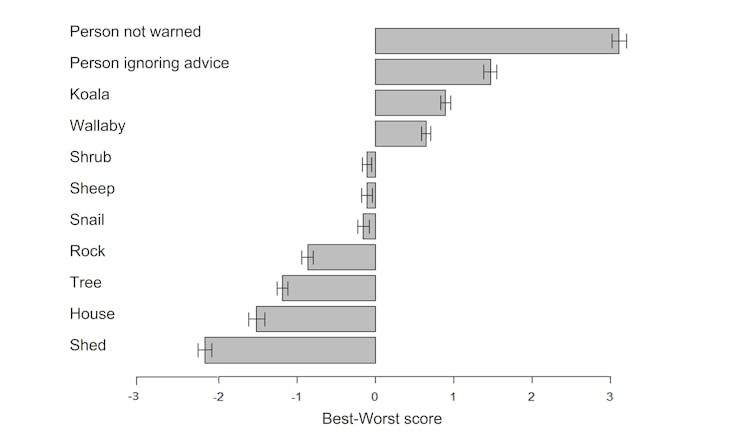
The survey involved 2,139 Australians. Respondents ranked the assets they would save in a hypothetical bushfire, choosing from the following options:
- a person not warned to evacuate
- a person who had ignored advice to evacuate (and so implicitly taken responsibility for their own safety)
- a population of 50 koalas (of which many other populations exist elsewhere)
- one of only two populations of a wallaby species
- the only population of a native snail species (which would become extinct if burnt)
- the only population of a native shrub species (which would become extinct if burnt)
- a flock of 50 sheep
- a house, shed and tractor
- two items of Indigenous cultural significance (a rock art gallery and a tree carving).
Survey respondents overwhelmingly gave the highest ranking to the two options involving saving a human life – even if that person had been repeatedly told to evacuate and even if, as a consequence, a snail or shrub species became extinct.
Saving a person who had not received evacuation warnings was rated highest, ahead of saving a person who ignored evacuation advice. Saving the koala population was next preferred, followed by saving the wallaby population.
The remaining options had negative scores, meaning that respondents were more likely to choose them as least important than most important.
Amongst the biodiversity assets, decisions based on conservation consequences would have meant the top priority was preventing the extinction of the snail and shrub populations. Next in line would have been the wallaby population, then a relatively less consequential loss of koalas.
But the results were the opposite: people prioritised the koalas over the wallabies, with less concern for the shrub and the snail. Ranked even lower were the items of Indigenous cultural significance. Saving the house and shed had lowest rankings.
The results are revealing
We take several key messages from the survey results.
First, the conventional hierarchy of protection during fire – prioritising human life, then infrastructure, then biodiversity – does not always reflect societal values. Sometimes, protecting natural assets is more important than protecting at least some infrastructure. In the Black Summer fires, the attempts to save crucial populations of the imperilled Wollemi Pine showed such protection of biodiversity assets is possible.
Second, our society values one human life more than the millions of years of evolution that can be eclipsed almost instantaneously in the extinction of another species.
Third, our regard for nature is far from egalitarian. In this case, the preference for saving koalas is consistent with previous studies that show we care far more for iconic cute mammals than other species.
Fourth, animal welfare issues may trump consideration for conservation consequences. We suspect that the haunting imagery of koalas suffering in the Black Summer wildfires may have contributed to them being prioritised ahead of more imperilled species.
And finally, our results were troubling for the conservation of poorly known species, the extinctions of which are increasing around the world. These losses have been largely disregarded or unmourned by society.
It suggests the case for saving such species needs to be better made. Australia’s invertebrate fauna is highly distinctive, fascinating and vital for the health of our ecosystems. To prevent mass losses of invertebrate species, we must take action now.
Read more: 5 remarkable stories of flora and fauna in the aftermath of Australia’s horror bushfire season
Rethinking our priorities?
The world is becoming more perilous. There’s a high risk of losing much of the nature that surrounds us, supports us and helps define us as Australians.
We must think carefully about what future we bequeath to our children and to future generations. This may require reconsidering our priorities – and in some cases, making different choices.
Authors: John Woinarski, Professor of Conservation Biology, Charles Darwin University


 Daily Bulletin


