

Read The Times Australia

Daily Bulletin

In his entertaining cancer memoir, Peter Goldsworthy explores the ‘necessary narcissism’ of illness

  • Written by: David McCooey, Professor of Writing and Literature, Deakin University

In his entertaining cancer memoir, Peter Goldsworthy explores the ‘necessary narcissism’ of illness

Illness memoir is based on a tension between the general and the particular. The writer presents (to use a medical term) as both representing all sufferers of a particular malady – in this case, myeloma – and a unique individual experiencing a specific, unrepeatable event. Peter Goldsworthy, who is both a GP and a prize-winning writer, is better equipped than most to engage with this tension.

Indeed, one of the reasons The Cancer Finishing School is so exciting (if I can use such a word in this context) is because it so effectively deals with this. It ties together the experiential and the abstract, the intellectual and the embodied, and the everyday and the extraordinary (not to mention other tensions more specific to cancer, such as between rationalism and magical thinking).

Review – The Cancer Finishing School by Peter Goldsworthy (Penguin)

Myeloma is a type of blood cancer that develops in the bone marrow and is both “an incurable disease” and a “good cancer to get”.

His memoir follows a simple narrative arc, familiar to illness memoirs (or “autopathography”) : diagnosis (accidentally via a scan of a problematic knee); treatment (with chemotherapy); hospitalisation (for a stem-cell transplant); and the return home (for recuperation).

And yet, Goldsworthy, the good writer-doctor that he is, makes this familiar journey utterly compelling. The reasons for this are, to use a term favoured by doctors, multifactorial.

At one level, Goldsworthy’s account is gripping because the simple facts are inherently interesting. Stem-cell transplant is an extraordinary medical procedure – half science-fiction, half medieval trial by ordeal – involving liquid mustard gas and the killing off of the patient’s bone marrow. This process, Goldsworthy notes, has the alarming mortality rate of 10% after 200 days.

The chemotherapy is also, perhaps surprisingly, fascinating. In this instance, it employs a steroid hormone called dexamethasone to counter the side effects of the chemotherapeutic agents. Dexamethasone produces periods of intense creativity and activity in Goldsworthy. Recreating “Dex bliss” is the source of much febrile inventiveness in the first third of The Cancer Finishing School.

Read more: Living with complex illness and surviving to tell about it: Anna Spargo-Ryan's chronic optimism

But “good material” is not in itself enough. Goldsworthy puts a lot of effort into representing what we might call the phenomenological intensity of not just the “dex” mania, but the entire “journey” of cancer.

Faced with the prospect of death, Goldsworthy recounts a time of intense living, and he gives a powerful sense of what that experience was like bodily and emotionally (a distinction that dexamethasone profoundly calls into question).
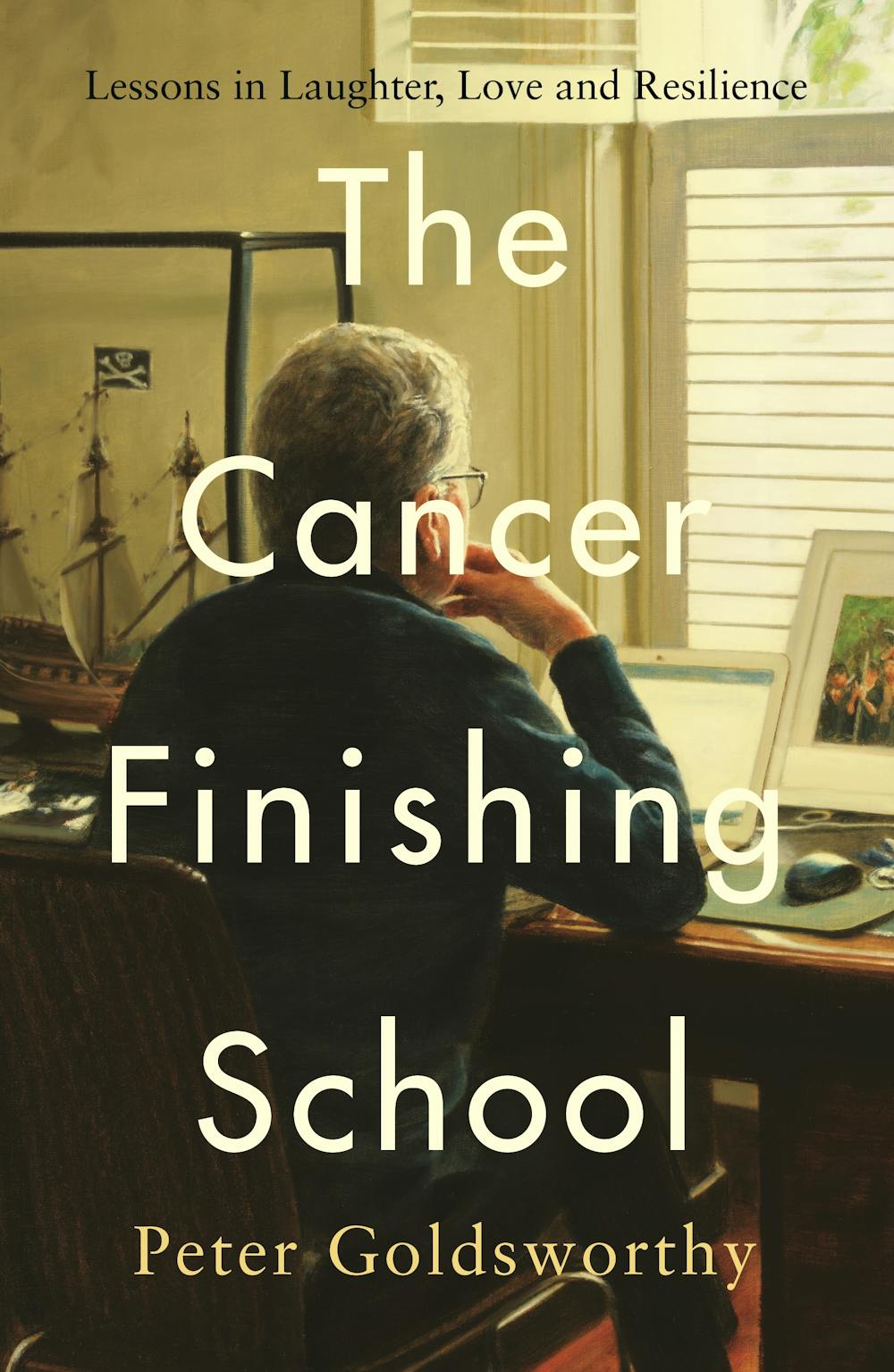
And while Goldsworthy’s style is characteristically unfussy, the memoir is filled with an equally characteristic intense use of word play, anecdotes and motifs that criss-cross the narrative. These give the work a complex structural harmony. Sometimes those motifs might more accurately be called riffs, and such riffing is continuous with Goldsworthy’s marvellous use of jokes. Jokes, writes Goldsworthy, “are useful forward scouts when entering enemy territory, especially the no-go areas of my own head”. At another level, then, Goldsworthy’s memoir is absorbing because it is so entertaining. That is not to say Goldsworthy “merely” deals with the sombre in comic terms. He can face the dark night of the soul square on, but the serio-comic is his habitual mode of attack. This mode is one that allows for important insights, borne out of an impressively nuanced and authoritative attention to its subject. For instance, Goldsworthy considers the “necessary narcissism” of illness in the following terms: For once everything is about you – you might die, after all. The stakes don’t come higher. I have seen it in my patients too often to judge it. Like a rat in a loaf, the mere knowledge that you have cancer eats out a bigger and bigger space for itself in your brain: a mental black hole that consumes ever more energy, attention, worry, love and conversation, often uselessly. In short: the knowledge you have cancer can be a kind of cancer itself. The nonjudgmental reference to patients is significant. While an individual’s reckoning with mortality is usually thought of in terms of a solitary person, one of the compelling features of The Cancer Finishing School is how Goldsworthy powerfully renders his experiences as inherently concerned with others. Goldsworthy’s self is very much a “relational” one: part of a network of carers, family members (especially his partner, Lisa), friends and patients who fill the pages with their own stories, insights and jokes. Some of the family and friends are well known, such as the Nobel laureate (and fellow citizen of Adelaide) J.M. Coetzee, the celebrated American writer Joan Didion (whose appearance makes for one of the book’s comic highpoints) and the late poet Les Murray. Read more: Vale Les Murray, a witty, anti-authoritarian, national poet who spoke to the world These worthies all have terrific walk-on parts, though they are, perhaps inevitably, outplayed by Goldsworthy’s patients, whose stories braid his own experience of illness. These stories are sometimes hilarious, sometimes heartbreaking. I am haunted by the bereaved woman who hangs a wetsuit in her kitchen so she might glimpse it and momentarily think the figure is her dead son. Goldsworthy makes it clear he is not exploiting these patients: he changes ages, names, genders and so on, and receives permission from those who are still alive to give it. And while it is important that these things are acknowledged, the most powerful element of such stories, when it comes to a virtual “ethics clearance” from the reader, is the evident sense of respect that accompanies these literary representations. If anyone comes off badly in these stories, it is Goldsworthy himself. This is ultimately a work about education, after all, and Goldsworthy’s anecdotes are usually concerned with important lessons (in humanity, in humility). Education, like illness, is a kind of journey, and Goldsworthy skilfully employs the tropes of schooling and roaming throughout The Cancer Finishing School. One of the notable aspects of Goldsworthy’s illness memoir is how self-conscious it is with regard to metaphor. He shows how the realm of the literal (illness, bodily death) swarms (to be metaphorical) with metaphor. Ever since Illness as Metaphor (1978), by Susan Sontag (who suffered and ultimately died from cancer), certain metaphors have been viewed with suspicion when it comes to cancer – mostly obviously, that of cancer-as-battle. Metaphor can, of course, have pernicious effects, but as Anita Wohlmann demonstrates, in Metaphor in Illness Writing: Fight and Battle Reused (2022), “even when a metaphor appears problematic and limiting, it can in fact be reused and reimagined in unexpected and creative ways”. This revisionary power is, of course, the power of literature generally. But it has a special intensity when it comes to memoirs about cancer. Unlike cancer, the generative force of writing is life-affirming: a beneficial unfurling, rather than a terminal metastasising. This is made apparent in Goldsworthy’s case through the way he constantly shows the value – social, dialogic – of story. Stories are as valuable to the speaker as they are to the listener. As Goldsworthy ruefully writes about first being diagnosed with cancer: “When the writing’s on the wall, it helps to get it down”. Authors: David McCooey, Professor of Writing and Literature, Deakin University

Read more https://theconversation.com/in-his-entertaining-cancer-memoir-peter-goldsworthy-explores-the-necessary-narcissism-of-illness-223197

Business News

How Businesses Can Prepare for Unexpected Power Outages

Power failures can occur quickly. The supply may be interrupted by bad weather, issues with the electricity network, damaged equipment or local construction work. This can be just a hassle for a fam...

Daily Bulletin - avatar Daily Bulletin

How Chatswood Tutoring Can Fit Into a Student’s Weekly Routine

Create a Predictable Weekly Structure A consistent weekly routine can make study easier to manage when students are balancing several subjects. Chatswood tutoring can provide a fixed learning point a...

Daily Bulletin - avatar Daily Bulletin

The Rise of Digital Marketplaces in the Australian Trade Sector

For decades, the Australian trade and construction sector operated almost entirely on word-of-mouth recommendations and local community networks. Small business owners typically relied on local newspa...

Daily Bulletin - avatar Daily Bulletin

How Immigration Lawyers Can Help

Introduction Visa decisions can shape employment, family life, study plans, travel, and future residence. A small omission can lead to delay, added expense, or refusal. Immigration lawyers assess l...

Daily Bulletin - avatar Daily Bulletin

How Industrial Drying Equipment Supports Efficient Processing

Many industrial processes require moisture to be removed from compressed air, products or process materials before they move to the next stage. Excess moisture can affect equipment performance, produc...

Daily Bulletin - avatar Daily Bulletin

Practical Ways a Whiteboard Can Improve Workplace Communication

Effective communication helps teams stay organised, share ideas and keep track of important information. While digital tools are now common in many workplaces, a whiteboard continues to provide a simp...

Daily Bulletin - avatar Daily Bulletin

Designing Eco-Friendly Custom Water Bottles for Your Next Event

The Evolution of Sustainable Event Merchandise Event planning has undergone a massive transformation over the last decade. Gone are the days when organizers could hand out cheap, single use plastic...

Daily Bulletin - avatar Daily Bulletin

Why Choosing a Professional Florist Melbourne Makes Flower Delivery Impactful

Flowers have a great power to speak when humans cannot express their feelings with right words. Flowers are the best gifts when you are celebrating a birthday or welcoming a newborn child into your fa...

Daily Bulletin - avatar Daily Bulletin

The Business Case for Choosing Australian Fabricators Over Imported Alternatives

For a long time, you might have defaulted to overseas suppliers when sourcing fabricated metal components for a project. The unit price was lower on paper, and the maths seemed straightforward. That...

Daily Bulletin - avatar Daily Bulletin

The Daily Magazine

How to Vet and Hire the Right Property Expert in the Australian Market

Navigating the Australian real estate market has become a highly strategic exercise. Recent nation...

Moving From Australia to Wellington: The Practical Settling-In Checklist

Wellington has a lot going for it. It's compact, walkable and full of cafes, with a harbour that r...

How to Match Replacement Roof Tiles on an Older Home

Renovating or repairing an existing roof comes with quite a few headaches, and matching the old roof...

Sydney Academy Partnership Targets Talent Development for Travel and Hospitality

VFS Global Academy’s Australian expansion will focus on practical skills and career development thro...

How Strategic Corporate Gifting Boosts Client Retention and Team Morale

As the calendar pushes towards the end of the year, business leaders across Australia begin evalua...

The Importance of Reliable Plumbing Services During Home Renovations

A freshly renovated bathroom can make an ordinary Monday morning feel a little more inviting. The ne...

Backyard Living Options for Campbelltown Homes: What Works Best?

You know that feeling at the end of a long, busy week when all you want is a calm spot outdoors, whe...

Smart Wardrobe Storage Ideas for Small Sydney Apartments and Bedrooms

A well-designed wardrobe is one of the most useful things a home can have. It's meant to keep clothe...

Colorbond Fencing in Australia: Costs, Colours, Rules and What Actually Lasts

Drive through almost any Australian suburb built in the last thirty years and you are looking at the...