

Huge housing costs make us slaves to our jobs and unsustainable growth. But there’s another way
- Written by: Alex Baumann, Sessional Lecturer, School of Social Sciences & Psychology, Western Sydney University
Every three months, Australian economists, analysts and commentators anxiously await the new gross domestic product (GDP) figures, a key measure of economic performance and growth. The latest figures, released today, show GDP growth of 0.2% in the December quarter.
But our dependence on such growth is destroying our planet. Humans are consuming resources faster than they can be replenished, and disrupting vital Earth systems through pollution, deforestation and other damage.
Why are we so reliant on an ever-expanding economy? The answer can be found in our economy’s first building block: the privatisation of land. The high and rising cost of land for housing has monumental, often lifelong implications. It influences the work we do, our available time, our need for a car, and so on. We’re made reliant on growth, while care for the planet often falls by the wayside.
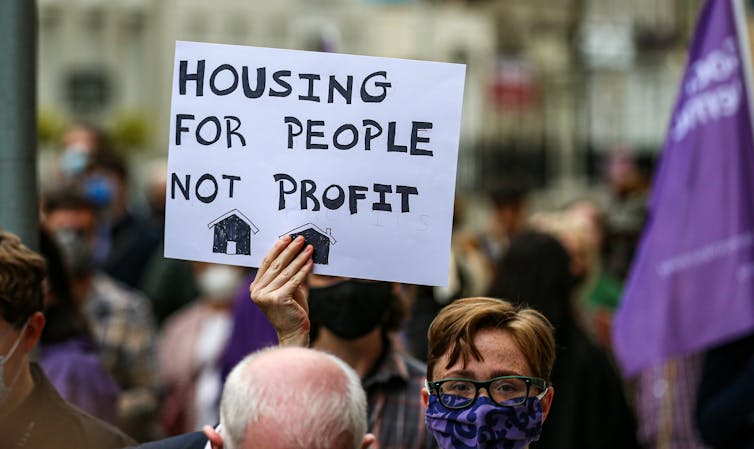
There are alternatives. Innovative examples of public housing offer hope – and a chance to move away from endless growth towards a more sustainable future.
The foundation of the problem
Before land was broadly privatised, people in many parts of the world survived through subsistence farming, hunting and gathering on land commons.
Much changed during the 16th century, starting in Europe and spreading through colonisation. The turning point was the shift to larger-scale agriculture, which made it increasingly profitable for the nobility and merchant classes to enclose land.
Once land was privatised, many people had no real option but to enter the market to sell their labour. They now had to rent or buy land for shelter and food.
Broadly speaking, the privatisation of land serves as the cornerstone for an economy tethered to economic growth.
Read more: Friday essay: searching for sanity in a world hell-bent on destruction
Alex Baumann and Western Sydney University students describe how land commons would make economic contraction, or degrowth, possible.Green growth has limits
Some proponents of economic growth argue a that rapid transition to renewable energy will make this growth environmentally sustainable.
But there’s increasing evidence that key industries – such as retail, construction and tourism – are just too environmentally intensive. Even with optimistic uptake of renewables, continued growth will surpass planetary boundaries, such as the extent of global warming and biodiversity loss Earth’s systems can withstand.
We cannot separate increases in GDP from dire environmental consequences.
The survival paradox
Altering our dependence on economic growth is not easy. We all rely on the opportunities it provides.
Take me, for example. I’m a sustainability academic and my employment relies on the government to subsidise education. But a large proportion of these funds come from taxing unsustainable commodities such as iron ore, coal and gas.
Universities also depend on international students who fly in from overseas, contributing to aviation emissions. And the university’s business model ultimately relies on student employment in a perpetually growing economy.
This dependence does not sit well with me. But bills have to be paid. The biggest and most unavoidable bill is the cost of keeping a roof over my head.
I’m not alone. For most people, the pressures of paying for housing far outweigh other survival concerns, such as those related to the environment. And those pressures are increasing.
Given this, it’s not surprising that environmental concerns also take a back seat in government priorities. To remain electable, governments must foster jobs through economic growth.
For instance, the Labor government has rejected the United Nations’ call for a moratorium on fossil fuel projects, citing mass job and revenue losses as primary reasons.
Read more: We are the 1%: the wealth of many Australians puts them in an elite club wrecking the planet
A practical way forward
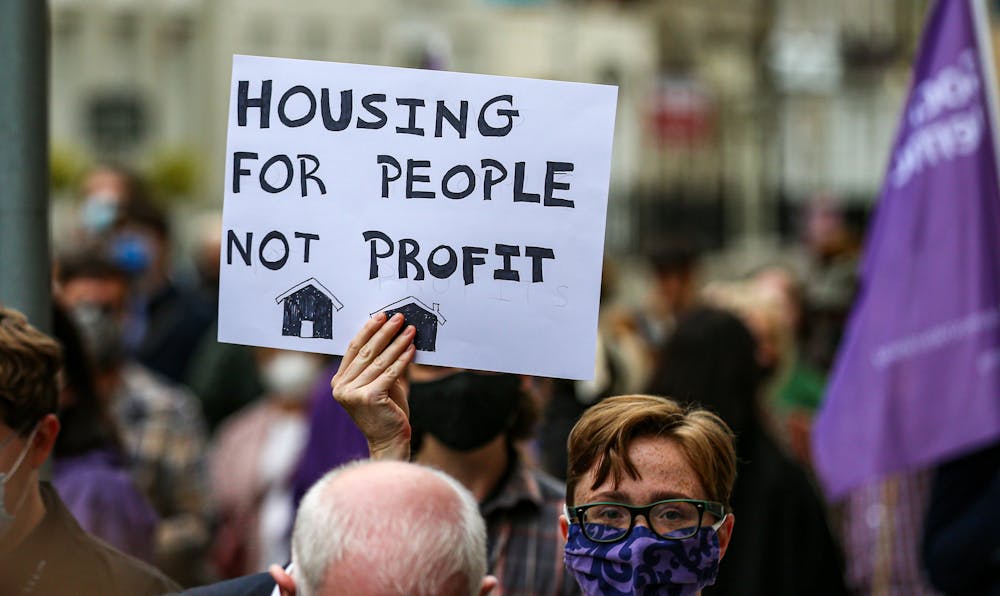
How do we escape this vicious cycle? A modern urban commons land arrangement, developed through a revitalised public housing sector, offers a way forward.
A noteworthy precedent can be found in Vienna, where public housing and rent controls mean 80% of residents spend only 20-25% of their income on housing.
This policy redefines land and housing as social or common goods, rather than just as market commodities. After all, land, like air and water, is not a market good but part of our collective natural heritage. Such policies can significantly free people from economic growth reliance. As Peter Pilz, a Viennese social housing tenant, told The New York Times:
If people don’t have to struggle all day long to survive — if your life is made safe, at least in social conditions — you can use your energy for much more important things.
These “more important things” could be activities that promote collaborative, sustainable ways of living such as self-help housing, “share and repair” programs and local food production.
Such housing models are not confined to Europe. In Singapore, as many as 80% of residents are publicly housed.
And what about Australia? The seeds are sewn in this nation’s long heritage of public housing and tenant participation. This includes activities such as producing food, hosting community events and managing tenancy issues.
The Emoh Ruo housing cooperative in Sydney is a public tenant housing cooperative, where tenants are active in roles such as managing their tenancies.
Centrelink’s voluntary work option for unemployed people – intended to partially fulfil their obligations for income support – also provides an Australian policy precedent.
A catalyst for change
Of course, many barriers to such urban commons arrangements exist.
The main barrier is inadequate funding of public housing. But as the housing crisis deepens, public housing is attracting more funding which could be applied to innovative housing models.
The right model of public housing could eventually be expanded toward the high levels seen in places such as Vienna and Singapore.
Not everyone wants to live in public housing, and there will likely always be a mix of housing tenure types. But widespread global adoption of public forms of housing could help balance the downsides of our current absolute reliance on economic growth.
Information in this article is drawn from a chapter written by the author and others in the Handbook of Degrowth.
Authors: Alex Baumann, Sessional Lecturer, School of Social Sciences & Psychology, Western Sydney University


 Daily Bulletin


