

From micro to macro, Andrew Leigh’s accessible history covers the economic essentials
- Written by: John Quiggin, Professor, School of Economics, The University of Queensland
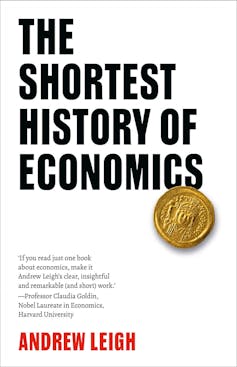
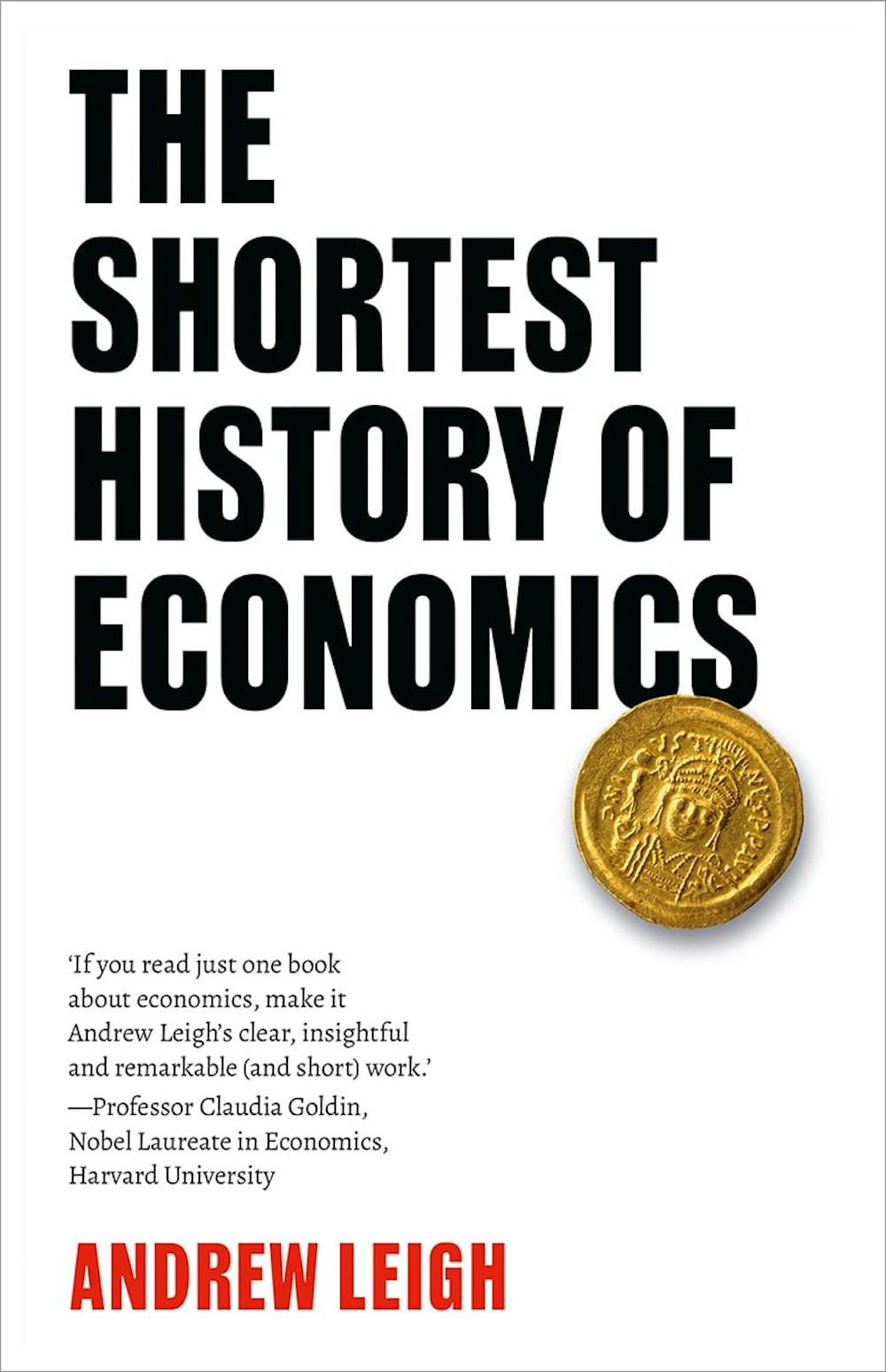
Andrew Leigh’s The Shortest History of Economics is the latest in a series of such histories, mostly focused on particular countries.
It begins with a striking mini-history of household lighting, focusing on the amount of labour required to produce the light now given off by a standard lightbulb: 58 hours for a wood fire, five hours for a candle based on animal fat, a few minutes for an early electric lightbulb, and less than one second for a modern light-emitting diode.
The Shortest History of Economics – Andrew Leigh (Black Inc.)
Importantly, what is true of labour hours is also true of material inputs. Older technologies required felling a tree or killing an animal, but an LED uses the photoelectric properties of common crystals. It only needs tiny quantities. The input of electricity is similarly modest.
Meanwhile, because workers in all kinds of activities have become more productive, the purchasing power of their wages, expressed in terms of services like lighting, has risen. The result is that services like lighting have become exceptionally cheap.
As this example shows, The Shortest History of Economics is not, as might be supposed, a history of economic thought (a topic primarily suited to retired economists like the author of this review). Rather, it is primarily a history of economic life, from Paleolithic times to the COVID pandemic.
The history is, however, informed by modern economics, included in the narrative in palatable doses.
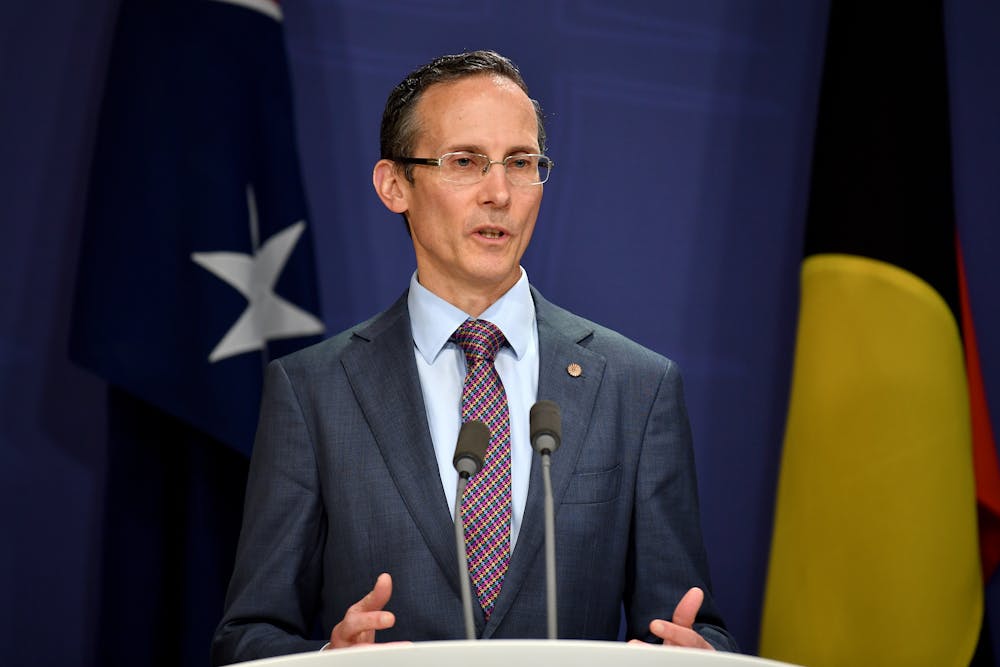 Andrew Leigh at a press conference in Sydney, August 23, 2023.
Bianca De Marchi/AAP
Read more:
Income redistribution or social insurance? A federal MP considers the future of the welfare state
Macroeconomics
The issues I have discussed so far have mostly concerned markets and prices, the topics studied by economists under the label “microeconomics”. But the 20th century also saw the emergence of “macroeconomics”, the analysis of booms, depressions, inflation and mass unemployment.
The key figure here was English economist John Maynard Keynes, whose General Theory of Employment, Interest and Money (1935) provided the theoretical basis for the use of public expenditure and taxation (fiscal policy) to stabilise the economy.
As Leigh notes in his introduction, The Shortest History of Economics is unusual among recent popular works on economics in covering both microeconomics and macroeconomics.
Despite proceeding briskly through millennia of economic history, Leigh manages to convey the essential points in a way that does not leave the reader feeling rushed through an incomplete argument. While it makes sense to begin by reading the book from beginning to end, it is also enjoyable to dip into it, more or less at random.
Inevitably, I have some points of disagreement. At a couple of points, Leigh gives uncritical credence to beliefs widely held among economists, but not supported by the evidence.
He repeats Adam Smith’s creation story for money as a more efficient alternative to barter. But a hundred years of anthropological evidence, beginning with my namesake Alison Hingston Quiggin and continuing to the work of the late David Graeber, suggests that money first emerged as a way of discharging debts (owed to the king whose face appeared on coins or as recompense for private injuries). It was only later adapted to use in commerce.
In his discussion of Keynesian macroeconomics, Leigh cites a popular rap video presenting a dispute between Keynes and Friedrich von Hayek, two of the great economists of the 20th century.
But in reality, although Hayek had criticised Keynes’ earlier Tract on Monetary Reform (1923), he did not even review his General Theory of Employment, Interest and Money. Arguably the most effective critic was A.C. Pigou, best known nowadays as the inventor of pollution taxes.
And Keynes was quite sympathetic to the arguments against economic planning Hayek presented in The Road to Serfdom (1944).
The idea of Hayek as Keynes’ primary antagonist is largely a piece of retroactive continuity (“retconning” in the jargon of genre fiction). The myth was created in the 1970s, following Hayek’s Nobel Prize in Economics in 1974 and his influence on political leaders, including Margaret Thatcher and Augusto Pinochet.
But these are quibbles, which will be of little concern to the general readership at which the book is aimed. As with all of the dozen or so books Leigh has produced since his election to Parliament (while also raising three children and maintaining a strenuous athletic regime – how does he do it?), The Shortest History of Economics is an engaging read, conveying economic insights to readers who would find a standard economics text both boring and impenetrable.
Authors: John Quiggin, Professor, School of Economics, The University of Queensland
Andrew Leigh at a press conference in Sydney, August 23, 2023.
Bianca De Marchi/AAP
Read more:
Income redistribution or social insurance? A federal MP considers the future of the welfare state
Macroeconomics
The issues I have discussed so far have mostly concerned markets and prices, the topics studied by economists under the label “microeconomics”. But the 20th century also saw the emergence of “macroeconomics”, the analysis of booms, depressions, inflation and mass unemployment.
The key figure here was English economist John Maynard Keynes, whose General Theory of Employment, Interest and Money (1935) provided the theoretical basis for the use of public expenditure and taxation (fiscal policy) to stabilise the economy.
As Leigh notes in his introduction, The Shortest History of Economics is unusual among recent popular works on economics in covering both microeconomics and macroeconomics.
Despite proceeding briskly through millennia of economic history, Leigh manages to convey the essential points in a way that does not leave the reader feeling rushed through an incomplete argument. While it makes sense to begin by reading the book from beginning to end, it is also enjoyable to dip into it, more or less at random.
Inevitably, I have some points of disagreement. At a couple of points, Leigh gives uncritical credence to beliefs widely held among economists, but not supported by the evidence.
He repeats Adam Smith’s creation story for money as a more efficient alternative to barter. But a hundred years of anthropological evidence, beginning with my namesake Alison Hingston Quiggin and continuing to the work of the late David Graeber, suggests that money first emerged as a way of discharging debts (owed to the king whose face appeared on coins or as recompense for private injuries). It was only later adapted to use in commerce.
In his discussion of Keynesian macroeconomics, Leigh cites a popular rap video presenting a dispute between Keynes and Friedrich von Hayek, two of the great economists of the 20th century.
But in reality, although Hayek had criticised Keynes’ earlier Tract on Monetary Reform (1923), he did not even review his General Theory of Employment, Interest and Money. Arguably the most effective critic was A.C. Pigou, best known nowadays as the inventor of pollution taxes.
And Keynes was quite sympathetic to the arguments against economic planning Hayek presented in The Road to Serfdom (1944).
The idea of Hayek as Keynes’ primary antagonist is largely a piece of retroactive continuity (“retconning” in the jargon of genre fiction). The myth was created in the 1970s, following Hayek’s Nobel Prize in Economics in 1974 and his influence on political leaders, including Margaret Thatcher and Augusto Pinochet.
But these are quibbles, which will be of little concern to the general readership at which the book is aimed. As with all of the dozen or so books Leigh has produced since his election to Parliament (while also raising three children and maintaining a strenuous athletic regime – how does he do it?), The Shortest History of Economics is an engaging read, conveying economic insights to readers who would find a standard economics text both boring and impenetrable.
Authors: John Quiggin, Professor, School of Economics, The University of Queensland


 Daily Bulletin


