

Australia must lead the world on nature restoration through ambitious interpretation of international law
- Written by: Justine Bell-James, Associate Professor, TC Beirne School of Law, The University of Queensland
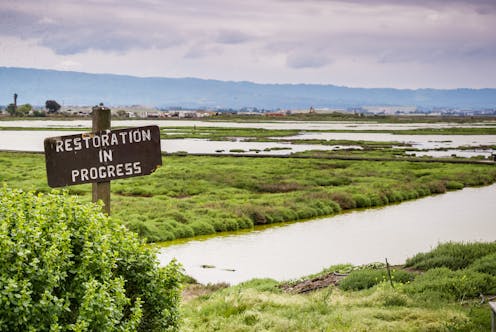
Australia has a once-in-a-generation opportunity to halt and reverse biodiversity loss through ambitious law and policy reform.
The federal government is currently rewriting our national environmental laws and updating the overarching Strategy for Nature. The updated strategy will include, among other things, goals for the restoration of degraded areas.
Part of the impetus for this reform is the Kunming-Montreal Global Biodiversity Framework. This 2022 United Nations treaty was signed by almost 200 countries committing to address the biodiversity crisis. It includes a pledge to achieve 30% of degraded land, water, coastal and marine ecosystems “under effective restoration” by 2030.
But as we argue in our new correspondence in Nature Ecology and Evolution, this restoration target is wide open to interpretation at the domestic level. Some responses could be very ambitious, while others would barely shift us from the status quo. Australia has an opportunity to lead here. We can show the world how to restore land and water for the benefit of all.
The United Nations Biodiversity Conference (COP15) ended in Montreal, Canada, on December 19, 2022 with a landmark agreement to guide global action on nature through to 2030.Read more: 5 things we need to see in Australia's new nature laws
Interpreting the 30% restoration target
The global framework contains 23 targets, to be “initiated immediately and completed by 2030”.
The restoration target obliges countries to:
Ensure that by 2030 at least 30% of areas of degraded terrestrial, inland water, and marine and coastal ecosystems are under effective restoration, in order to enhance biodiversity and ecosystem functions and services, ecological integrity and connectivity.
At first glance, this 30% restoration target sounds like a huge and important step towards reversing biodiversity loss. But the devil is in the detail, and almost every word of this target is open to interpretation.
For example, the term “degraded” can be interpreted in various ways. A country may interpret it to include only areas that have seen a drastic decline in biodiversity, such as those that have been totally cleared.
But if a country interprets it more broadly as areas that have experienced any decline in biodiversity, this translates to a much larger area for restoration.
The wording also refers to 30% of areas of “degraded terrestrial, inland water, and marine and coastal ecosystems”. Crucially, it does not say effort must be spread evenly across these different ecosystems. This may lead countries to focus on areas where restoration is easier or cheaper. Given the complexities involved in marine and coastal restoration, there is a risk countries may focus their efforts on land while continuing to neglect freshwater, marine or coastal ecosystems.
The phrase “under effective restoration” also has a range of possible meanings. Does “effective” simply mean in a better state than it was before restoration began? Or does it mean bringing the ecosystem back to an approximation of its natural state – prior to interference from development or other harm?
How the term “effective” restoration is defined at a national scale will drastically influence reports of “success” and make it difficult to compare results between countries.
The United Nations is honouring the planet’s most ambitious, successful, and inspiring examples of large-scale ecosystem restoration.Scaling up
Australia has signed the framework and is currently considering how to implement it domestically. If Australia does decide to interpret the restoration target broadly and commit to restoring larger areas of land and water through more ambitious standards, there will be other issues to contend with.
For example, one study identified a lack of funding and complex legal requirements as barriers to upscaling restoration in marine and coastal areas. In particular, having to apply for numerous government permits for restoration can slow progress and lead people to scale back their plans.
To meet the 30% target, the government will need to reconsider how to fund restoration and streamline legal processes. Remember, much of the heavy lifting is currently done by non-government organisations such as The Nature Conservancy, Australian Wildlife Conservancy, Bush Heritage Australia and Trust for Nature.
Read more: The new major players in conservation? NGOs thrive while national parks struggle
Leading by example
Ultimately, we argue countries should have discretion over how and where to implement restoration based on their individual circumstances. But we also think the global framework could be supplemented by standardised terminology and metrics to allow genuine comparison of countries’ progress towards the global targets.
Closer to home, our analysis has some important lessons for Australia as the federal government contemplates the fate of our national environmental laws and biodiversity strategy. Australia’s most recent State of the Environment Report painted a bleak picture of biodiversity decline, highlighting an urgent need to upscale restoration of our land and water.
Australia has an opportunity to take a leading role in this area and reverse our legacy of biodiversity loss. Interpreting the 30% restoration target broadly and ambitiously would set us on a path towards achieving meaningful outcomes for biodiversity and make Australia a world leader in restoration.
Read more: We've committed to protect 30% of Australia's land by 2030. Here's how we could actually do it
Authors: Justine Bell-James, Associate Professor, TC Beirne School of Law, The University of Queensland


 Daily Bulletin


