

Stand by for a pay rise on top of a tax cut. Here’s why things will feel better from July
- Written by: Peter Martin, Visiting Fellow, Crawford School of Public Policy, Australian National University
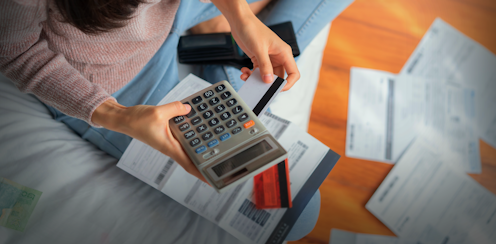
At the moment, things look awful.
The latest Bureau of Statistics count of retail spending (spending online and in shops) released Tuesday shows we spent less in April than in February.
The Westpac card tracker, which tracks spending by Westpac customers, shows spending on essentials has fallen 1.6% since April. Spending on non-essentials (what Westpac calls discretionary spending) has fallen 2.2%.
Each month for decades now the Melbourne Institute has asked Australians whether “now is the right time to buy a major household item”.
This month, in a survey conducted just before and just after the federal budget, only 15.2% said it was. That’s the second-lowest percentage in the three decades I have been keeping results.
Go back a few years to the time before COVID (and even during COVID in the lockdowns) and the proportion was typically double – 30-40% of Australians said now was a good time to buy a major household item.
The economic growth figures due for release next week might well show living standards, as measured by GDP per person, going backward for the fourth consecutive quarter – for an entire year.
It’s something that hasn’t happened since the early 1980s, in more than 40 years.
The good news (and there is good news) is things are about to get a little better, beginning very soon, in July.
Reasons to be (more) cheerful
Already well publicised (probably over-publicised given its size) is the $300 per household electricity rebate, which will work out at $75 per quarter, or 82 cents per day.
In some states there will be more. The West Australian government is offering an extra $400, and the Queensland government an extra $1,000.
Added to this will be lower electricity prices for most customers not already on a good deal. The Australian Energy Regulator has announced cuts in the maximum that can be charged of 2% to 4% beginning in July.
Tax cuts hit pay packets in July
Much more important will be the long-awaited (and revamped) Stage 3 tax cuts due finally to hit pay packets in July.
For a middle-earning Australian (half earn more than this, half earn less) on $67,600 it’ll mean a tax cut of $1,369, or $52.60 every fortnight.
And there’s something likely to make an even bigger difference to the one in five Australian workers whose pay is set by an award rather than an enterprise agreement or an individual contract.
For many, wage increases will be bigger
Next Monday the Fair Work Commission will announce the increase in award wages due to take effect four weeks later on July 1.
In headline terms (and there’s more to it than the headline this time, as I’ll outline shortly) the Australian Council of Trades Unions is asking for 5%.
One of the employer groups, the Australian Chamber of Commerce and Industry, is asking for much less, and much less than the rate of inflation – just 2%.

Its chief executive Andrew McKellar says employers’ legislated superannuation contributions are set to climb by 0.5% of most wages in July, meaning the cost to employers of a 2% increase would be 2.5%.
Another employers body, the Australian Industry Group, is suggesting 2.8%, which is also less than the rate of inflation.
The government itself wants at least the rate of inflation for workers on low pay. It has asked the commission to ensure the “real wages of Australia’s low-paid workers do not go backwards”.
It’s a fair bet the commission will award at least the rate of inflation.
On only two occasions in the past decade has the commission awarded less than the published annual rate of inflation at the time. One was when businesses were in danger of going under as COVID hit in 2020 and the other was last year, when inflation was an unusually high 7%.
The most recent quarterly inflation figures point to an annual rate of 3.6%. (There will be an update on the more experimental monthly figure on Wednesday, but the commission is unlikely to pay too much attention to that).
That’ll mean an increase of 3.6% to 4% from July highly likely, which for an Australian on an award wage of $67,600 will mean an after-tax increase of at least $1,703, which is $65.50 per fortnight, on top of the fortnightly tax cut of $52.60.
There was a bizarre moment at last week’s hearing when the Australian Industry Group tried to argue that whatever increase the commission thought was fair should be cut to take account of the benefit workers would get from the tax cut.
Fair Work Commission President Adam Hatcher pointed out the commission had never boosted pay to compensate for the higher tax payments that flowed from bracket creep, and asked rhetorically: “why should we go in the other direction now?”
Wage decision unlikely to feed inflation
History suggests that if the wage rise the commission hands to Australians on awards is substantial, it won’t spark broader wage inflation. Only about 20% of workers are on awards. Many of them have low rates of pay, and many of them work in retail and hospitality.
Last year the commission awarded them 5.75%. Overall wages didn’t jump in response, climbing just 4.1%.
And there might be something else for low-paid workers. By law, the commission is now required to redress the undervaluation of work in industries traditionally dominated by women.
The Australian Council of Trades Unions has asked that, as an interim measure, workers in industries that require “emotional labour” be given an extra 4%.
We will find out on Monday.
Authors: Peter Martin, Visiting Fellow, Crawford School of Public Policy, Australian National University


 Daily Bulletin


