

In 1614, a mother of eight put on a play about her cheating neighbour. The scandalous story changes what we know about women in theatre
- Written by: David McInnis, Professor of Shakespeare and Early Modern Drama, The University of Melbourne
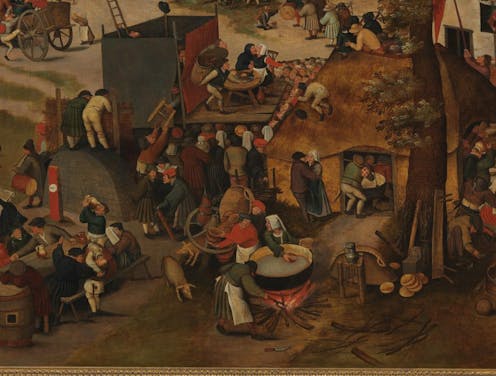
On September 4, in 1614, a woman named Alice Mustian put on a play in the English city of Salisbury. Erecting a stage in her own backyard, Mustian assembled a group of local children, including her ten-year-old son Phillip, to perform a play based on local gossip: that Mary Roberts, the wife of a joiner, had had an affair with a baker named Robert Humphries.
Nothing except eyewitness accounts of Mustian’s play has survived to the modern day. This is the case for most plays written and performed in early modern England. The vast majority have been lost, and are known only by sparse and fragmentary evidence, if at all.
But as our research shows, the story of Mustian’s play, gleaned through witness testimony during her defamation trial, sheds fascinating light on the theatrical culture of England at the time, and the role of women within it.
Who was Alice Mustian?
Alice Mustian was likely born in the early 1570s and died in 1633. She lived with her husband Roger Mustian, a chandler (candle-maker), in the parish of St Thomas, Salisbury, and had eight children. Records from the parish church indicate the Mustians were relatively wealthy by the standards of the area.
While the Mustians had many friends, they also had their enemies. According to locals, Mary Roberts, who had moved to the parish around ten years earlier, was one such enemy. As one local testified:
Roger Mustion, & his wife were Capitall enemyes to […] Mary Roberts, & there was much enmytye & striffe betweene them.
The play that rocked the town
The day on which this enmity reached its boiling point began when witnesses saw four neighbourhood children aged between 10 and 12 building a stage in Mustian’s backyard on top of old barrels.
When the play was about to begin, Alice stood at the entrance to her property to collect admission fees of coins or “pins”, which were often used by children as gambling currency.
According to the neighbours who saw the performance, the climax of the play came when a character named “Robin the Devil” was caught undressed and in a compromising position with a joiner’s wife by her husband and the local police constable.
While we don’t know how large the audience was, at least one family, the Benburys, who lived next door, identified the plot as a thinly veiled retelling of neighbourhood gossip from two years prior.
News of the performance quickly reached Mary Roberts. Salisbury local Rombald Benbury, who had seen the play, also reported Roberts’s reaction:
so soone as the sayd Mary Roberts did heare of the sayd Stage played & that it was played in disgrace of her & to her discreditt, she was very Angry, and much displeased, & sayd that she would sue the said Alice Mustian.
Roberts soon sued Mustian for defamation. (The outcome of the case remains unknown).
Women as playwrights
Since our understanding of early modern English theatre tends to draw on surviving texts, our knowledge about the women of the period who wrote plays is limited to a handful of examples. Often these plays were written by women from aristocratic families moving in elite and literary circles.
Mustian, on the other hand, is completely different to them, a middle-class woman writing for her local community. While she has sometimes been cited as example of an early modern woman connected to performance, earlier scholarship, not aware of how elaborate her production was, has tended to consider her not as a playwright, but just as someone who performed an improvisatory “one-woman show”.
But this, we suggest, sells Alice short.
Witnesses in the trial provide a compelling case to believe there was a text composed prior to the performance. Margaret Benbury, the next-door neighbour, claims Mustian “did prompte and teache the said Actors as they were upon the stage”.

The way Mustian chose to stage her backyard play suggests she had some familiarity with broader performance practices of professional companies (quite possibly having watched them on tour in Salisbury) and may have tried to emulate these practices herself. Indeed, her collecting an admission fee at the door is reminiscent of how the Queen’s Men (the leading professional acting company of the 1580s) were paid “att the hall door” during performances in Leicester in 1590.
We also know that while Mustian had teenage daughters, a nine-year-old boy named Augustine Hodds or Hodges performed the female role. This was a time when the “boy actress” phenomenon was ubiquitous among the major professional theatre companies.
As the evidence makes clear, Mustian was demonstrably capable of initiating and planning the logistics of an entire dramatic entertainment, serving both as playwright and impresario.
We can’t say Mustian is “typical” of amateur playwrights during her time due to the vast number of plays lost. But we can say Mustian’s work and trial give us insight into the rich social tapestry of early modern England and the wide range of people who might have written and performed plays at the time.
Authors: David McInnis, Professor of Shakespeare and Early Modern Drama, The University of Melbourne


 Daily Bulletin


