

Climate holdout Japan drove Australia’s LNG boom. Could the partnership go green?
- Written by: Wesley Morgan, Research Fellow, Griffith Asia Institute, Griffith University
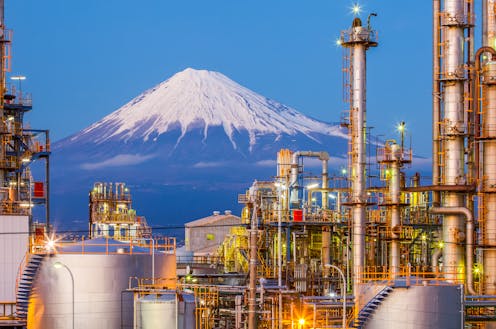
Without funding from Japan, many of Australia’s gas projects wouldn’t have gone ahead. Massive public loans from Japanese taxpayers are propping up Australia’s now-enormous fossil gas industry. Japan is also becoming a major gas trader and today exports more gas to other countries than it imports from Australia.
Even as the world rapidly shifts to a clean energy future, Japan is emerging as a fossil fuel holdout. The world’s fourth biggest economy, Japan has long been dependent on foreign sources of fossil fuels. Even as China has filled its deserts with solar farms, Japan has focused on gas.
These projects make it harder for Australia to achieve its climate goals and undermine the shift to clean energy industries. New gas projects threaten to divert workforce and investment away from these export industries.
But this can change. As Australia spends big on green power, green manufacturing and green exports – as part of the government’s Future Made in Australia policies – the enduring partnership between the two nations could go green.
Developing new clean energy partnerships with energy-hungry Asian nations such as Japan, China and South Korea could boost climate cooperation, grow new clean energy exports and promote investment.
Japanese funding, Australian gas
Worried about energy security, Japan is subsidising new offshore gas projects in Australia which probably wouldn’t go ahead otherwise.
Japan is the world’s largest provider of international public finance for gas production. While other nations – including Australia – have pledged to end international finance for fossil fuels, Japan has kept the money flowing.
For example, last month, the Japan Bank for International Cooperation provided Australia’s biggest gas corporation, Woodside, with A$1.5 billion in loans to develop the Scarborough gas field offshore from Western Australia. Japanese power utility JERA also received $1.2billion from the Japanese bank to acquire a 15% stake in the project, gaining rights to a share of the liquefied natural gas (LNG) produced.
Without this kind of financial support, new gas projects would be less likely to proceed.
It is not certain other funders would step in. Gas production in Australia is relatively expensive, due to remote locations and high operating costs. Over the past decade, Australian gas projects have typically been delivered late and over budget and have delivered poor returns for investors.
In the years ahead, Australian gas projects will struggle to deliver gas at internationally competitive prices. In 2022, Russia’s invasion of Ukraine triggered a surge in demand for LNG. Now, the world is facing a massive oversupply of gas.
In two years time, large new LNG volumes will come online from lower-cost producers in the Middle East – mainly Qatar – and in North America, just as demand for gas falls in key markets. The Australian government’s own analysis projects a much lower price of LNG from these producers than the cost of production in Australia.
If we left it up to the market, Australia’s increasingly uncompetitive gas exports would lose market share. But it’s not being left up to the market. Japan is underwriting new gas projects to make money-losing projects seem viable. And that makes it much harder for Australia to shift to a lucrative green economy.
Tokyo’s neon lights will keep glowing
Last year, Japanese ambassador Yamagami Shingo claimed Australian gas exports were crucial to keeping the neon lights of Tokyo glowing.
In reality, Japan is now reselling more LNG to other Asian nations than it imports from Australia. Japanese gas corporations are contracted to buy more gas over the next decade than Japan will use at home, and are planning to sell excess gas in other markets in Asia.
This is a direct result of official policy, which aims to create new demand for gas in Southeast Asia by offering financial support for gas import terminals and gas-fired power plants and supporting Japanese corporations to supply that demand.
This is not hidden. It’s an open goal. By 2030, the Japanese government wants its corporations to “handle” 100 million tonnes of LNG each year – far more than Japan will use to meet its own energy needs.
Why? Japan’s government sees maintaining influence in the region’s LNG market as important to its own energy security.
Renewables offer Japan true energy security
The gas industry has tried to brand gas as cleaner than coal or a transition fuel. In reality, gas is a dangerous fossil fuel. It’s largely methane, 80 times more potent in heating the planet than carbon dioxide. Methane has added almost a third (30%) of the extra heat building up since the industrial revolution.
Woodside chief Meg O’Neill claims Australian gas exports “can help Asia to decarbonise by replacing coal”. But gas can be just as polluting as coal. Methane leaks are very common across the gas supply chain. You only need a very low amount of leakage for gas to be on par with coal for pollution.
While Japan buys and resells Australian gas, it’s own power grid is greening. The government now plans to double the role of renewables – rising from 18% of power generation in 2019 to 37% by 2030 – while gas-fired power shrinks.
Japan’s demand for gas at home is already falling. It fell 18% in the decade to 2022. In 2023 alone, demand for gas fell by 8%.
Shifting to renewables even faster would improve Japan’s energy security by reducing dependence on imported gas. Recent analysis suggests Japan could achieve a 90% clean energy system by 2035.
Without Japanese funds, Australian gas would be dwindling
In the five years to 2017, Australia’s gas industry grew enormously. By 2019 Australia became the world’s largest LNG exporter. Analysis from the Institute for Energy Economics and Financial Analysis points out this is remarkable given how remote and relatively small Australia’s gas reserves are.
International subsidies – including Japan’s largesse – helped turn Australia into a fossil fuel giant. But these subsidies will not serve our interests long term. Continuing to allow subsidised investment in new gas projects diverts investment, workforce, and supply-chain capacity away from the green industries the government wants to grow for the future.
This doesn’t mean turning our back on Japan. Japan has a huge need for energy. But it can get it without resorting to fossil fuels. Japan could partner with Australia to supply critical minerals and green metals for batteries and renewables, green ammonia for fertilisers and industry, and green hydrogen for transport and industry.
Acknowledgements: Ben McLeod (Quantitative analyst, Climate Council) and Josh Runciman (Lead analyst, Australian Gas, IEEFA) provided data used in the article.
Authors: Wesley Morgan, Research Fellow, Griffith Asia Institute, Griffith University


 Daily Bulletin


