

Guide to the classics: The Art of War, the ancient Chinese war manual loved by edgelords and management gurus
- Written by: Jamie Q Roberts, Lecturer in Politics and International Relations, University of Sydney
Quoting The Art of War, an ancient Chinese war manual dating from the 5th century BCE, has become a cliché. It is, alas, the hallmark of teen edgelords, management gurus and, as one of my students informed me, pseudo-intellectual boyfriends.
Because of all this, the book has become part of the endless layers of irony that are the bedrock of internet culture. Various memes both reference its famous lines, such as “know your enemy; know yourself” and “do not press a desperate foe too hard”, and make fun of this excessive referencing.
 A portrait of Sun Wu.
Wikimedia Commons
But in these records fact and legend mingle. The earliest written fragments of The Art of War are from around 200 BCE – 300 years after Sun Wu lived. So it is difficult to verify Sima Qian’s claims.
Historian Michael Nylan, who produced the translation I am using for this article, says the scholarly consensus is that all early Chinese texts are “composite texts”. They were compiled over time – sometimes over centuries – before they crystallised into a definitive written version.
They are attributed to one author; however, it is likely this author didn’t exactly exist, or as the joke goes, classic works like Sun Tzu’s The Art of War were written by somebody else with the same name.
However, having no better option, I, like everyone else, will attribute the book to Sun Tzu: Master Sun.
The context
The Spring and Autumn period (roughly 771–476 BCE) in Chinese history was characterised by numerous smaller polities engaging in frequent but somewhat ritualistic conflicts. These conflicts were undertaken by aristocrats, and deaths were limited.
A portrait of Sun Wu.
Wikimedia Commons
But in these records fact and legend mingle. The earliest written fragments of The Art of War are from around 200 BCE – 300 years after Sun Wu lived. So it is difficult to verify Sima Qian’s claims.
Historian Michael Nylan, who produced the translation I am using for this article, says the scholarly consensus is that all early Chinese texts are “composite texts”. They were compiled over time – sometimes over centuries – before they crystallised into a definitive written version.
They are attributed to one author; however, it is likely this author didn’t exactly exist, or as the joke goes, classic works like Sun Tzu’s The Art of War were written by somebody else with the same name.
However, having no better option, I, like everyone else, will attribute the book to Sun Tzu: Master Sun.
The context
The Spring and Autumn period (roughly 771–476 BCE) in Chinese history was characterised by numerous smaller polities engaging in frequent but somewhat ritualistic conflicts. These conflicts were undertaken by aristocrats, and deaths were limited.
 A Chinese bamboo copy of The Art of War.
vlasta2, bluefootedbooby on flickr.com, CC BY
The Warring States Period (roughly 475–221 BCE) saw the polities coalesce into seven states: Qi, Chu, Yan, Han, Zhao, Wei and Qin.
These states were engaged in relentless warfare. At this time, conflicts were for real – not ritualised. Tens and sometimes hundreds of thousands of soldiers – commoners, not aristocrats – took to the field.
This transformation in warfare was accompanied by a transformation in strategies and tactics. The Art of War is a record of this change.
The King’s concubines
The Records of the Grand Historian tells a story about Sun Wu’s first meeting with king Helü of Wu. This ought to be mentioned, even if possibly apocryphal, as it further establishes Master Sun’s reputation as being clear-sighted and ruthless.
The king wanted to test Sun Wu’s abilities so he summoned 180 of his concubines and asked him to conduct a military drill with them. Sun Wu divided the concubines into two groups, putting each under the charge of one of the king’s favourites. Sun Wu repeatedly explained the way he wanted the concubines to drill. However, when ordered, they giggled and didn’t obey.
Sun Wu observed that when instructions are not clear, it is the fault of the commander. He repeated what he wanted. Again, he was not obeyed. He then noted that when instructions are clear but are not obeyed, the fault lies with the unit commanders. Thus he ordered the two lead concubines to be beheaded.
The king refused to do this. Sun Wu said once a mandate to command has been given, the king has no more power.
The two concubines were executed.
Two more lead concubines were appointed, and the groups drilled perfectly. Sun Wu was appointed the king’s military commander.
We see parts of this story echoed in The Art of War:
If the way he goes into battle guarantees victory, the commander-in-charge must insist on fighting, even if the ruler forbids the engagement. And if the way he is directed to go into battle will not allow a victory, he must refuse to fight, even if the ruler insists that he do so.
Realism
The Art of War is Machiavellian – in the best sense of the term. What do I mean by this? The struggle between good and evil is a familiar theme. We could say that good is something like treating others as we’d like to be treated, and evil is something like taking pleasure in cruelty. It is easy to think that much of the time we must choose between one or the other.
A Chinese bamboo copy of The Art of War.
vlasta2, bluefootedbooby on flickr.com, CC BY
The Warring States Period (roughly 475–221 BCE) saw the polities coalesce into seven states: Qi, Chu, Yan, Han, Zhao, Wei and Qin.
These states were engaged in relentless warfare. At this time, conflicts were for real – not ritualised. Tens and sometimes hundreds of thousands of soldiers – commoners, not aristocrats – took to the field.
This transformation in warfare was accompanied by a transformation in strategies and tactics. The Art of War is a record of this change.
The King’s concubines
The Records of the Grand Historian tells a story about Sun Wu’s first meeting with king Helü of Wu. This ought to be mentioned, even if possibly apocryphal, as it further establishes Master Sun’s reputation as being clear-sighted and ruthless.
The king wanted to test Sun Wu’s abilities so he summoned 180 of his concubines and asked him to conduct a military drill with them. Sun Wu divided the concubines into two groups, putting each under the charge of one of the king’s favourites. Sun Wu repeatedly explained the way he wanted the concubines to drill. However, when ordered, they giggled and didn’t obey.
Sun Wu observed that when instructions are not clear, it is the fault of the commander. He repeated what he wanted. Again, he was not obeyed. He then noted that when instructions are clear but are not obeyed, the fault lies with the unit commanders. Thus he ordered the two lead concubines to be beheaded.
The king refused to do this. Sun Wu said once a mandate to command has been given, the king has no more power.
The two concubines were executed.
Two more lead concubines were appointed, and the groups drilled perfectly. Sun Wu was appointed the king’s military commander.
We see parts of this story echoed in The Art of War:
If the way he goes into battle guarantees victory, the commander-in-charge must insist on fighting, even if the ruler forbids the engagement. And if the way he is directed to go into battle will not allow a victory, he must refuse to fight, even if the ruler insists that he do so.
Realism
The Art of War is Machiavellian – in the best sense of the term. What do I mean by this? The struggle between good and evil is a familiar theme. We could say that good is something like treating others as we’d like to be treated, and evil is something like taking pleasure in cruelty. It is easy to think that much of the time we must choose between one or the other.
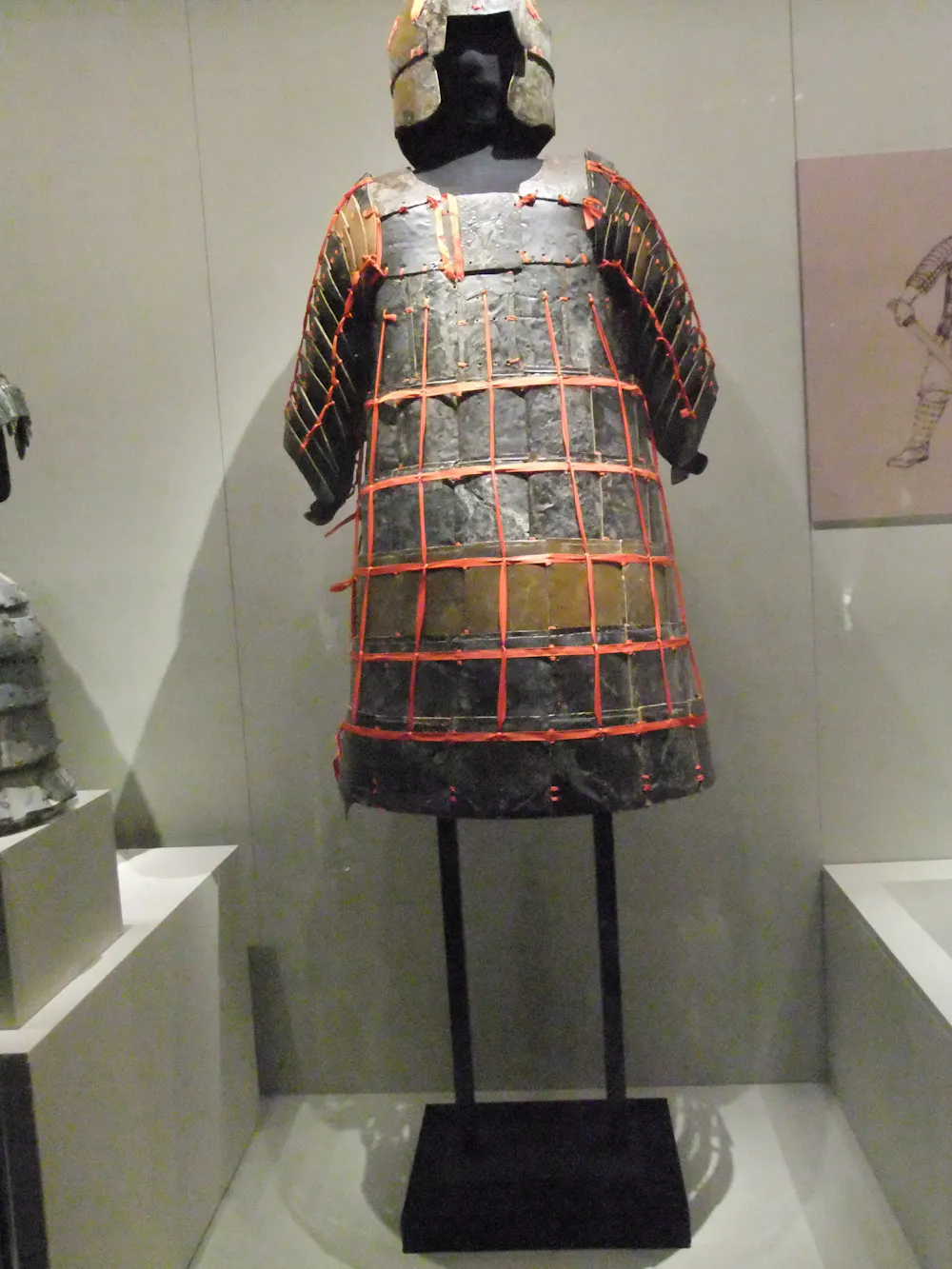 Leather armour from the Warring States period, excavated in 2002 in Zaoyang, Hubei.
Wikimedia Commons
However, as we see in both Machiavelli’s writing and The Art of War, there is a middle path that we can characterise as “realism”. To paraphrase Machiavelli’s advice, a ruler deviates from good not when he or she can, but when necessity demands.
As we have seen, Master Sun encourages ruthless action in some instances. He also regularly encourages deception; for example, he advocates using “devious” rather than “direct” tactics (though this is hardly remarkable in war).
Yet – and this is the crucial point – for Master Sun, there is no pleasure in war: absent is the familiar glorification of heroism that we see in the likes of Homer’s Iliad and many militaristic cultures. The most striking remarks in The Art of War are:
winning a hundred victories in a hundred battles in not the best possible outcome. Best is to subdue the enemy’s troops without ever engaging them on the battlefield.
Leather armour from the Warring States period, excavated in 2002 in Zaoyang, Hubei.
Wikimedia Commons
However, as we see in both Machiavelli’s writing and The Art of War, there is a middle path that we can characterise as “realism”. To paraphrase Machiavelli’s advice, a ruler deviates from good not when he or she can, but when necessity demands.
As we have seen, Master Sun encourages ruthless action in some instances. He also regularly encourages deception; for example, he advocates using “devious” rather than “direct” tactics (though this is hardly remarkable in war).
Yet – and this is the crucial point – for Master Sun, there is no pleasure in war: absent is the familiar glorification of heroism that we see in the likes of Homer’s Iliad and many militaristic cultures. The most striking remarks in The Art of War are:
winning a hundred victories in a hundred battles in not the best possible outcome. Best is to subdue the enemy’s troops without ever engaging them on the battlefield.
 A billboard with a quote from Sun Tzu.
Shutterstock
We also see Master Sun advising rulers not to mobilise forces when in a rage. Wars, he writes, should not be fought over a slight. After all, “a kingdom, once destroyed, cannot be restored, nor can the dead be brought back to life”.
And yet, as international relations scholar John Herz (who coined the term “security dilemma”) observes: “Realism may well, and often does, glorify ‘realist’ trends as the desirable ones.”
This critical objection suggests that some people who appear to be realists are not deviating from good because of a lamentable necessity, but cloaking their evil behaviour in the rhetoric of realism. Even a cursory assessment of history reveals such behaviour as all too common.
Authors: Jamie Q Roberts, Lecturer in Politics and International Relations, University of Sydney
A billboard with a quote from Sun Tzu.
Shutterstock
We also see Master Sun advising rulers not to mobilise forces when in a rage. Wars, he writes, should not be fought over a slight. After all, “a kingdom, once destroyed, cannot be restored, nor can the dead be brought back to life”.
And yet, as international relations scholar John Herz (who coined the term “security dilemma”) observes: “Realism may well, and often does, glorify ‘realist’ trends as the desirable ones.”
This critical objection suggests that some people who appear to be realists are not deviating from good because of a lamentable necessity, but cloaking their evil behaviour in the rhetoric of realism. Even a cursory assessment of history reveals such behaviour as all too common.
Authors: Jamie Q Roberts, Lecturer in Politics and International Relations, University of Sydney


 Daily Bulletin


