

Is Australia becoming a dumping ground for unrepairable appliances?
- Written by: Leanne Wiseman, Professor of Law, Griffith University, Griffith University
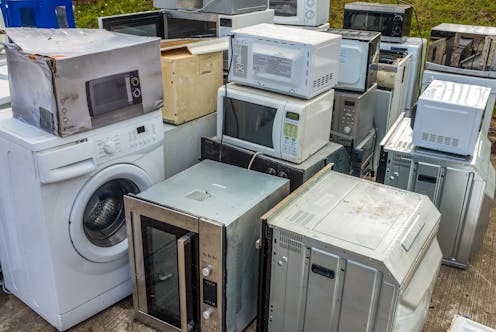
Australians have a love affair with household appliances. The national household appliance market is projected to reach A$13 billion in 2024 – a figure that grows each year.
On average, Australian homes have five large appliances and up to ten smaller ones such as hair clippers and irons – not to mention numerous other electronic gadgets not included in this count, such as those operated by batteries. As you might expect, the most common appliances are refrigerators and washing machines, with vacuum cleaners, microwaves and toasters close behind.
But what happens when these appliances break? Unfortunately, broken appliances are unlikely to be repaired. It doesn’t have to be this way, however.
And if we fail to keep up with legal developments in other parts of the world, Australia could soon become a dumping ground for cheap and nasty appliances.
They don’t make them the way they used to
Just over a decade or so ago, when household appliances such as televisions or washing machines broke down, an appliance repair man could be called, spare parts obtained, and the problem fixed.
But getting large and small appliances repaired these days can be very challenging, if not impossible. Brands and retailers often discourage repair by offering replacement instead.
While it may be technically possible to repair modern white goods and appliances, it’s expensive. There are high call-out fees for service technicians, and spare parts are difficult to find.
And many appliances are designed in such a way that makes repairs impossible, or there are no spare parts available.
Most manufacturers, brands and retailers provide only a one- or two-year warranty. Often we are encouraged to pay extra for an extended warranty. But that shouldn’t be necessary, because consumer law requires the manufacturer or importer to provide spare parts and repair facilities for a reasonable time after purchase – longer than the manufacturer’s warranty.
Once the warranty has expired, Australian consumers with broken appliances can really only take the matter up with the Australian Competition and Consumer Commission as a breach of their consumer rights. Even then, as consumer advocates have repeatedly highlighted, there are no penalties for manufacturers that refuse to comply with our consumer rights by failing to offer repair over replacement.
What is Right to Repair, and Why is it Important? (iFixit)A lack of consumer protection
Australia’s consumer law means we technically have a right to repair, refund or replacement for defective goods. However, manufacturers are not required to provide spare parts or repair services – so there’s no guarantee consumers can have their broken appliance fixed.
In contrast, both the United Kingdom and European Union have passed laws to ensure manufacturers that sell their goods in those markets support their products for longer than one or two years. A UK Right to Repair law was passed in 2021. This law requires manufacturers to make spare parts available to consumers and third-party companies, effectively extending the life cycle of a range of devices and appliances by up to ten years.
Similarly, in the EU, the new Right to Repair directive will require manufacturers to not only provide spare parts but also provide these details on their website, as well as offering spare parts to independent repairers at reasonable prices.
Consumers in France, and soon the EU more broadly, are also better informed about the “repairability” of their appliance.
Labels on appliances and packaging at the point of sale will reflect the ability to have an appliance repaired, as well as the spare parts and service support available. A repairability label helps educate consumers and encourages manufacturers to better design their products for longevity and disassembly now that they have to disclose more information at the point of sale.
It seems obvious that manufacturers required to comply with the right to repair laws, labelling and other sustainability requirements in the UK and EU should have to adhere to the same conditions in Australia. However, without similar law, this is simply not the case.
This means Australia could become a dumping ground for endless streams of poorly designed, low-quality, cheap imports that have no regulatory support for repair. Global e-waste is growing five times faster than the rate of recycling, so most appliances will never be recycled.
Only repair cafes are helping appliances last longer
Australians are increasingly taking their broken appliances to one of the nation’s 100 “Repair Cafes”. These are community-run events aimed at giving a new life to broken items that would otherwise be thrown away. Volunteer repairers help to fix broken items. They report commonly attending to small household electrical appliances such as stick vacuums, coffee machines, toasters, lights and kettles.
But these volunteer-run repair cafes cannot repair the thousands of broken appliances in our homes. The system must change.
Embracing the benefits of repair
Repairing appliances reduces waste, and saves energy, materials and emissions involved in making replacements. It also saves the emissions and road congestion associated with transporting replacement appliances to stores.
But if Australia is to take repair seriously, we need the infrastructure to support repair activity at scale.
Almost two years ago, Assistant Minister for Competition Andrew Leigh opened the Australian Repair Summit in Canberra, saying:
There are opportunities to further reduce barriers to repair for products in some markets, and the Australian Government wants to pursue reforms that are evidence‑based and target sectors where it will be most beneficial.
But little has changed. Australia is still lacking policies to require manufacturers to provide better long-term support for the appliances they make. This means Australians will continually struggle to keep their appliances going.
Repairing household appliances to keep them in use for just a couple more years would significantly reduce the amount of electronic waste being generated.
As is often cited, the best kettle, toaster or washing machine is the one you already have. Australia must create laws and incentives to extend product life through durability and repairability.
Authors: Leanne Wiseman, Professor of Law, Griffith University, Griffith University


 Daily Bulletin


