

Sodium-ion batteries are set to spark a renewable energy revolution – and Australia must be ready
- Written by: Peter Newman, Professor of Sustainability, Curtin University
The extent to which renewables should dominate Australia’s energy grids is a major issue in science and politics. Solar and wind are clearly now the cheapest form of electricity. But limits to these technologies can undermine the case for a renewables-only electricity mix.
The challenges posed by solar and wind generators are real. They are inherently variable, producing electricity only when the sun is shining and the wind is blowing. To ensure reliable energy supplies, grids dominated by renewables need “firming” capacity: back-up technology that can supply electricity on demand.
Some, including the Albanese government, argue gas-fired generators are needed to fill the gap. Others, such as the Coalition, say renewables can’t “keep the lights on” at all and Australia should pursue nuclear energy instead.
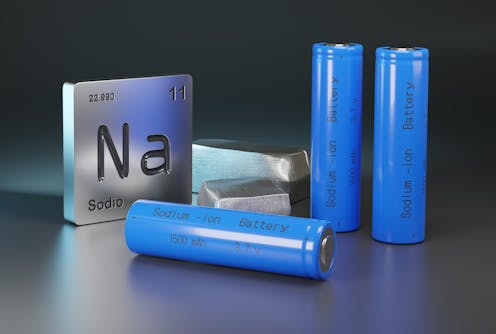
But a new way to firm up the world’s electricity grids is fast developing: sodium-ion batteries. This emerging energy storage technology could be a game-changer – enabling our grids to run on 100% renewables.
Sodium-ion batteries: pros and cons
Energy storage collects excess energy generated by renewables, stores it then releases it on demand, to help ensure a reliable supply. Such facilities provide either short or long-term (more than 100 hours) storage.
At present, lithium-ion batteries are the primary storage technology but are best for short-term storage. Sodium-ion batteries are now almost ready to fill the long-term storage gap.
As the name suggests, sodium-ion batteries contain sodium (symbol Na), an element found in salt. The technology involves the movement of sodium ions between positive and negative poles, which creates a charge.
The technology used in sodium-ion batteries is similar to that of lithium-ion batteries. In fact, as others have noted, factories currently producing lithium batteries could easily and cheaply move to sodium batteries.
And sodium is a far more abundant material than lithium, and potentially cheaper to extract.
Some types of lithium mining require a lot of water and energy and have led to local pollution, such as in South America’s alpine lakes. The pollution issues are far fewer, however, in Australian hard-rock lithium.
The recycling and disposal of lithium batteries is challenging – though much easier than recycling carbon from fossil fuels.
In terms of performance, sodium batteries hold their charge for much longer than lithium batteries.
But as with any technology, sodium-ion batteries present challenges. Sodium ions are bigger and heavier than lithium ions. This means the batteries are less energy-dense than their lithium counterparts, and so require more space and material to store the same amount of charge.
This is improving, however. According to one analysis, the energy density of sodium-based batteries in 2022 was equal to that of lower-end lithium-ion batteries a decade earlier.
And ongoing research and development means their energy-density continues to increase.
Getting to market
As with all promising technologies, a key question for sodium-ion batteries is when they might become widely commercialised.
To answer that, we may look to recent analysis based on a method developed by the Massachusetts Institute of Technology. It suggests sodium-ion batteries are becoming increasingly competitive on cost – and so may enter the global market as early as 2027.
The analysis suggested sodium-ion batteries would soon match the cost of using gas-fired power as a firming energy source.
Similarly, an assessment by the United States energy department in September last year found sodium-ion batteries are “expected to adopt a significant market share by 2030”.
It said the technology could become a competitive replacement for lead-acid or lithium-iron phosphate batteries in both small-scale vehicle electrification and “behind-the-meter” applications such as backing up home solar panel systems.
The analysis found current and planned manufacturing of sodium-ion batteries was concentrated in China and Europe, and several large battery producers were “projecting large-scale manufacturing facilities in the near future”.
They include Chinese electric motor vehicle company BYD, which has reportedly started constructing a sodium-ion battery facility in Xuzhou.
In Australia, United Kingdom-based battery company Faradion installed small stationary modules in Victoria’s Yarra Valley in 2022.
Keeping our options open
A recent plan by the Australian Energy Market Operator (AEMO) suggests coal-fired power will be phased out by 2035. But the plan suggests a significant amount of gas will remain in the grid.
The AEMO analysis did not look at the potential for long-duration energy storage to compete with gas. However, the development of technologies such as sodium-ion batteries suggests we should question AEMO’s assumed need for gas in future.
Disruptive innovations grow quickly and exponentially. We need only look to the annual growth rates for existing clean energy technologies such as solar (29%), wind (14%), electric vehicles (54%) and battery storage (52%).
The Climate Change Authority is currently assessing Australia’s potential technology transition and emission pathways as we head towards net-zero emissions by 2050. Within the review’s scope is to examine which technologies may be deployed in each sector to support emissions reductions.
The potential of sodium-ion batteries suggests policies put forward by the authority should not lock in polluting options for the electricity sector, such as gas-fired power. Cleaner alternatives are likely to be commercial in a few years – and the stability of our climate depends on planning for them.
Authors: Peter Newman, Professor of Sustainability, Curtin University


 Daily Bulletin


