

Want to buy an electric car but unsure you can justify it? Here’s how the arguments against EVs stack up
- Written by: John Rose, Professor of Sustainable Future Transport, University of Sydney
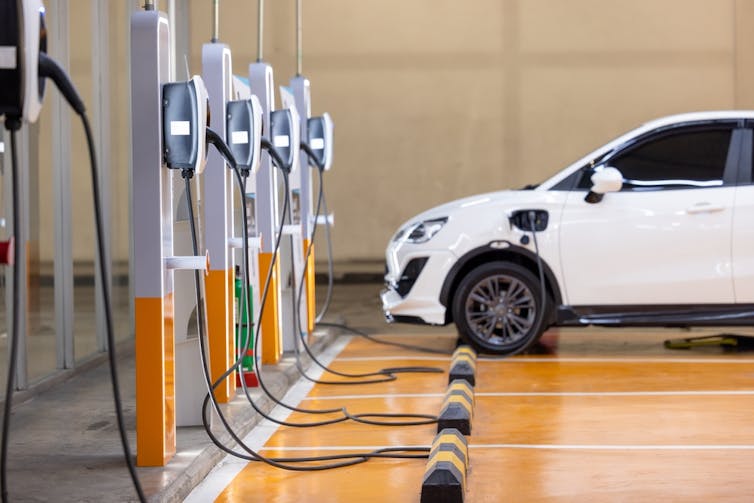
So you’re thinking of buying an electric car. Perhaps you want to save money on fuel, or reduce your greenhouse gas emissions, or both. After all, for Australia to reach net zero it needs to electrify vehicles (and expand public transport use).
But you’ve heard arguments against electric cars: they have limited range and many owners can’t easily charge at home. They cost too much, resale values are poor and insurance costs are higher than for other cars. They’re also heavier and cause more damage to our roads.
Alarmingly, the mining of some minerals used to make them involves modern-day slavery.
Are these concerns warranted? Let’s walk through them.
Driving range
In 2014, an electric vehicle’s top driving range was between 160 and 210 kilometres. Today, most new models can travel 300–600km under real-world conditions.
In Australia, the average privately owned car travels 12,100km a year. That’s about 33.2km a day. Current models have more than enough battery capacity to cover most trips.
Access to chargers
What about longer trips? Many drivers still worry about finding a public charger. It’s common to see long queues at public charging stations (when they are working) or owners searching for a charger.
Public charging infrastructure is struggling to keep up with rising demand. While not an issue for short trips (90% of owners charge at home or work), it’s a challenge for longer travel.
Private home chargers are getting cheaper but not everyone has off-street parking. Some resort to the legally questionable strategy of running power cables over sidewalks or through trees.
Apartment block residents typically have requests to install private chargers rejected for safety reasons (mainly fire risks). Many also can’t install solar panels, which would greatly reduce charging costs.
Purchase costs
While electric vehicles cost more than petrol or diesel vehicles today, this won’t be true in future. In 2023, the average price of a new petrol car in Australia was A$40,916, compared to $117,785 for battery electric vehicles.
But the problem with averages is they’re skewed by outliers. And there are lots of very expensive outliers on the electric vehicle market. You can own a Porsche Taycon Turbo S for $374,000, or a Mercedes-AMG EQS 53 for $327,000.
Three models account for about 70% of electric vehicle sales in Australia: the Telsa Model Y (from $60,900), Tesla Model 3 (from $58,900) and the BYD Atto 3 (from $48,011). The Model 3 entered our market in 2019 at $66,000, so it’s clear prices are dropping, and dropping fast. You can buy the GWM ORA or MG4 Excite MY23 for $39,990.
Prices becoming cheaper is common for most new technology. It’s just we notice it more with electric vehicles because they cost more than most technology we buy, including phones and TVs.
Secondhand value
Concerns about resale value may be justified. In the year to January 2024, the value of used electric vehicles fell 21%, which was more than for fossil fuel vehicles.
A higher initial price does not necessarily carry over to the second-hand market. Early adopters valued EV technology, but most buyers have different priorities.
As the technology improves and misconceptions fade, resale values could rebound.
Insurance costs
Insurance costs are also higher than for other vehicles – typically around 20% more.
The vehicles generally cost more to buy in the first place and newer technology is more costly to produce and replace. The supply chain for parts is still developing, with fewer trained technicians and service centres to maintain these vehicles.
As the market grows and service infrastructure improves, insurance costs should fall.
Environmental damage?
One recent study suggests electric vehicles are actually more environmentally damaging than petrol and diesel vehicles. They are typically heavier, resulting in more tyre wear and heavier braking. As this produces small particulate matter with a diameter of 10 microns (PM10) or less (a typical human hair is 50–70 microns wide), the suggestion is electric vehicles will produce more of it.
But such studies often compare particulate emissions from EVs to tailpipe emissions from their fossil fuel counterparts. They ignore the latter’s tyre and braking concerns, which means comparing apples to oranges. More scientific studies suggest electric vehicles, particularly smaller ones, produce less PM10 from non-exhaust sources than their non-electric equivalents.
Slavery in the supply chain
Unfortunately, the modern-day slavery concern is very real.
Electric vehicle batteries require cobalt. About 70% of the world’s supply comes from the Democratic Republic of Congo. About 20% of this mining activity involves small, informal, subsistence mines with little or no mechanisation and often using child labour.
The minerals from such mines are scattered throughout the world’s supply chains. Those who raise slavery concerns against electric vehicles are usually silent on other affected products such as phones and laptops. Much more must be done to reduce these concerns about battery supply chains.
The good outweighs the bad
On balance, you’re justified in buying an electric vehicle, assuming you want one. Overall operating costs are far lower than for other vehicles. Public charger issues affect a small percentage of trips.
While prices are dropping quickly, this doesn’t mean the bottom is falling out of the market. Price reductions simply represent greater supply of cheaper electric vehicles. Previous market-leading manufacturers can no longer charge hefty premiums for their products.
And demand isn’t decreasing. The share of electric vehicles on the road continues to increase.
Further, the technology is evolving. Trials of vehicle-to-grid charging, where vehicles return power to the grid or directly to a person’s house, have been taking place across Australia. This ability to power your house will help reduce energy bills, saving owners even more money.
Aside from justifiable concerns about human rights abuses, most of the perceived barriers to EV uptake aren’t really barriers at all, or soon won’t be.
Authors: John Rose, Professor of Sustainable Future Transport, University of Sydney


 Daily Bulletin


