

From microbes to mammals: we tracked the rapid rise of new ecosystems as glaciers retreat and ice sheets melt
- Written by: Levan Tielidze, Research Fellow in glacial geomorphology, Monash University
As global temperatures inch upwards year after year, the world’s glaciers retreat. These rivers of ice and the even larger ice sheets which cover Greenland and Antarctica are melting – and the melt is speeding up.
Glaciers and ice sheets have only a few species which can live on them, from ice worms to snow fleas and snow algae. When the ice melts, these species have to retreat with them.
But what happens to the areas the glaciers leave behind? Does life move in?
Our international team of researchers has spent the last decade investigating what happens to the newly uncovered ground as glaciers retreat further up mountain ranges. We tracked what’s happening at 46 retreating glaciers: from the Himalayas to the Andes, from the Arctic archipelago of Svalbard to as far south as New Zealand, and even tropical glaciers in Mexico.
What our new research has found is life quickly moves to colonise these new habitats, from microorganisms to hardy lichens and mosses, to pioneer species such as grasses. More plants arrive – and then, following them, come the animals. Over time, we’ve watched as new ecosystems emerged.
Life finds a way
When a glacier melts, what’s left behind is a barren landscape of bare rock and sediment. Over time, these areas gradually transform into a complex and diverse post-glacial ecosystem.
What we wanted to know was how this happens, how long it takes, and how life goes about colonising new habitat.
Between roughly the 14th and 19th centuries, the world was in the grip of the “Little Ice Age” – a period of moderate cooling largely affecting the northern hemisphere. During this period, many glaciers in this hemisphere expanded.
From the late 19th century onwards, human activities – especially the routine burning of fossil fuels – began to trap more heat and warm the planet, slowly at first but now accelerating.
We chose our glacial landscapes with care, selecting only those glaciers where we could accurately date the beginning of the retreat of the ice using a range of data sources, including topographical maps, field measurements, photographs, paintings, remote imaging and field data. Our team covered many parts of the world, but we did less sampling in polar regions.
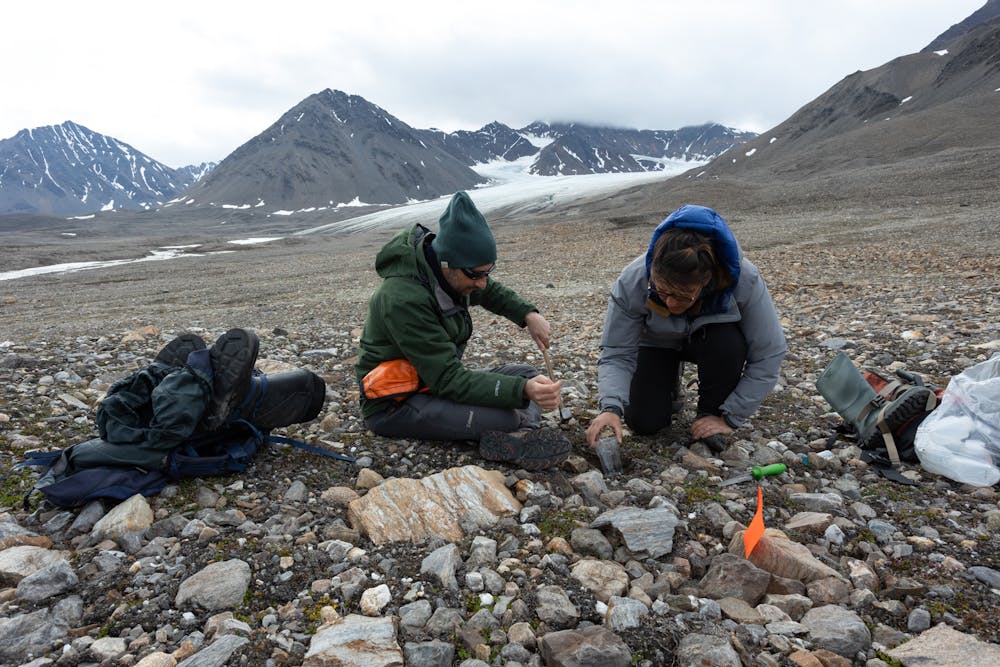
We collected soil samples from more than 1,200 plots across our 46 glaciers and analysed them in the laboratory to track which species arrived when. We tracked ecosystem formation by analysing soil properties and nutrients and the evidence of carbon capture by plants. We also used environmental DNA sampling techniques to capture DNA traces left by animal species to gauge local biodiversity.
We could then cross-reference the arrival of species with when each glacier began to retreat.
What did we find? A surprisingly widespread pattern of ecosystem formation.
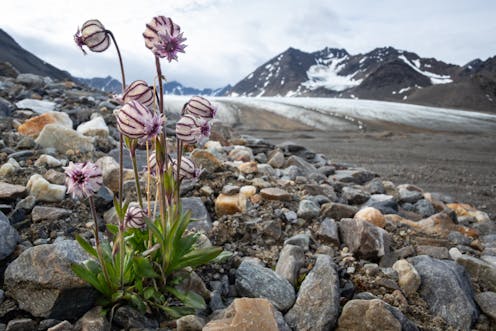
 First microorganisms, then lichens and mosses, and then more complex plants and animals. This photo shows a flowering plant on newly-ice free parts of Iceland, 2019.
Francesco Ficetola, Author provided (no reuse)
First microorganisms, then lichens and mosses, and then more complex plants and animals. This photo shows a flowering plant on newly-ice free parts of Iceland, 2019.
Francesco Ficetola, Author provided (no reuse)
The first lifeforms to arrive were the smallest. Microorganisms such as bacteria, protists and algae colonise the ground. These tiny lifeforms can form surprisingly rich communities all by themselves.
It takes about a decade of colonisation by microorganisms before larger species can arrive. Some microorganisms can make minerals in the rocks available for other species.
Next comes hardy pioneer species such as lichens, mosses, and grasses able to tolerate tough conditions. Even though the ice has gone, these areas are still scoured by wind and cold.
After pioneer species grow and die, they leave behind organic material. This gradually enriches the thin soils. When there’s enough organic matter, more complex plants can take root. Larger animals arrived last, as herbivores need thriving plant communities to survive and predators need prey animals to eat.
How do different species form an ecosystem?
Ecosystems can be very simple through to hugely complex. For instance, on ice-free parts of the Antarctic peninsula, the ecosystem is dominated by mosses and hardy species of tardigrade and springtail.
 After the ice retreated, Antarctic moss moved in. This photo was taken in 2024 on Watson Bluff, a rock area facing the sea on David Island in eastern Antarctica.
Levan Tielidze, Author provided (no reuse)
After the ice retreated, Antarctic moss moved in. This photo was taken in 2024 on Watson Bluff, a rock area facing the sea on David Island in eastern Antarctica.
Levan Tielidze, Author provided (no reuse)
What makes ecosystems become more complex?
As our research shows, the most important feature is time, rather than species interaction. As time passes, more new species are likely to colonise these post-glacial landscapes.
But it’s the interactions between organisms which makes ecosystems function.
Microorganisms often help pioneer plants by accelerating the development of fertile soils. How? Bacteria and fungi break down organic matter from dead plants into simpler compounds. This process creates humus, a rich, fertile component of soil which improves its structure and nutrient content.
In turn, plants create new habitat and food sources for animals. Animals begin to interact with each other, through predator-prey relationships such as arctic foxes and rabbits, or as “ecosystem engineers” such as earthworms, who pave the way for more animals by eating dead plant matter and improving nutrient availability in the soil.
Even in seemingly barren environments, the way organisms interact with each other and their environment can be extremely complex and rich.
Authors: Levan Tielidze, Research Fellow in glacial geomorphology, Monash University


 Daily Bulletin


