

Soft plastics, glass bins and bans on compostable liners: will Victoria’s new recycling proposal be a step forward?
- Written by: Bhavna Middha, ARC DECRA and Senior Research Fellow, Centre for Urban Research, RMIT University
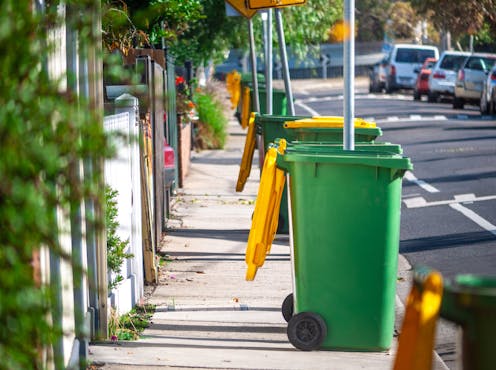
In recent years, the question of what to do with our household waste has become more pressing. In 2018, China stopped accepting many types of recyclable plastic waste from Australia. Four years later, Australia’s main soft plastics recycling scheme, REDcycle, collapsed, leaving behind big stockpiles. Food scraps or non-recyclable plastics in recycling bins slash the value of these waste streams.
This year, Australia’s second most populous state, Victoria, is trying to improve matters with a proposed waste system using four bins across all 79 council areas and its alpine resorts. The state government is seeking your feedback on these changes and how they would be implemented. Our research suggests there’s much to like in these changes, but there are also big sticking points.
What would the new system look like?
Many Victorians will be familiar with the first two bins:
- general rubbish (goes to landfill)
- mixed recycling (goes to various recyclers)
But the two other streams will be new to many, namely:
- glass recycling (goes to glass recyclers)
- food organics and garden organics (goes to councils or other providers to be composted or mulched)
Some councils have already trialled or rolled out all four bins to their residents.
Why would more bins help?
While recycling and reducing waste enjoy widespread support, there’s often a gap between how we feel and what actually happens.
For instance, a survey of 1,000 Australians this year found 89% see recycling as important and 74% of us believe our own recycling practices are good or very good.
But in Victoria, the actual rate of recycling is only 45%. That means more than half of all recyclable materials end up in other waste streams – mainly landfill.
Worse, our waste streams are very often contaminated. If there are meat scraps in the recycling bin, or polystyrene in the food waste bin, the entire truckload may have no recycling or composting value.
Will the government’s proposal improve the situation?
There’s much to like in Victoria’s plan.
Standardised bin colours will help people recognise waste streams even if they move houses.
There will be much-needed clarity over what to do with a pizza box – you will be able to recycle them, if they are shaken out.
Another big plus is proposing to let households throw soft plastics into mixed recycling. However, under the proposal, councils could decide not to offer this service. This is because only some councils have access to soft-plastic recycling at present, which is not ideal.
Glass-only recycling bins will help avoid the common problem of broken bottles contaminating paper in the mixed recycling bin. One issue is Victoria has only just introduced a Container Deposit Scheme offering 10 cents per eligible glass container, which may compete with the glass bin at home, which would not be eligible.

Big gaps remain
There’s not enough focus on reducing waste, especially plastic, in the first place.
Plastic production is soaring and our current plastic recycling options are limited. Many types of plastic can’t be recycled. The recycling process steadily degrades plastics, making all plastic into landfill eventually. It would be far better to focus on cutting demand for virgin plastics.
It would also be better to focus on reusing glass, rather than recycling it, as recycling glass is energy intensive.
Apartment residents also look to miss out. Victoria’s proposed new system would only apply to residents with access to council rubbish services or hard waste collection. Most apartments are privately serviced, meaning they have to contract waste contractors directly. This is expensive, and can lead to issues such as littering
Then there is the issue of compostable kitchen caddy liners. Many of us use these liners to make our food and organic waste bins less gross. But the Victorian plan would ban compostable liners due to concerns over contamination. The concern is real – these liners vary a lot and cannot be guaranteed to actually decompose.
If the ban happens, it’s likely some people will put food waste in their general waste bin to avoid the yuck factor, just as residents did after a similar ban took effect in the United Kingdom.
On the plus side, the proposed changes give clarity over “compostable” and “biodegradable” liners and coffee cups – they cannot be put in the food and organic waste bin.
What should we do?
Redesigning a waste system is hard. Here are some ideas to make the Victorian proposal even better:
The new system should be ubiquitous. The four options should be available on streets, at home, at work and in public places.
Collection sites for the container deposit scheme should be located next to supermarkets to boost convenience and as a backup for housing unable to accommodate glass bins.
Soft plastics recycling should be rolled out statewide. This should be paired with a gradual phase out of hard or impossible to recycle materials and products such as polystyrene and composite materials.
Regulate compostable bin liners so only genuinely biodegradable liners can be sold. In the interim, replace these liners with paper.
Give apartments the same waste options as residents of freestanding houses to avoid further disadvantaging apartment residents. Design better bin-sharing systems with robust ways of ensuring waste streams don’t get contaminated.
 More and more of us live in apartments – but waste services to these buildings is often more expensive.
https://www.shutterstock.com/g/PeterGalleghan
More and more of us live in apartments – but waste services to these buildings is often more expensive.
https://www.shutterstock.com/g/PeterGalleghan
From Victoria to the nation
Our research suggests consistency and standardisation is central to recycling success – not just in Victoria but nationally. At present, there’s great variation across states and territories.
South Australia and New South Wales have three bins, one each for landfill, mixed recycling and green waste. But neither has plans for a glass bin, as South Australia has had a container scheme for 45 years and NSW for around seven.
In Queensland, most households have two bins. Many councils are now rolling out a green and food waste bin. Queensland does not have a glass bin but has made wine and spirit bottles eligible for its container scheme in an Australian first.
To really make our system work, we need federal standardisation – just as New Zealand has done.
Authors: Bhavna Middha, ARC DECRA and Senior Research Fellow, Centre for Urban Research, RMIT University


 Daily Bulletin


