

‘Wake-up call to humanity’: research shows the Great Barrier Reef is the hottest it’s been in 400 years
- Written by: Ben Henley, Lecturer, School of Agriculture, Food and Ecosystem Sciences, The University of Melbourne
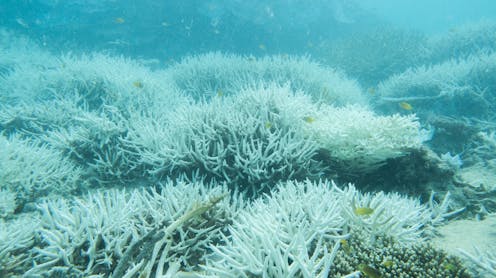
The Great Barrier Reef is vast and spectacular. But repeated mass coral bleachings, driven by high ocean temperatures, are threatening the survival of coral colonies which are the backbone of the reef.
Our study, published today in Nature, provides a new long-term picture of the ocean surface temperatures driving coral bleaching. It shows recent sea surface heat is unprecedented compared to the past 400 years. It also confirms humans are to blame.
The results are sobering confirmation that global warming – caused by human activities – will continue to damage the Great Barrier Reef.
All hope is not lost. But we must face a confronting truth: if humanity does not divert from its current course, our generation will likely witness the demise of one of Earth’s great natural wonders.
One-of-a-kind ecosystem
The Great Barrier Reef is the most extensive coral reef system on Earth. It is home to a phenomenal array of biodiversity, including more than 400 types of coral, 1,500 species of fish and 4,000 types of molluscs, as well as endangered turtles and dugongs.
However, mass coral bleaching over the past three decades has had serious impacts on the reef. Bleaching occurs when corals become so heat-stressed they eject the tiny organisms living inside their tissues. These organisms give coral some of its colour and help power its metabolism.
In mild bleaching events, corals can recover. But in the most recent events, many corals died.
The Great Barrier Reef has suffered five mass bleaching events in the past nine summers. Is this an anomaly, or within the natural variability the reef has experienced in previous centuries? Our research set out to answer this question.
A 400-year-old story
Coral itself can tell us what happened in the past.
As corals grow, the chemistry of their skeleton reflects the ocean conditions at the time – including its temperature. In particular, large boulder-shaped corals, known as Porites, can live for centuries and are excellent recorders of the past.
Our study sought to understand how surface temperatures in the Coral Sea, which includes the reef, have varied over the past four centuries. We focused on the January–March period – the warmest three months on the reef.
First, we collated a network of high-quality, continuous coral records from the region. These records were analysed by coral climate scientists and consist of thousands of measurements of Porites corals from across the Western tropical Pacific.
Drilling a coral skeleton core in the Coral Sea. Source: Tom DeCarlo.From these records, we could reconstruct average surface temperatures for the Coral Sea from the year 1618 to 1995, and calibrate this to modern temperature records from 1900 to 2024. The overall result was alarming.
From 1960 to 2024, we observed annual average summer warming of 0.12°C per decade.
And average sea surface temperatures in 2016, 2017, 2020, 2022 and 2024 were five of the six warmest the region has experienced in four centuries.
Humans are undoubtedly to blame
The next step was to examine the extent to which increased temperatures in the Coral Sea can be attributed to human influence.
To do this, we used published computer model simulations of the Earth’s climate – both with and without human influence, including greenhouse gases from the burning of fossil fuels.
So what did we find? Without human influence, Coral Sea surface temperatures during January–March remain relatively constant since 1900. Add in the human impacts, and the region warms steadily in the early 1900s, then rapidly after the 1960s.
In short: without human-caused global warming, the very high sea temperatures of recent years would be virtually impossible, based on our analysis using the world’s top climate models.
There is worse news. Recent climate projections put us on a path to intensified warming, even when accounting for international commitments to reduce emissions. This places the reef at risk of coral bleaching on a near-annual basis.
Back-to-back bleaching is likely to be catastrophic for the Great Barrier Reef, because it thwarts the chances of corals recovering between bleaching events.
Even if global warming is kept under the Paris Agreement goal of 1.5°C above pre-industrial temperatures, 70% to 90% of corals across the world could be lost.
We must stay focused
The Australian government has a crucial role to play in managing threats to the Great Barrier Reef. The devastation is in their backyard, on their watch.
But what’s happening on the Great Barrier Reef should also be an international wake-up call. The fourth global mass coral bleaching event occurred this year; the Great Barrier Reef is not the only one at risk.
Every fraction of a degree of warming we avoid gives more hope for coral reefs. That’s why the world must stay focused on ambitious action to reduce greenhouse gas emissions.
Emissions reduction targets must be met, at the very least. The solutions are available and our leaders must implement them.
Our research equips society with the scientific evidence for what’s at stake if we don’t act.
The future of one of Earth’s most remarkable ecosystems depends on all of us.
The authors of this piece gratefully acknowledge the contributions of Andrew King, Ariella Arzey, David Karoly, Janice Lough, Tom DeCarlo and Brad Linsley and the producers of the coral data which made this study possible.
Authors: Ben Henley, Lecturer, School of Agriculture, Food and Ecosystem Sciences, The University of Melbourne


 Daily Bulletin


