

How do 4,500 people become 250? The stark reality of life on Japan’s rapidly depopulating Gotō Islands
- Written by: Gwyn McClelland, Senior Lecturer, Japanese Studies, University of New England
Japan’s population crisis isn’t letting up, despite ongoing efforts by its government to boost fertility rates. According to data released in June, birth rates fell for the eighth consecutive year in 2023, reaching a record low.
The data came shortly after a report by the Population Strategy Council warning that 744 of the nation’s 1,729 municipalities were at risk of disappearing by 2050.
The figures – startling as they are – are perhaps unsurprising considering Japan’s fertility rate has been on a decades-long downturn. But what does this feel like for the people who live there?
My research on the remote Gotō Islands of Western Japan, known for the 2018 UNESCO World Heritage sites of the Hidden Christians, provides a window into life in a quickly depopulating place.
A traumatic history
On the island of Hisaka, my interviewees explained how a population of around 4,500 in the 1950s has rapidly fallen to fewer than 250 people today. Arriving here is like travelling to a deep past with no cinemas, no fast food restaurants and few transport alternatives apart from boats.
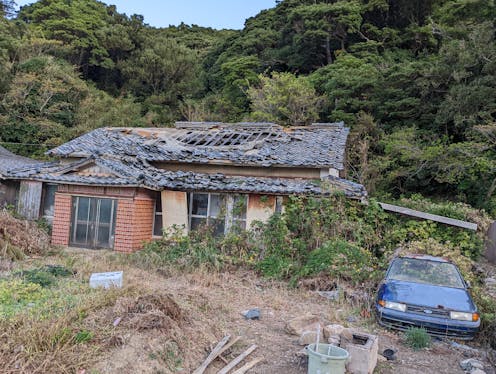
Although they are naturally beautiful and verdant, the Gotō Islands are also marred by the symptoms of depopulation, from abandoned houses to cars and even vending machines.
The return to nature is evident: no people means the roads and houses are overgrown by forests. In some places without human life, wild deer, cattle and boar cause damage to the environment.

Depopulation is not a new problem on the Gotō Islands, which are remembered as the arrival place of Japanese Christians fleeing religious persecution since the late 1700s.
These Hidden Christians originally arrived on the invitation of the local Daimyo, or Lord, to farm the land and make it productive.
In 2018, four locations on the religiously diverse Gotō Islands were named as UNESCO World Heritage sites. These stunning landscapes are now known for their Catholic churches, alongside a traumatic history.
Exploring the Gotō
I have travelled to the Gotō Islands multiple times since 2022. I spoke with the people of the islands – and in particular to the descendants of the famed minority, the Hidden Christians.
Five of the interviews I conducted in this project are now online in both the original Japanese and with English transcripts.
Naru Island Junior High School Principal Miyamoto Kin'ichirō (born 1972) explained to me that when he went to school on the neighbouring island, Hisaka, there were just under 1,000 residents and 43 students at the school.
Today, there are more residents on Naru Island – just under 4,000 – but only 19 students at the school where he works. Kin'ichirō used the Japanese phrase “tonde mo nai” to express his concerns about the future:
In 50 years from now, it will be a situation ‘beyond help’ […] when there are basically no children on the island, and it is only the elderly.
Some islands of the Gotō archipelago are already abandoned.
One afternoon, my interviewee Kuzushima Yoshinobu (born 1956) took me on his boat to see the tiny island of Kazura-shima, which his community left wholesale almost 50 years ago.
He showed me the location of the removed church and a fig tree he had climbed as a child, now surrounded by the remains of the community’s village.
The Hidden Christians, which included Kuzushima’s ancestors, came from the mainland to the Gotō after 1797 in response to a call to repopulate and cultivate the islands’ neglected areas.
While the remote island inlets were inhospitable, they were the perfect place for peasants to hide outlawed Christian religious practices under the umbrella of apparent Shintoism and Buddhism.
The places that were the most difficult for the Hidden Christians to settle at were among the first to become uninhabited in the 20th century.
 Akōgi Hidden Christian Museum on Naru Island, Gotō Islands.
Gwyn McClelland
Akōgi Hidden Christian Museum on Naru Island, Gotō Islands.
Gwyn McClelland
When I asked Hidden Christian descendant Urakami Sachiko (born 1943) about her hopes for the islands, she said:
at this point, I feel like there is no hope. I think that this island [Naru Island] will probably become uninhabited in some decades.
She playfully continued:
the young people who are from this place, I really want them to try a bit harder.
In what is called U-taan (U-turn) in Japanese, Sachiko and others like her returned to the islands later in life after living on the mainland.
One tourist guide and atheist, Iriguchi Hitoshi, showed me maps on which he had scrawled many historical migrations so he could explain the history to tourists.
But he said he was most worried about the most recent migration away from the islands, warning that young people with Hidden Christian and Catholic heritage would lose their faith as they moved to the mainlands.
“Faith’s base-camp is disappearing,” he said.
A history of helping
Not all of the islands have suffered population decline in the same way. Since the pandemic, a number of young and middle-aged people have come from Osaka and Tokyo to live and work remotely on the Gotō.
In 2024, the city of Fukue rejoiced that its number of residents had actually increased. I met some of the young people who brought their families here, found jobs and were welcomed by the locals.
I noted how the people living in these remote places helped each other out and shared resources.
Two of my interviewees and descendants of the Hidden Christians, Miyamoto Fujie and Jitsuo, took me along as they bought vegetables on a neighbouring island and sold them to the villagers of Hisaka Island (where there was no longer a shop) for 100 yen a bag (about A$1).
In fact, while some aspects of the Hidden Christian history include extreme persecution and prejudice, the historical cooperation between Buddhist, Shinto and Hidden Christian communities on the Gotō is one positive aspect of this story.
As explained by Sakatani Nobuko, a Buddhist guide (and collaborator on my project) on Hisaka Island:
because there is that history of helping each other as well as the difficult, the history is very rich.
 The Gotō islands are beautiful and verdant, with many abandoned dwellings now overgrown with forest.
Gwyn McClelland
The Gotō islands are beautiful and verdant, with many abandoned dwellings now overgrown with forest.
Gwyn McClelland
Authors: Gwyn McClelland, Senior Lecturer, Japanese Studies, University of New England


 Daily Bulletin


