

Read The Times Australia

Daily Bulletin

Earth’s oldest, tiniest creatures are poised to be climate change winners – and the repercussions could be huge

  • Written by: Ryan Heneghan, Lecturer in Environmental Modelling, Griffith University
fish in net

The world’s oceans are home to microscopic organisms invisible to the human eye. The tiny creatures, known as “prokaryotes”, comprise 30% of life in the world’s oceans.

These organisms play an important role in keeping the oceans in balance. But new research by myself and colleagues shows this balance is at risk.

We found prokaryotes are remarkably resilient to climate change – and as a result, could increasingly dominate marine environments.

This could reduce the availability of fish humans rely on for food, and hamper the ocean’s ability to absorb carbon emissions.

fish in net
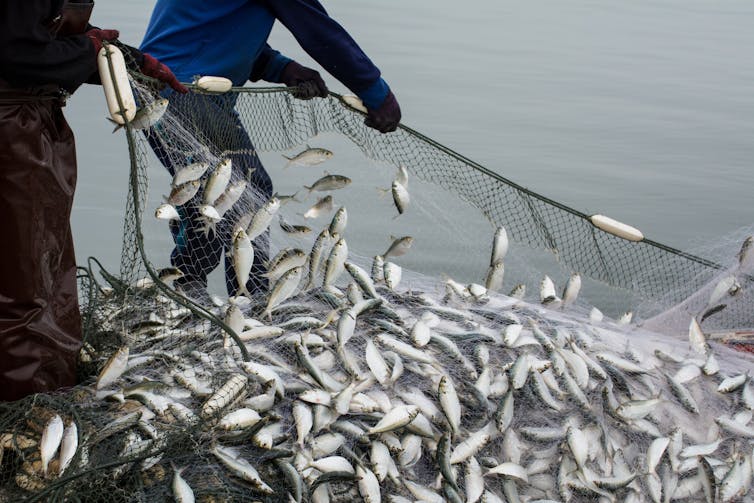
Greater dominance of prokaryotes could reduce the availability of fish humans rely on for food. Shutterstock

A fine balance

Prokaryotes include both bacteria and “archaea”, another type of single-celled organism.

These organisms are thought to be the oldest cell-based lifeforms on Earth. They thrive across the entire planet – on land and in water, from the tropics to the poles.

What prokaryotes lack in size they make up in sheer abundance. Globally, about two tonnes of marine prokaryotes exist for every human on the planet.

They play a crucial role in the world’s food chains, helping support the nutrient needs of fish humans catch and eat.

Marine prokaryotes grow extremely fast – a process that emits a lot of carbon. In fact, prokaryotes to an ocean depth of 200 metres produce about 20 billion tonnes of carbon a year: double that of humans.

This massive carbon output is balanced by phytoplankton – another type of microscopic organism which turns sunlight and carbon dioxide into energy, through photosynthesis.

Phytoplankton and other ocean processes also absorb up to one-third of the carbon humans release into the atmosphere each year. This helps limit the pace of global warming.

How prokaryotes respond to warming is key to understanding how the fine balance of the world’s oceans may change in a warmer world. This was the focus of our research.

A 3D illustration of marine bacteria.
Prokaryotes are thought to be the oldest cell-based lifeforms on Earth. Pictured: a 3D illustration of marine bacteria. Shutterstock

What we found

We wanted to predict how climate change would affect the “biomass”, or total global weight, of marine prokaryotes. We also wanted to examine how it would affect their carbon output.

To do this, we built computer models that integrated decades of observations from dozens of scientific surveys across the world’s oceans.

So what did we find? Prokaryotes are likely to be climate change winners, relative to other marine life.

For each degree of ocean warming, their biomass will decline by about 1.5%. This is less than half the projected 3–5% decline we predicted for larger plankton, fish and mammals.

It means future marine ecosystems will have lower overall biomass, and will increasingly be dominated by prokaryotes. This could divert a greater share of available nutrients and energy toward prokaryotes and away from fish, reducing the supply of fish humans eat.

We discovered another important change. For every degree of warming, we predict prokaryotes in the top 200 metres of the world’s oceans would produce an additional 800 million tonnes of carbon per year.

This is equivalent to the present-day emissions of the entire European Union (after converting CO₂ to carbon).

plankton
The biomass of prokaryotes will decline less than plankton. Shutterstock

What does all this mean?

Due to human-caused climate change, Earth’s oceans are expected to warm by between 1°C and 3°C by the end of this century, unless humanity changes course.

If the amount of carbon produced by prokaryotes does increase as predicted, it could reduce the potential of oceans to absorb human emissions. This means achieving global net-zero emissions will become even more difficult.

What’s more, present projections of declines in global fish stocks under climate change generally do not consider how warming may restructure marine food webs by favouring prokaryotes. This means the predicted declines are likely to be underestimated.

Declines in fish populations present a major problem for global food supply, because the oceans are a major source of protein for about 3 billion people.

What should happen now

Our analysis is an important step in uncovering the changing role of marine prokaryotes. But significant uncertainties remain.

Our analysis is built with existing observations. Climate change is already changing conditions in marine ecosystems in ways our models may not have captured.

We also don’t know how quickly prokaryotes will adapt and evolve to new environments. But existing research shows that in a matter of weeks, bacteria can develop new traits that make it easier for them to survive.

Clearly, scientists must continue to improve their understanding of prokaryotes, and how they may be affected by climate change.

Authors: Ryan Heneghan, Lecturer in Environmental Modelling, Griffith University

Read more https://theconversation.com/earths-oldest-tiniest-creatures-are-poised-to-be-climate-change-winners-and-the-repercussions-could-be-huge-235115

Business News

The Rise of Digital Marketplaces in the Australian Trade Sector

For decades, the Australian trade and construction sector operated almost entirely on word-of-mouth recommendations and local community networks. Small business owners typically relied on local newspa...

Daily Bulletin - avatar Daily Bulletin

How Immigration Lawyers Can Help

Introduction Visa decisions can shape employment, family life, study plans, travel, and future residence. A small omission can lead to delay, added expense, or refusal. Immigration lawyers assess l...

Daily Bulletin - avatar Daily Bulletin

How Industrial Drying Equipment Supports Efficient Processing

Many industrial processes require moisture to be removed from compressed air, products or process materials before they move to the next stage. Excess moisture can affect equipment performance, produc...

Daily Bulletin - avatar Daily Bulletin

Practical Ways a Whiteboard Can Improve Workplace Communication

Effective communication helps teams stay organised, share ideas and keep track of important information. While digital tools are now common in many workplaces, a whiteboard continues to provide a simp...

Daily Bulletin - avatar Daily Bulletin

Designing Eco-Friendly Custom Water Bottles for Your Next Event

The Evolution of Sustainable Event Merchandise Event planning has undergone a massive transformation over the last decade. Gone are the days when organizers could hand out cheap, single use plastic...

Daily Bulletin - avatar Daily Bulletin

Why Choosing a Professional Florist Melbourne Makes Flower Delivery Impactful

Flowers have a great power to speak when humans cannot express their feelings with right words. Flowers are the best gifts when you are celebrating a birthday or welcoming a newborn child into your fa...

Daily Bulletin - avatar Daily Bulletin

The Business Case for Choosing Australian Fabricators Over Imported Alternatives

For a long time, you might have defaulted to overseas suppliers when sourcing fabricated metal components for a project. The unit price was lower on paper, and the maths seemed straightforward. That...

Daily Bulletin - avatar Daily Bulletin

Australian organisations are relying on business continuity plans built for a far more predictable world

Tariff escalations, supply chain fragility, geopolitical events, and the ongoing threat of cyber disruption have reshaped the risk environment facing Australian organisations. The problem is that ma...

Daily Bulletin - avatar Daily Bulletin

How to Rent a Car for Uber in Melbourne: What Every New Driver Needs to Know

Starting out as an Uber driver in Melbourne is not as complicated as it sounds but getting the vehicle right is where most new drivers get stuck. Uber has strict requirements around vehicle age, condi...

Daily Bulletin - avatar Daily Bulletin

The Daily Magazine

Architectural Window Shading: Solutions for Triangle Blinds, Raked Glazing, and High Ceilings

Mastering Light and Privacy with Specialized Window Coverings Modern architectural de...

From Suburban Streets to Modern Events: Why Australians Still Love the Ice Cream Truck

Did you know Australia consistently ranks among the world's highest ice cream-consuming countries? ...

Will These Bloody Kids Ever Move Out? The Resurrection of the Duplex Says No

Whilst Baby Boomers and Gen Xer’s typically finished school, got a job and moved out of home relativ...

Critical Structural Checks to Prioritise Before Renovating an Older Property

The Australian home renovation market is experiencing unprecedented growth. The total value of thi...

Why Regular Gutter Cleaning Northern Beaches Is Important

Living in the Northern Beaches offers beautiful coastal scenery, fresh air, and leafy surroundings...

Double Glazed Sliding Doors vs Standard Sliding Doors: Key Differences

Sliding doors are a popular choice in modern homes due to their space-saving design and ability to...

How to Plan a Bathroom Renovation Timeline (Without Surprises)

A bathroom renovation rarely feels “small” once work begins. Even modest updates involve multiple ...

What “Extraction Facial” Actually Means (And When It Helps)

“Extraction facial” is one of those skincare terms people use as if it’s one standard treatment, b...

How Compounded Medicines Support Individual Health Needs

Not every patient responds to medicine in the same way. Age, allergies, dosage requirements and sw...