

Heaviest antimatter observation yet will fine-tune numbers for dark matter search
- Written by: Ulrik Egede, Professor of Physics, Monash University
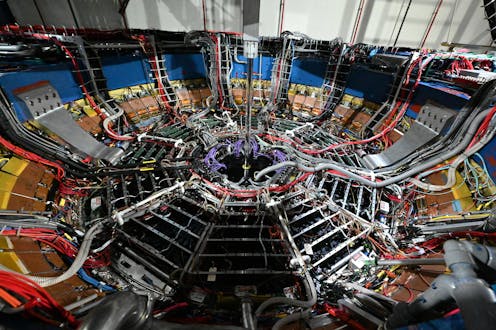
In experiments at the Brookhaven National Lab in the US, an international team of physicists has detected the heaviest “anti-nuclei” ever seen. The tiny, short-lived objects are composed of exotic antimatter particles.
The measurements of how often these entities are produced and their properties confirms our current understanding of the nature of antimatter, and will help the search for another mysterious kind of particles – dark matter – in deep space.
The results are published today in Nature.
A missing mirror world
The idea of antimatter is less than a century old. In 1928, British physicist Paul Dirac developed a very accurate theory for the behaviour of electrons that made a disturbing prediction: the existence of electrons with negative energy, which would have made the stable universe we live in impossible.
Luckily scientists found an alternative explanation for these “negative energy” states: antielectrons, or twins of the electron with the opposite electric charge. Antielectrons were duly discovered in experiments in 1932, and since then scientists have found that all fundamental particles have their own antimatter equivalents.
However, this raises another question. Antielectrons, antiprotons and antineutrons should be able to combine to make whole antiatoms, and indeed antiplanets and antigalaxies. What’s more, our theories of the Big Bang suggest equal amounts of matter and antimatter must have been created at the beginning of the universe.
But everywhere we look, we see matter – and only insignificant amounts of antimatter. Where did the antimatter go? That is a question that has vexed scientists for nearly a century.
Fragments of smashed atoms
Today’s results come from the STAR experiment, located at the Relativistic Heavy Ion Collider at Brookhaven National Lab in the US.
The experiment works by smashing the cores of heavy elements such as uranium into one another at extremely high speed. These collisions create tiny, intense fireballs which briefly replicate the conditions of the universe in the first few milliseconds after the Big Bang.
Each collision produces hundreds of new particles, and the STAR experiment can detect them all. Most of those particles are short-lived, unstable entities called pions, but ever so occasionally something more interesting turns up.
In the STAR detector, particles zoom through a large container full of gas inside a magnetic field – and leave visible trails in their wake. By measuring the “thickness” of the trails and how much they bend in the magnetic field, scientists can work out what kind of particle produced it.
Matter and antimatter have an opposite charge, so their paths will bend in opposite directions in the magnetic field.
‘Antihyperhydrogen’
In nature, the nuclei of atoms are made of protons and neutrons. However, we can also make something called a “hypernucleus”, in which one of the neutrons is replaced by a hyperon – a slightly heavier version of the neutron.
What they detected at the STAR experiment was a hypernucleus made of antimatter, or an antihypernucleus. In fact, it was the heaviest and most exotic antimatter nucleus ever seen.
To be specific, it consists of one antiproton, two antineutrons and an antihyperon, and has the name of antihyperhydrogen-4. Among the billions of pions produced, the STAR researchers identified just 16 antihyperhydrogen-4 nuclei.
Results confirm predictions
The new paper compares these new and heaviest antinuclei as well as a host of other lighter antinuclei to their counterparts in normal matter. The hypernuclei are all unstable and decay after about a tenth of a nanosecond.
Comparing the hypernuclei with their corresponding antihypernuclei, we see that they have identical lifetimes and masses – which is exactly what we would expect from Dirac’s theory.
Existing theories also do a good job of predicting how lighter antihypernuclei are produced more often, and heavier ones more rarely.
A shadow world as well?
Antimatter also has fascinating links to another exotic substance, dark matter. From observations, we know dark matter permeates the universe and is five times more prevalent than normal matter – but we have never been able to detect it directly.
Some theories of dark matter predict that if two dark matter particles collide, they will annihilate each other and produce a burst of matter and antimatter particles. This would then produce antihydrogen and antihelium – and an experiment called the Alpha Magnetic Spectrometer aboard the International Space Station is looking out for it.
If we did observe antihelium in space, how would we know if it had been produced by dark matter or normal matter? Well, measurements like this new one from STAR let us calibrate our theoretical models for how much antimatter is produced in collisions of normal matter. This latest paper provides a wealth of data for that type of calibration.
Basic questions remain
We have learned a lot about antimatter over the past century. However, we are still no closer to answering the question of why we see so little of it in the universe.
The STAR experiment is far from alone in the quest to understand the nature of antimatter and where it all went. Work at experiments such as LHCb and Alice at the Large Hadron Collider in Switzerland will enhance our understanding by looking for signs of differences in behaviour between matter and antimatter.
Perhaps by 2032, when the centenary of the initial discovery of antimatter rolls around, we will have made some strides in understanding the place of this curious mirror matter in the universe – and even know how it is connected the enigma of dark matter.
Authors: Ulrik Egede, Professor of Physics, Monash University


 Daily Bulletin


