

Read The Times Australia

Daily Bulletin

85% of the matter in the universe is missing. But we’re getting closer to finding it

  • Written by: Theresa Fruth, Lecturer in Physics, University of Sydney
85% of the matter in the universe is missing. But we’re getting closer to finding it

Most of the matter in the universe is missing. Scientists believe around 85% of the matter in the cosmos is made of invisible dark matter, which has only been detected indirectly by its gravitational effects on its surroundings.

My colleagues and I – a team of some 250 scientists from around the world working on a dark matter experiment called LUX-ZEPLIN (or LZ) – today report our latest findings from the long quest to discover exactly what this dark matter is made of.

We have not yet found the elusive particles we believe dark matter consists of, but we have set the tightest limits yet on their properties. We have also shown our detector is working as expected – and should produce even better results in the future.

Our results are reported today at the TeV Particle Astrophysics 2024 conference in Chicago and the LIDINE 2024 conference in São Paulo, Brazil. A journal paper will be submitted for peer review in the coming weeks.

What is dark matter?

When astronomers look at the universe, they see evidence that the visible matter of stars, gas and galaxies is not all there is. Many phenomena, such as how fast galaxies spin and the pattern of the residual glow of the Big Bang, can only be explained by the presence of large amounts of some invisible substance – dark matter.

So what is this dark matter made of? We currently don’t know of any kind of particle that could explain these astronomical observations.

Photo of a person wearing a full-body white suit in a lab next to a large white cylinder.
The central detector of the LZ experiment in an above-ground lab before delivery underground. Matthew Kapust / Sanford Underground Research Facility

There are dozens of theories that aim to explain dark matter observations, ranging from exotic unknown particles to tiny black holes or fundamental changes to our theory of gravity. However, none of them has yet been proven correct.

One of the most popular theories suggests dark matter is made up of so-called “weakly interacting massive particles” (or WIMPs). These relatively heavy particles could cause the observed gravitational effects and also – very rarely – interact with ordinary matter.

How would we know if this theory is correct? Well, we think these particles must be streaming through Earth all the time. For the most part, they will pass through without interacting with anything, but every so often a WIMP might crash directly into the nucleus of an atom – and these collisions are what we are trying to spot.

A big cold tank of liquid xenon

The LZ experiment is located in an old goldmine about 1,500 metres below ground in South Dakota in the US. Placing the experiment deep underground helps to cut out as much background radiation as possible.

The experiment consists of a large double-walled tank filled with seven tonnes of liquid xenon, a noble gas chilled down to a temperature of 175 kelvin (–98°C).

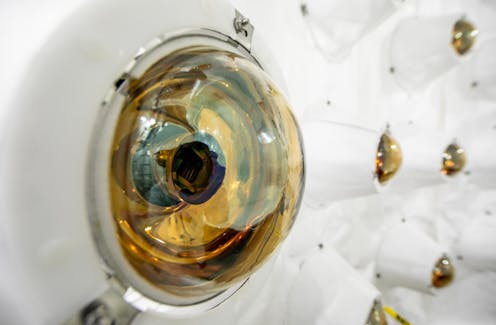
If a dark matter particle smacks into a xenon nucleus, it should give off a tiny flash of light. Our detector has 494 light sensors to detect these flashes.

Scientists complete building the sensor array for the LZ experiment.

Of course, dark matter particles aren’t the only things that can create these flashes. There is still some background radiation from the surroundings and even the materials of the tank and detectors themselves.

A big part of figuring out whether we are seeing signs of dark matter is disentangling this background radiation from anything more exotic. To do this, we make detailed simulations of the results we would expect to see with and without dark matter.

These simulations have been the focus of much of my part in the experiment, which began when I started my PhD in 2015. I also developed detector monitoring sensors and was responsible for the integration and commissioning of the central detector underground, which began collecting data in 2021.

Drawing the net tighter

Our latest results show no signs of dark matter. However, they let us rule out a lot of possibilities.

We found no traces of particles with masses above 1.6 × 10⁻²⁶ kilograms, which is about ten times as heavy as a proton.

These results are based on 280 days’ worth of observations from the detector. Eventually, we aim to collect 1,000 days’ worth – which will let us search for even more elusive potential dark matter particles.

If we’re lucky, we might find dark matter turns up in the new data. If not, we have already begun to make plans for a next generation dark matter experiment. The XLZD (XENON-LUX-ZEPLIN-DARWIN) consortium is aiming to build a detector almost ten times bigger that would allow us to trawl through even more of the space where these ubiquitous yet elusive particles may be hiding.

Authors: Theresa Fruth, Lecturer in Physics, University of Sydney

Read more https://theconversation.com/85-of-the-matter-in-the-universe-is-missing-but-were-getting-closer-to-finding-it-237459

Business News

Reducing Sales Friction Through Centralized Content Delivery

Sales friction appears whenever buyers or sales teams face unnecessary obstacles in the buying journey. It can happen when information is hard to find, when messaging feels inconsistent, when product ...

Daily Bulletin - avatar Daily Bulletin

Why Choosing the Right Bollard Supplier Matters for Australian Businesses and Public Spaces

From busy CBD streetscapes to sprawling warehouse loading docks, bollards have become one of the most essential safety and security fixtures across Australia. Whether protecting pedestrians from veh...

Daily Bulletin - avatar Daily Bulletin

Why Modular Content Is Transforming Modern Marketing Teams

Modern marketing teams are expected to produce more content than ever before. They need to support websites, landing pages, email campaigns, social channels, product pages, sales enablement material...

Daily Bulletin - avatar Daily Bulletin

Everything You Need to Know About Getting Support from Optus

Whether you've been an Optus customer for years or you've just switched over, at some point you'll probably need to contact their support team. Maybe your bill looks different from what you expected. ...

Daily Bulletin - avatar Daily Bulletin

The Marketing Strategy That’s Quietly Draining Sydney Business Owners’ Bank Accounts

Sydney businesses are investing more in digital marketing than ever before. The intention is clear. More visibility should mean more leads, more customers, and steady growth. However, many business ...

Daily Bulletin - avatar Daily Bulletin

Why Mining Hose Solutions Are Essential For High-Performance Industrial Operations

In environments where the ground itself is constantly shifting, breaking, and being reshaped, every component must be built to endure. Mining operations are among the most demanding in the industria...

Daily Bulletin - avatar Daily Bulletin

The Reason Talented Teams Underperform

If you’re in business, you might have seen it before. A team of capable and smart people just suddenly slows down, and things start spiraling out of control. On paper, everything looks perfect, but ...

Daily Bulletin - avatar Daily Bulletin

Why More Aussie Tradies Are Moving Away From Paid Ads

Across Australia, a lot of tradies are busy. There’s no shortage of demand in industries like plumbing, electrical, landscaping, and building. But being busy doesn’t always mean running a smooth or...

Daily Bulletin - avatar Daily Bulletin

Why Careers In The Defence Industry Are Growing Rapidly

The defence sector has evolved far beyond traditional roles, opening doors to a wide range of opportunities across technology, engineering, intelligence, and operations. This is where defense industry...

Daily Bulletin - avatar Daily Bulletin

The Daily Magazine

Australia’s Best Walking Trails and the Shoes You Need to Tackle Them

Australia is not short on spectacular walks. You can follow ocean cliffs in Victoria, cross ancien...

Why Pre-Purchase Building Inspections Are Essential Before Buying a Home in Australia

source Have you ever walked through an open home and started picturing your furniture, family d...

5 Signs Your Car Needs Immediate Attention Before It Breaks Down

Car problems rarely appear without warning. In most cases, your vehicle gives clear signals before...

Ensuring Safety and Efficiency with Professional Electrical Solutions

For businesses in Newcastle, a safe and fully functioning workplace remains a key part of day-to-d...

Choosing The Right Bin Hire Solution For Hassle-Free Waste Management

When it comes to managing waste efficiently, finding the right solution can save both time and eff...

Why Cleanliness Is Critical In Childcare Environments

Children explore the world with curiosity, often touching surfaces, sharing toys, and interacting ...

What to Look for in a Reliable Australian Engineering Partner

Choosing an engineering partner is rarely just about technical capability. Most businesses can fin...

How to Choose a Funeral Home That Supports Families with Care

Choosing a funeral home is rarely something families do under ideal circumstances. It often happen...

Why Premium Coffee Matters in Modern Hospitality Venues

In hospitality, details shape perception long before a guest consciously evaluates them.  Lightin...