

Vital green spaces are disappearing in NZ cities – what can central and local government do?
- Written by: Paul Blaschke, Honorary Research Associate, Te Herenga Waka — Victoria University of Wellington
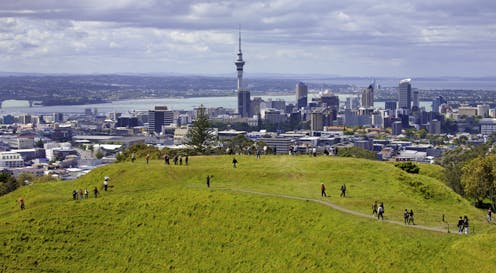
Urban green spaces are disappearing from New Zealand cities, at a time when denser housing is being planned in many areas.
Overall, the total area of green space is reasonable in New Zealand cities because they are relatively small by world standards. But our new research shows complex links between urban intensification and the availability of green spaces.
It highlights that Aotearoa’s cities have experienced significant loss of green space over recent decades, often concentrated on private land as a consequence of subdivisions and paving within residential lots.
We also show uneven distribution of green spaces between and within cities.
This is concerning because surveys show city residents value green spaces highly for recreation, social interaction and cultural practices. Access to parks and nature strips is also vital for people’s health and wellbeing.
Pressures on urban green space
Cyclone Gabrielle and the devastating floods of 2023 underlined the benefits of green spaces for urban resilience. About 13% of New Zealand’s population live in flood-prone areas and this proportion will grow as flooding becomes more frequent due to climate change.
This has focused attention on the idea of “sponge cities”, an urban design concept that emphasises the use of parks, gardens and other “green infrastructure” for stormwater and flood management, rather than relying purely on hard infrastructure such as drainage systems.
For green spaces to benefit urban resilience, they must be accessible and well-placed within cityscapes and communities. Flooding-related resilience increases when they are situated appropriately – for example in valleys or hollows where flood waters can safely accumulate. It’s not enough to have ample green space on the outskirts of cities or in steep town green belts.
However, the push for higher density in response to the housing crisis puts pressure on maintaining green spaces, let alone creating new ones, especially where land is scarce or expensive. This all adds to the pressure on council budgets, competing with other priorities for infrastructure provision in cities.
Our research shows both a loss and uneven distribution of urban green spaces.
For example, Wellington’s urban areas have twice as much land with tree cover than in Auckland and Hamilton. The variation between different parts of the same city is even more striking. Some Hamilton suburbs have up to eight times more green space than others. In Wellington, nearby parts of the city centre also differ dramatically.
In Auckland, private green space per person decreased by approximately 20% between 1980 and 2016. Given the forecast population growth over the coming decades in parts of most cities, these losses will become even more acute.
Inequities in access
This trend is compounding already significant inequities in access to urban green spaces and its benefits. This is important given 87% of us live in cities.
In line with international literature, more affluent suburbs typically enjoy more green space per person, closer to where people live. In some of the studies we reviewed, inequities in access reflect inequities in health and wellbeing.
Research in Christchurch shows residents of more economically and socially vulnerable neighbourhoods have access to fewer ecosystem services (the benefits people get from nature). This includes flooding mitigation, improved air quality, shade, and public and private green spaces. The researchers conclude the distribution of urban ecosystem services disadvantages more vulnerable residents.
There are also important design and quality issues for green spaces. Many parks and other public green spaces suffer from deferred maintenance due to stretched council budgets. This can make physical access (steps, paths) more difficult, particularly for people with impaired mobility.
A further issue is the increasing prevalence of hard surfaces, impervious to water. Central Wellington has one of the highest rates of paved surfaces in public spaces. This trend is also seen on private residential lots where former garden or lawn areas have been paved over for driveways or hard courtyards.
This is more than an aesthetic issue, given the critical importance of permeable surfaces for draining heavy rain and floodwaters.
How to do better
All these considerations should be taken into account if we want to improve the effectiveness of urban green spaces. Based on our research, we recommend the following.
Urban green spaces must be considered essential assets for the wellbeing of all residents and as a climate adaptation strategy. Their provision and quality should be protected and strengthened through council policy. Many useful policy initiatives exist and could be strengthened, but current policy is highly variable between councils.
Over-stretched councils can’t be expected to make up for the loss of private green spaces through subdivisions and urban intensification, as encouraged at all levels of government. Policies must require adequate provision of green infrastructure.
Strategic creative design can incorporate green space within medium and high-density development cost effectively, if supported by the right policies. This may include green roofs and walls integrated in buildings.
Continued investment in the provision and maintenance of green spaces is crucial even while cities build more homes and make infrastructure more secure.
Authors: Paul Blaschke, Honorary Research Associate, Te Herenga Waka — Victoria University of Wellington


 Daily Bulletin


