

In 2025, let’s make it game on – not game over – for our precious natural world
- Written by: Darcy Watchorn, Threatened Species Biologist, Wildlife Conservation & Science Department, Zoos Victoria, and Visiting Scholar, School of Life & Environmental Science, Deakin University
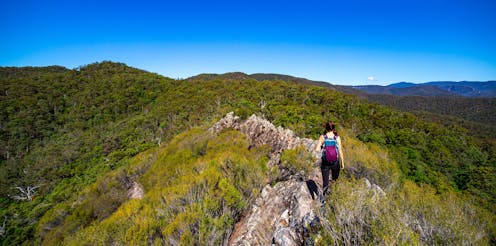
It’s just past midnight in the cool, ancient forests of Tasmania. We’ve spent a long day and night surveying endangered Tasmanian devils. All around, small animals scurry through bushes. A devil calls in the darkness. Microbats swoop and swirl as a spotted-tailed quoll slips through the shadows. Working here is spine-tingling and electric.
Weeks later, we’re in a moonlit forest in Victoria. It was logged a few years earlier and burnt by bushfire a few decades before that. The old trees are gone. So too are the quolls, bats and moths that once dwelled in their hollows. Invasive blackberry chokes what remains. The silence is deafening, and devastating.
In our work as field biologists, we often desperately wish we saw a place before it was cleared, logged, burnt or overtaken by invasive species. Other times, we hold back tears as we read about the latest environmental catastrophe, overwhelmed by anger and frustration. Perhaps you know this feeling of grief?
The new year is a chance to reflect on the past and consider future possibilities. Perhaps we’ll sign up to the gym, spend more time with family, or – perish the thought – finally get to the dentist.
But let us also set a New Year’s resolution for nature. Let’s make a personal pledge to care for beetles and butterflies, rainforests and reefs, for ourselves, and for future generations. Because now, more than ever — when the natural world seems to be on the precipice — it’s not too late to be a catalyst for positive change.

A trail of destruction
Our work brings us up close to the beauty of nature. We trek through deserts, stumble through forests and trudge over snowy mountains to study and conserve Australia’s unique wildlife.
But we must also confront devastating destruction. The underlying purpose of our work – trying to save species before it is too late – is almost always heartbreaking. It is a race we cannot always win.
Since Europeans arrived in Australia, much of the country has become severely degraded.
Around 40% of our forests and 99% of grasslands have been cut down and cleared, and much of what remains is under threat. Thousands of ecological communities, plants and animal species are threatened with extinction.
 Australia’s forests have been razed since Europeans arrived. Pictured: cleared land near Dorrigo, New South Wales. The photo first appeared in The Sydney Mail and New South Wales Advertiser in September 1907.
Trove
Australia’s forests have been razed since Europeans arrived. Pictured: cleared land near Dorrigo, New South Wales. The photo first appeared in The Sydney Mail and New South Wales Advertiser in September 1907.
Trove
And it seems the news only gets worse. The global average temperature for the past decade is the warmest on record, about 1.2°C above the pre-industrial average. Severe bushfires are more and more likely. Yet Australia’s federal government recently approved four coalmine expansions.
Australia remains a global logging and deforestation hotspot. We have the world’s worst record for mammal extinctions and lead the world in arresting climate and environment protesters.
To top it off, a recent study estimated more than 9,000 native Australian animals, mostly invertebrates, have gone extinct since European arrival. That’s between one and three species every week.
Many will never be formally listed, named or known. Is this how the world ends – not with a bang, but with a silent invertebrate apocalypse?
 More than 9,000 native Australian animals, mostly invertebrates, have gone extinct since European arrival. Pictured: the Kangaroo Island forester moth, which was badly affected by the Black Summer fires.
David A. Young
More than 9,000 native Australian animals, mostly invertebrates, have gone extinct since European arrival. Pictured: the Kangaroo Island forester moth, which was badly affected by the Black Summer fires.
David A. Young
This destruction provokes ecological grief
The degradation of our environment affects more than distant plants and animals. It resonates deeply with many humans, too.
Ecological grief is an emotional response to environmental degradation and climate change, damaging our mental health and wellbeing. It can manifest as sadness, anxiety, despair or helplessness. Or it might bring a profound sense of guilt that we all, directly or indirectly, contribute to the problems facing the natural world.
Academic research on ecological grief is growing rapidly, but the concept has been around for decades.
In 1949, American writer and philosopher Aldo Leopold – widely considered the father of wildlife ecology and modern conservation – eloquently wrote in his book A Sand County Almanac that:
One of the penalties of an ecological education is that one lives alone in a world of wounds. Much of the damage inflicted on land is quite invisible to laymen. An ecologist must either harden his shell and make believe that the consequences of science are none of his business, or he must be the doctor who sees the marks of death in a community that believes itself well and does not want to be told otherwise.
Ecological grief is certainly a heavy burden. But it can also be a catalyst for change.
Turning grief into action
So how do we unlock the transformative potential of ecological grief?
In our experience, it first helps to share our experience with colleagues, friends and family. It’s important to know others have similar feelings and that we are not alone.
Next, remember that it is not too late to act – passivity is the enemy of positive change. It’s vital to value and protect what remains, and restore what we can.
Taking action doesn’t just help nature, it’s also a powerful way to combat feelings of helplessness and grief. It might involve helping local wildlife, supporting environmental causes, reducing meat consumption, or – perhaps most importantly – lobbying political representatives to demand change.
Lastly, for environmental professionals such as us, celebrating wins – no matter how small – can help buoy us to fight another day.
We are encouraged by our proud memories of helping return the mainland eastern barred bandicoot to the wild. The species was declared extinct on mainland Australia in 2013. After more than three decades of conservation action, it was taken off the “extinct in the wild list” in 2021, a first for an Australian threatened species.
 Our colleague Dr Amy Coetsee releasing an eastern barred bandicoot.
Zoos Victoria
Our colleague Dr Amy Coetsee releasing an eastern barred bandicoot.
Zoos Victoria
Our work to support mountain pygmy-possum populations after the Black Summer fires helped to ease our grief at the loss of so many forests, as did seeing the end of native forest logging in Victoria a year ago.
So, for our New Year’s resolution, let’s harness our ecological grief to bring about positive change. Let’s renew the fight to return those lost voices, and protect our remaining ancient ecosystems. We can, and must, do better – because so much depends on it.
And maybe, just maybe, we’ll finally get to the dentist.
Authors: Darcy Watchorn, Threatened Species Biologist, Wildlife Conservation & Science Department, Zoos Victoria, and Visiting Scholar, School of Life & Environmental Science, Deakin University


 Daily Bulletin


