

Read The Times Australia

Daily Bulletin

Monarch butterflies are in decline in NZ and Australia – they need your help to track where they gather

  • Written by: Myron Zalucki, Professor in Biological Sciences, The University of Queensland
Monarch butterflies are in decline in NZ and Australia – they need your help to track where they gather

Monarch butterflies (Danaus plexippus) appear to be declining not just in North America but also in Australiasia. Could this be a consequence of global change, including climate change, the intensification of agriculture, and urbanisation?

We need more citizen scientists to monitor what is really going on.

Insect populations, even species that seemed impervious, are in decline globally. Monarch butterflies exemplify the problem. Once a very common species, numbers have declined dramatically in North America, engendering keen public interest in restoring populations.

The monarch butterfly is an iconic species. It is usually the species people recall when drawing a butterfly and observations are shared frequently on the online social network iNaturalist.

This is partly because monarch images are used in advertising, but the butterflies are also a species of choice for school biology classes and television documentaries on animal migration.

Monarchs in the southern hemisphere

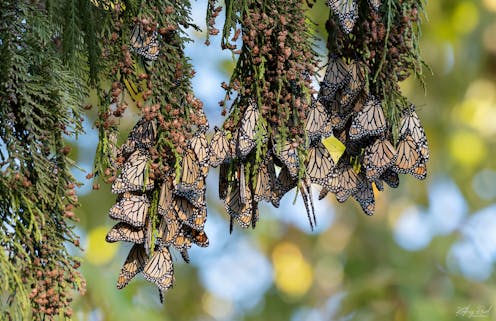
Monarch butterfies hanging off a branch
Monarchs expanded their range to reach Australia and New Zealand during the mid-1800s. Kathy Reid, CC BY-SA

The monarch butterfly’s ancestral home in North America is noted for an annual mass migration and spectacular overwintering of adults in fir forests in a few locations in Mexico, at densities of 50 million per hectare, and at multiple sites in Southern California. These sites are monitored to track the decline.

What is not as well known is that this butterfly greatly extended its range, spreading across the Pacific in the mid-1800s to reach Australia and New Zealand by riding on storms that blew in from New Caledonia.

The species is now part of the roadside scene in these countries and was once known as “the wanderer” – reflecting its propensity to fly across the landscape in search of milkweed plants (known as swan plants in New Zealand). In both countries, monarchs lay eggs on introduced milkweed species for their caterpillars to feed and develop. They take up the plant’s toxins as part of their own defence.

Interestingly, in their expanded range in the southern hemisphere, monarchs have adapted their migration patterns to suit local conditions. They have established overwinter sites – places where large numbers of adults congregate on trees throughout winter.

Need for citizen science

In Australia, the late entomologist Courtenay Smithers organised people to report these sites and participate in a mark-recapture programme. Essentially, this involves attaching a small unique identifying tag to the wing, noting the age and condition of the butterfly and the date and location of capture.

If the same individual is then recaptured sometime later and the information shared, it provides valuable data on survival and the distance and direction it moved, and even population size. This volunteer tagging programme enabled many aspects of the monarch’s ecology in Australia to be documented, but it was discontinued a few years ago.

Moths and Butterflies Australasia now hosts the butterfly database and has become an umbrella group for encouraging everyone with a mobile phone to get involved and report and record sightings.

Monarch butterflies hanging off a ginkgo tree.
Monarchs have established wintering sites in New Zealand and Australia. Kathy Reid, CC BY-SA

A similar programme is run in New Zealand by the Moths and Butterflies of New Zealand Trust. Monarch overwintering sites and local breeding populations have been documented over the years. Alas, these data sets have been short term and haphazard.

What is intriguing is that populations appear to have declined in Australia and New Zealand, perhaps reflecting climate variability, expanding cities gobbling up local breeding habitats, and the intensification of agriculture.

What we need is reliable long-term data on adult numbers. Hence the call to reinvigorate interest in mark-recapture and reporting. We need the help of people who love the outdoors and love the monarch butterfly to become citizen scientists.

A Monarch butterfly with a tag on its wing
Citizen scientists are needed to help with tagging monarch butterflies. Anna Barnett, CC BY-SA

The Moths and Butterflies of New Zealand Trust is asking individuals, groups and schools to tag monarch butterflies late in the autumn when the butterflies head for their overwintering habitat. This is a great project for schools, involving students in real science and addressing an environmental issue.

Each tag has a unique code. A computer system calculates the distance the monarch has flown and the time it took to get there. This information can then be collated with weather data to get a clearer picture of what is happening.

We hope people will spot tagged monarchs in their gardens and record where the butterfly was sighted, together with its tag number.

The author wishes to thank Washington State University entomologist David James and Moths and Butterflies of New Zealand trustee Jacqui Knight for their input, and Australian National University ecologist Michael Braby for comments.

Authors: Myron Zalucki, Professor in Biological Sciences, The University of Queensland

Read more https://theconversation.com/monarch-butterflies-are-in-decline-in-nz-and-australia-they-need-your-help-to-track-where-they-gather-244384

Business News

Designing Eco-Friendly Custom Water Bottles for Your Next Event

The Evolution of Sustainable Event Merchandise Event planning has undergone a massive transformation over the last decade. Gone are the days when organizers could hand out cheap, single use plastic...

Daily Bulletin - avatar Daily Bulletin

Why Choosing a Professional Florist Melbourne Makes Flower Delivery Impactful

Flowers have a great power to speak when humans cannot express their feelings with right words. Flowers are the best gifts when you are celebrating a birthday or welcoming a newborn child into your fa...

Daily Bulletin - avatar Daily Bulletin

The Business Case for Choosing Australian Fabricators Over Imported Alternatives

For a long time, you might have defaulted to overseas suppliers when sourcing fabricated metal components for a project. The unit price was lower on paper, and the maths seemed straightforward. That...

Daily Bulletin - avatar Daily Bulletin

Australian organisations are relying on business continuity plans built for a far more predictable world

Tariff escalations, supply chain fragility, geopolitical events, and the ongoing threat of cyber disruption have reshaped the risk environment facing Australian organisations. The problem is that ma...

Daily Bulletin - avatar Daily Bulletin

How to Rent a Car for Uber in Melbourne: What Every New Driver Needs to Know

Starting out as an Uber driver in Melbourne is not as complicated as it sounds but getting the vehicle right is where most new drivers get stuck. Uber has strict requirements around vehicle age, condi...

Daily Bulletin - avatar Daily Bulletin

When Should You Speak to a Lawyer About a Legal Issue?

Legal issues can begin with a simple question, then become harder to manage once formal steps are involved. Many people wait until a matter feels urgent before seeking guidance, even though earlier ...

Daily Bulletin - avatar Daily Bulletin

The strategic rise of Bali as Australia’s next essential healthcare support hub

As Australian healthcare providers grapple with unprecedented operational bottlenecks, a new nearshore model is quietly transforming patient care delivery. Forward-thinking organisations,  including...

Daily Bulletin - avatar Daily Bulletin

Cost Savings and Benefits of Using Used Pallets in Logistics

In today’s competitive logistics and supply chain industry, businesses are constantly looking for ways to reduce operational costs without compromising efficiency and reliability. One of the most prac...

Daily Bulletin - avatar Daily Bulletin

How Fulfilment Services in Australia Help Businesses Scale Efficiently

The growth of e-commerce and modern retail has transformed customer expectations. Consumers now expect fast shipping, accurate order processing, and seamless delivery experiences regardless of where...

Daily Bulletin - avatar Daily Bulletin

The Daily Magazine

Why a Cordless Rebar Tying Machine Is a Smart Investment for Australian Construction Projects

Tying reinforcing steel by hand means spending hours bent over while making the same twisting moti...

How to Get a Document Notarised in Sydney: What to Bring, What It Costs and How Long It Takes

If an overseas bank, embassy, university, employer or land registry has asked you for a notarised ...

The 2026 Used-Car Market

For a few strange years, the used-car market rewrote its own rules. Supply shortages sent second-h...

Why CCTV Alone Is Not Enough for Modern Business Security

Cameras are usually the initial step that companies take to strengthen their physical security. If...

Why Every Workplace Should Take Emergency Preparedness Seriously

Emergency planning is one of those things many workplaces know they should think about, but it oft...

Why Clearer Communication Still Matters in a Digital-First Business

It’s never been easier for businesses to communicate, but that doesn’t mean they’re always communica...

What Happens After You Lodge a BYDA Enquiry? The Step Most Excavation Projects Miss

Every excavation project in Australia — from a backyard deck footing to a multi-storey commercial bu...

How to Choose the Right Dentist on the Gold Coast

Finding a dentist you trust is one of those decisions that quietly affects your health for years, ye...

The Hidden Engineering Problem Inside Australia's Older Housing Stock

A significant share of Australian homes were built for a way of living that no longer exists. Houses...