

Read The Times Australia

Daily Bulletin

Monarch butterflies are in decline in NZ and Australia – they need your help to track where they gather

  • Written by: Myron Zalucki, Professor in Biological Sciences, The University of Queensland
Monarch butterflies are in decline in NZ and Australia – they need your help to track where they gather

Monarch butterflies (Danaus plexippus) appear to be declining not just in North America but also in Australiasia. Could this be a consequence of global change, including climate change, the intensification of agriculture, and urbanisation?

We need more citizen scientists to monitor what is really going on.

Insect populations, even species that seemed impervious, are in decline globally. Monarch butterflies exemplify the problem. Once a very common species, numbers have declined dramatically in North America, engendering keen public interest in restoring populations.

The monarch butterfly is an iconic species. It is usually the species people recall when drawing a butterfly and observations are shared frequently on the online social network iNaturalist.

This is partly because monarch images are used in advertising, but the butterflies are also a species of choice for school biology classes and television documentaries on animal migration.

Monarchs in the southern hemisphere

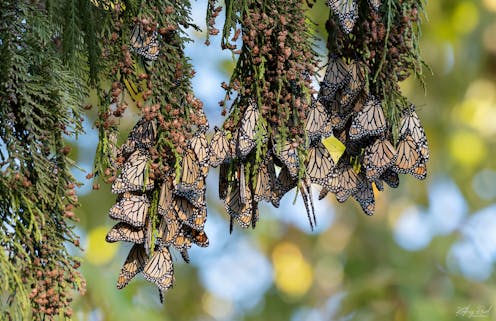
Monarch butterfies hanging off a branch
Monarchs expanded their range to reach Australia and New Zealand during the mid-1800s. Kathy Reid, CC BY-SA

The monarch butterfly’s ancestral home in North America is noted for an annual mass migration and spectacular overwintering of adults in fir forests in a few locations in Mexico, at densities of 50 million per hectare, and at multiple sites in Southern California. These sites are monitored to track the decline.

What is not as well known is that this butterfly greatly extended its range, spreading across the Pacific in the mid-1800s to reach Australia and New Zealand by riding on storms that blew in from New Caledonia.

The species is now part of the roadside scene in these countries and was once known as “the wanderer” – reflecting its propensity to fly across the landscape in search of milkweed plants (known as swan plants in New Zealand). In both countries, monarchs lay eggs on introduced milkweed species for their caterpillars to feed and develop. They take up the plant’s toxins as part of their own defence.

Interestingly, in their expanded range in the southern hemisphere, monarchs have adapted their migration patterns to suit local conditions. They have established overwinter sites – places where large numbers of adults congregate on trees throughout winter.

Need for citizen science

In Australia, the late entomologist Courtenay Smithers organised people to report these sites and participate in a mark-recapture programme. Essentially, this involves attaching a small unique identifying tag to the wing, noting the age and condition of the butterfly and the date and location of capture.

If the same individual is then recaptured sometime later and the information shared, it provides valuable data on survival and the distance and direction it moved, and even population size. This volunteer tagging programme enabled many aspects of the monarch’s ecology in Australia to be documented, but it was discontinued a few years ago.

Moths and Butterflies Australasia now hosts the butterfly database and has become an umbrella group for encouraging everyone with a mobile phone to get involved and report and record sightings.

Monarch butterflies hanging off a ginkgo tree.
Monarchs have established wintering sites in New Zealand and Australia. Kathy Reid, CC BY-SA

A similar programme is run in New Zealand by the Moths and Butterflies of New Zealand Trust. Monarch overwintering sites and local breeding populations have been documented over the years. Alas, these data sets have been short term and haphazard.

What is intriguing is that populations appear to have declined in Australia and New Zealand, perhaps reflecting climate variability, expanding cities gobbling up local breeding habitats, and the intensification of agriculture.

What we need is reliable long-term data on adult numbers. Hence the call to reinvigorate interest in mark-recapture and reporting. We need the help of people who love the outdoors and love the monarch butterfly to become citizen scientists.

A Monarch butterfly with a tag on its wing
Citizen scientists are needed to help with tagging monarch butterflies. Anna Barnett, CC BY-SA

The Moths and Butterflies of New Zealand Trust is asking individuals, groups and schools to tag monarch butterflies late in the autumn when the butterflies head for their overwintering habitat. This is a great project for schools, involving students in real science and addressing an environmental issue.

Each tag has a unique code. A computer system calculates the distance the monarch has flown and the time it took to get there. This information can then be collated with weather data to get a clearer picture of what is happening.

We hope people will spot tagged monarchs in their gardens and record where the butterfly was sighted, together with its tag number.

The author wishes to thank Washington State University entomologist David James and Moths and Butterflies of New Zealand trustee Jacqui Knight for their input, and Australian National University ecologist Michael Braby for comments.

Authors: Myron Zalucki, Professor in Biological Sciences, The University of Queensland

Read more https://theconversation.com/monarch-butterflies-are-in-decline-in-nz-and-australia-they-need-your-help-to-track-where-they-gather-244384

Business News

Inside the Icon: The BridgeMuseum Officially Opens at the Sydney Harbour Bridge

A bold new way to experience one of Australia’s most recognisable landmarks has arrived, with BridgeClimb Sydney officially opening the all-new BridgeMuseum.  Located inside the Sydney Harbour Brid...

Daily Bulletin - avatar Daily Bulletin

Is Your Brand Showing Up in AI Search? Most Melbourne Brands Aren't.

The New Front Door Nobody Told You About Something changed. Quietly. Without a press release. The way buyers find businesses in Australia has been rewired. Not replaced, rewired. Google isn't dead...

Daily Bulletin - avatar Daily Bulletin

How Australian Businesses Can Measure SEO ROI

SEO can feel vague when you are staring at a dashboard full of numbers that do not clearly connect to revenue. The key is to measure the right signals in the right order, then tie them back to outcome...

Daily Bulletin - avatar Daily Bulletin

How Commercial Roller Shutters Improve Site Security Without Slowing Operations

Security upgrades can be frustrating when they make everyday work harder. A door that takes too long to open, creates bottlenecks at shift change, or fails at the worst time can turn “better protectio...

Daily Bulletin - avatar Daily Bulletin

Why a Document Destruction Service Still Matters for Modern Businesses

Businesses generate large volumes of information every day, from staff records and contracts to invoices, reports and customer files. While attention often focuses on how documents are stored, the way...

Daily Bulletin - avatar Daily Bulletin

Bicycle Rack Safety and Space-Smart Storage

Bike storage problems usually show up as small annoyances first: tangled handlebars, scratched frames, and bikes that topple when you pull one out. Over time, those issues become safety risks, especia...

Daily Bulletin - avatar Daily Bulletin

How to Tell if a Childcare Centre Is a Good Fit for Your Child

Choosing childcare can feel like you’re making a huge decision with limited information. Tours are short, centres are often on their best behaviour, and your child might act differently in a new space...

Daily Bulletin - avatar Daily Bulletin

Car Import Timeline: What Usually Happens at Each Stage

Importing a car into Australia can feel confusing because multiple agencies and checkpoints are involved, and the timeline is shaped as much by paperwork quality as it is by shipping speed. The most u...

Daily Bulletin - avatar Daily Bulletin

Portable Toilet Hygiene Standards Explained: Clean vs Sanitised vs Disinfected

In portable toilet servicing, the words clean, sanitised, and disinfected often get used as if they mean the same thing. They don’t. And that difference matters because a unit can look tidy and still ...

Daily Bulletin - avatar Daily Bulletin

The Daily Magazine

What Actually Makes a Good Criminal Lawyer in Melbourne

Most people only think about this question once. That is usually too late. Most people charged wi...

Why Working With A Chatswood Tutor Can Improve Academic Performance

Academic expectations continue increasing for students across primary school, high school, and senio...

Is It Worth Getting Solar Panels in Melbourne?

The real question is not whether solar works in Melbourne. It works. The question is what it is co...

How A Diploma Of Project Management Builds Practical Skills For Modern Work Environments

Developing the ability to plan, execute, and deliver outcomes efficiently is a key requirement in to...

How to Choose the Right Football for Every Level

Choosing a football may seem straightforward, but the right option depends on who will be using it a...

What to Ask a Wedding Photographer Before You Book

Booking a wedding photographer can feel deceptively simple: you like the photos, you like the vibe...

Why Stress Relief For Dogs Is Essential For Emotional Balance And Long-Term Wellbeing

Managing emotional health is just as important as physical care when it comes to pets, which is why ...

Australia’s Best Walking Trails and the Shoes You Need to Tackle Them

Australia is not short on spectacular walks. You can follow ocean cliffs in Victoria, cross ancien...

Why Pre-Purchase Building Inspections Are Essential Before Buying a Home in Australia

source Have you ever walked through an open home and started picturing your furniture, family d...