

Fruit and veg, exercise, frequent bloodletting and more tips on staying healthy from medieval travellers
- Written by: Megan Cassidy-Welch, Professor of History and Dean of Research Strategy, University of Divinity
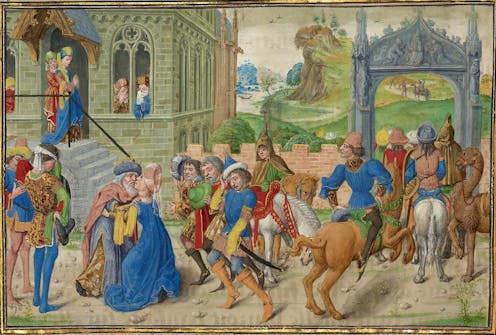
Travellers have always faced health hazards when far from home. Medieval people were no exception. Pilgrims, crusaders and others were warned by preachers such as 13th century Jacques de Vitry of “dangers on land, dangers at sea, the dangers of thieves, the dangers of predators, the dangers of battles”.
There were also dangers to health: disease, lack of good nutrition and water, injury, accident and poisoning. Medieval travellers were active and innovative in trying to prevent ill health while away.
Although the adjective “medieval” continues to be used disparagingly to imply backwardness in medical and scientific knowledge, this history of preventive medicine shows us something different.
From good sleep to ‘good’ leeches
One especially interesting set of practical health care instructions for travellers is the De regimine et via itineris et fine peregrinatium (About the regimen and way of the journey for the traveller). The text was composed by Adam of Cremona in about 1227–28 for the German emperor Frederick II, who was about to set out on crusade.
Unedited and surviving in a single manuscript, Adam draws heavily on Ibn Sina’s 11th century Canon of Medicine, used for medical teaching in medieval universities.
Adam advised bloodletting (phlebotomy) should be performed prior to the emperor’s journey and then regularly throughout, depending on the “will and mood” of the stars.
Bloodletting was central to medieval medical practice. It used leeches or sharp knife-like instruments to nick the vein and cause blood to drain from the body. It was performed both preventatively and, in the case of some medieval religious communities, periodically as part of monastic bodily regulation and discipline.
Devoting some 25 chapters of his text to phlebotomy, Adam drew on the idea that bloodletting would regulate the humours (the four fluids thought to make up the body: blood, yellow bile, black bile and phlegm), evacuating “bad” ones and setting the body in balance to prepare for healthy travel.
While the concept of the four humours has since been abandoned by modern medicine, bloodletting and “leech therapy” continue to be performed in some medical settings for specific purposes.

Adam advised all travellers should be mindful of the instruments of bloodletting – especially leeches – while on the road. His writing included warnings to distinguish between leeches: good (round and shiny) and bad (black or blue in colour and found near fetid water).
He also gave careful instruction on how to desalinate water, as well as advice about diet (as close as possible to the traveller’s home diet, with plenty of fruit and vegetables), the importance of rest and adequate sleep, and the importance of regular bathing.
Dysentery was a well known hazard of travel, especially for crusaders, and Adam’s guide reflected all travellers’ wish to avoid it by keeping the digestive system in balance.
Balancing body and spirit
Knowledge about water supplies was especially important for travellers.
One pilgrimage guide informed travellers one of the best sources of water in the holy land was just outside Haifa, in modern-day Israel.
Theodoric’s Guide for the Holy Land reminded travellers there was no water in Jerusalem other than the rainwater collected by inhabitants and stored in cisterns for daily use.
Medieval travellers were also reminded to take particular care of their feet. In 1260, Vincent of Beauvais gave instructions to travellers to use poultices (a dressing for wounds) made of oil, plants and quicksilver (mercury) to prevent and manage blisters – an all too frequent ailment experienced by pilgrims walking long distances.
 Vincent of Beauvais depicted into Speculum historiale, late 15th century.
Wikimedia Commons/British Library
Vincent of Beauvais depicted into Speculum historiale, late 15th century.
Wikimedia Commons/British Library
Adam of Cremona suggested travellers regulate their pace as they walked, especially on unfamiliar and rough roads.
The overall benefit of exercise was generally understood. Preachers such as Jacques de Vitry told his congregations movement made the body healthy both physically and spiritually, so should be undertaken regularly before and during a journey.
Different climates and environments meant encounters with dangerous fauna. The holy land was said to be home to poisonous serpents.
Travellers took with them theriac, an antidote made in part from snake flesh in case of a bite. This would be ingested or smeared on the wound.
Crocodiles in Egypt were also often mentioned as a hazard. There were no antidotes for an attack, but forewarning travellers with knowledge helped them to remain alert.
Medieval travellers did not leave their fate entirely in God’s hands. Even the crusaders took precautionary measures to balance both bodily and spiritual health before and during their journeys.
 Designed by Domenico Paradisi, woven at the San Michele, The Crusaders Reach Jerusalem (from a set of Scenes from Gerusalemme Liberata), designed 1689–93, woven 1732–39.
The Met
Designed by Domenico Paradisi, woven at the San Michele, The Crusaders Reach Jerusalem (from a set of Scenes from Gerusalemme Liberata), designed 1689–93, woven 1732–39.
The Met
They confessed sins, sought blessings to protect their property and baggage and carried with them charms and amulets that were thought to ensure “the health of body and protection of the soul”, as one 12th century Italian blessing explained. This “divine prophylaxis” ran alongside more practical care of the physical body – a holistic view of health as corporeal and spiritual.
The actions and remedies available to medieval pilgrims and other travellers may seem limited and perhaps dangerous to modern readers. But like all travellers, medieval people used the knowledge they had and tried hard to maintain good health in sometimes difficult conditions.
The urge to remain well is a very human one, and its long medieval history reminds us that good health has always been carefully managed through prevention just as much as cure.
Authors: Megan Cassidy-Welch, Professor of History and Dean of Research Strategy, University of Divinity


 Daily Bulletin


