

History under the floorboards: decoding the diets of institutionalised women in 19th century Sydney
- Written by: Kimberley Connor, Postdoctoral Scholar at Stanford Archaeology Center, Stanford University
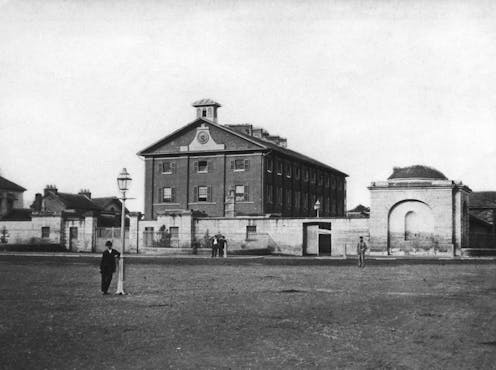
Sydney’s Hyde Park Barracks was built between 1817 and 1819 to house male convicts.
The barracks is World Heritage Listed for its convict history, but is equally important for the story of 19th century Australian immigration.
After the end of convict transportation to New South Wales, the Hyde Park Barracks became home to the Female Immigration Depot (1848–87) and the Female Destitute Asylum (1862–86).
The depot housed newly arrived unmarried women and girls who came to New South Wales on subsidised tickets. The asylum was for women who couldn’t support themselves because of age, illness or disability.
Official records for the two female institutions suggest the women who stayed there ate a monotonous diet of bread, tea and meat (roasted or boiled into soup) in the dining rooms.
My new archaeological research published in Antiquity tells a different story. Dried plant materials found under the floorboards of the upstairs dormitories show inhabitants were eating a range of fresh fruits, nuts, vegetables and even spices.
This research sheds new light on the diets of settlers in 19th century Sydney and the importance of combining documentary research with archaeology to understand the history of institutions where official records alone can’t tell the whole story.
More than a monotonous diet
The women and girls who stayed in the Female Immigration Depot and the Female Destitute Asylum found a safe place to stay, with a bed and three meals a day.
But they also had to live by strict rules under the supervision of a matron, and had to do most of the cooking and cleaning to keep the institutions running.
Eyewitness accounts, government reports and official records tell us the meals served in the dining rooms were monotonous: bread and tea for breakfast and supper, and a soup made of boiled meat and vegetables with yet more bread for dinner (served at lunch time), the main meal of the day.

On special occasions, such as Christmas, the meat might be roasted and supplemented with puddings, fresh fruit and extra tobacco. But if that was what inhabitants were eating, why did archaeologists find thousands of fruit seeds and nut shells under the floorboards?
In the 1980s, archaeologists excavated parts of the courtyard as well as inside the building itself. As renovations started on the floorboards on the second and third floors of the building, archaeologists found tens of thousands of objects dropped or hidden beneath floorboards.
Like much of the archaeological collection, the botanical remains were not analysed systematically at the time of excavation. Now, my new analysis of the dried plant remains in the Hyde Park Barracks museum’s collection reveals women who stayed in these institutions supplemented the bland meals they were served.

Maybe they foraged fresh peaches on the way back from church, or bought peanuts from peddlers at the gates, or worked within the asylum for an extra ration of tobacco.
In an environment where everyone ate the same thing at the same time, these off-menu items were probably a way of expressing personal preferences and building relationships through sharing or bartering.
Food from home and away
Many of the foods the women were acquiring would have been familiar to immigrants from Britain.
The most common items I found were pits from stone fruit including peaches or nectarines, plums, cherries and apricots. There was also evidence for apples or pears, grapes, dates, hazelnuts, walnuts and citrus fruit.
Other foods introduced from South America, the Pacific and Southeast Asia, like an annonaceous fruit (like a modern custard apple), Brazil nuts, coconut, and lychees might have been unfamiliar to the British migrants. These plants, alongside pumpkin, chili pepper and corn originally from the Americas, highlight how Australia was part of global networks of plant exchanges.
 The seed pod of a woody pear labelled with the botanical name Xylomelum pyriforme.
Kimberley Connor
The seed pod of a woody pear labelled with the botanical name Xylomelum pyriforme.
Kimberley Connor
The women were also learning about native Australian plants. A single fragment of macadamia shell is probably the only direct evidence of consumption of a native plant, but the women were collecting bottlebrush and tea tree.
The most interesting example is a complete woody pear, the seed pod of a shrub native to Australia’s east coast. Someone at Hyde Park Barracks carefully collected this specimen and labelled it with the botanical name Xylomelum pyriforme, revealing an interest in Australian botany.
A look at the lives of women
While we can’t connect individual people to individual plant remains at Hyde Park Barracks, we can catch glimpses of the lives of the women who stayed there.
A beautifully preserved rose must have been special to somebody who carefully kept it safe by placing it under the floorboards.
Groups of citrus peel or the seeds from something like a cherimoya hint at illicit meals, with the evidence hidden away from the matron’s watchful eye.
And maybe a whole chili pepper, still bright red, tells us about someone who liked to spice up their meals.
Each seed gets us a little bit closer to the lives of the women of Sydney 150 years ago.
Authors: Kimberley Connor, Postdoctoral Scholar at Stanford Archaeology Center, Stanford University


 Daily Bulletin


