

80 years after the liberation of Auschwitz, amid rising antisemitism, the memory of the Holocaust remains contentious
- Written by: Jan Lanicek, Associate Professor in Modern European History and Jewish History, UNSW Sydney
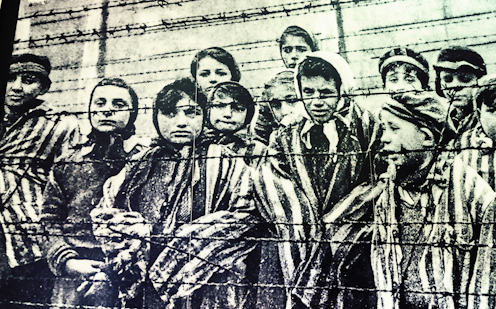
On January 27 2025, political dignitaries and Holocaust survivors will gather in Oswiecim (Auschwitz) in Poland. They will attend the commemoration of the 80th anniversary of the liberation of the concentration camps by the Red Army.
Auschwitz was a major network of Nazi concentration and death camps in occupied Poland during the second world war. It has become the preeminent symbol of the Holocaust. Some 1.1 million people, 90% of them Jews, were murdered in the Auschwitz-Birkenau network of camps. In 2005, the United Nations established January 27 as International Holocaust Remembrance Day.
Australia will be represented by high-ranking politicians. The Minister of Foreign Affairs Penny Wong and Attorney General Mark Dreyfus will attend the ceremony. They will be accompanied by Jillian Segal, the recently appointed Australian special envoy to combat antisemitism.
The Department of Foreign Affairs and Trade issued a statement that “it is vital that the lessons of the past continue to be learnt to ensure this never happens again”. It also praises “the remarkable contribution” Jewish survivors and their descendants made to Australia.
Not all countries will be represented by their political leaders. A major controversy has surrounded the visit of the Israeli delegation. In November 2024, the International Criminal Court in the Hague issued an arrest warrant for Israeli prime minister Benjamin Netanyahu, accusing him of “war crimes” and “crimes against humanity”. Poland is a member state of the ICC and would be obliged to arrest Netanyahu. Although the Polish government guaranteed Netanyahu’s safety, he will not be attending the ceremony.
Representatives of the Russian Federation, the successor state of the Soviet Union, whose military liberated Auschwitz, will not be among the guests. This is a consequence of the ongoing large-scale Russian military invasion of Ukraine that started in February 2022.
In an unusual decision, the Auschwitz memorial decided that politicians would not deliver speeches. The focus will be on the remaining survivors, “their pain, their trauma and their way to offer us some difficult moral obligations for the present”.
These controversies and decisions reflect the challenges that accompany Holocaust remembrance 80 years after the end of the war. In 2025, we commemorate the Holocaust at a time when the last survivors, the “custodians of Holocaust memory”, are passing.
It is also a time where our television screens provide daily reminders of rising antisemitism in Australia and elsewhere, a conflict in the Middle East with global repercussions, and examples of Australia’s continuing struggle to come to terms with its colonial past.

Antisemitism in Australia
The Nazis and their collaborators murdered some six million Jews and millions of other victims.
Close to 10,000 Jewish refugees escaped to Australia before and during WWII. This included around 2,000 German-Jewish detainees sent to Australia from Britain on the HMT Dunera in 1940. More could have come, but the government was unwilling to accept large numbers of non-British migrants.
Antisemitism played a role as well. At the Evian Conference on refugees in July 1938, the Australian representative Thomas H. White proclaimed that Australia had “no real racial problem, we are not desirous of importing one by encouraging any scheme of large scale foreign migration”.
In 2018, the Australian parliament passed a motion that
issued a profound apology and says “sorry” to the Jewish people for the indifference shown by the Parliament in 1938 that worsened the impact of the Holocaust.
After 1945, Australia accepted the second largest number of Holocaust survivors per capita after the state of Israel. Historians estimate at least 27,000 arrived by 1961. They were part of a major transformation in Australian migration policies after WWII.
Once in Australia, they contributed to all sectors of society as model citizens. In public memory, Australia has prided itself on providing a haven for these destitute survivors who for years languished in the Displaced Persons camps of postwar Europe.
The 80th anniversary of the liberation of Auschwitz is being commemorated in the shadow of rising antisemitism in Australia and globally. While antisemitism has a long history in Australia, the past 18 months has witnessed a sharp increase in antisemitic incidents, following the October 7 2023 Hamas attacks and the subsequent war in Gaza.
In recent months, places of worship, private homes, vehicles and a kindergarten have been vandalised and torched. There were even suspected targeted attacks against Jewish community leaders. The eminent Australian Holocaust historian and survivor, Konrad Kwiet has commented that “the safe season for Jewish people is ending”.
Some journalists and dissenting Jewish organisations have questioned the numbers. They have tried to differentiate between antisemitism and criticism of Zionism and Israel. Since October 2023, Australian cities have experienced major pro-Palestinian and anti-Israel demonstrations. There were encampments at universities, as well as accusations of antisemitism at the same institutions.
Critics of the protests argue that, although they primarily target Israeli policies, they also normalise antisemitism. A Labor-led Senate committee called the universities responses to antisemitism “woefully inadequate”. We know from recent history that it is often hard to draw a clear line between antisemitism and anti-Zionism. This difficulty is manifested in academic debates that struggle to define what constitutes legitimate criticism of Israel.
The growing number of antisemitic incidents has been recognised by Australian politicians. Most recently Prime Minister Anthony Albanese called a meeting of the National Cabinet on antisemitism. The opposition has proposed “mandatory minimum jail terms” for antisemitic acts.

The Gaza war
The most recent wave of violence in the Middle East has shaken the field of Holocaust and genocide studies, and influenced Holocaust remembrance. Politicians and activists were quick to draw historical parallels.
The 1988 Hamas covenant calls for the destruction of Israel. Supporters of Israel, including prominent historians, called the massacre on 7 October 2023 “the most important mass murder of Jews since the Holocaust”, some of them even comparing it to the “Final Solution”.
Other scholars have criticised “crimes against civilians” committed by the Israeli army, going so far as accusing Israel of genocide. These claims were later supported by several human rights agencies.
This and other similar charges led to accusations of antisemitism. Others argued such charges were a form of “Holocaust inversion” and a cynical attempt to delegitimise the existence of the state of Israel.
The power of historical comparisons in public discourse makes it hard to predict how the war in Gaza will eventually influence Holocaust remembrance and education. Regardless of the final outcome of the case brought by South Africa against Israel, currently before the International Court of Justice, these tensions are likely to remain.
The Holocaust and colonialism
Genocide is a legal term that originated as a response to the horrors of the Holocaust. In public perception, the Holocaust is the ultimate yardstick against which suspected genocides are measured.
Another topic of heated public debate is positioning the Holocaust in the long history of colonialism. Such discussions have flared up in Germany and Britain, among other countries. The treatment of Indigenous people in the Americas, Africa and Australia in the 19th and early 20th century has been characterised by some scholars as a prelude to the Holocaust. How does one properly commemorate the Jewish genocide in a country with a violent colonial past?
The linking of colonialism and genocide remains a sensitive issue in Australian public life. Politicians have publicly stated that any comparison between the Holocaust and colonial history is offensive to the Australian people. In 2017, the Turnbull government rejected the “extreme and divisive nature” of these discussions.
Poignantly, International Holocaust Remembrance Day follows immediately after Australia Day on 26 January. Activists for Indigenous rights mourn January 26 as “Invasion Day” or “Survival Day”: a date that commemorates the beginning of the destruction of Indigenous communities and the theft of their land.
 Yorta Yorta man William Cooper led an anti-Nazi protest in 1938.
Public domain, via Wikimedia Commons
Yorta Yorta man William Cooper led an anti-Nazi protest in 1938.
Public domain, via Wikimedia Commons
There have been efforts to connect these historical experiences in Holocaust remembrance. In the last decade, there has been an increasing emphasis on the Indigenous-led protest in December 1938 against the Nazi persecution of the Jews. Following Kristallnacht – a wholesale violent pogrom across Germany – the Australian Aborigines League unsuccessfully attempted to submit a petition to the German consulate in Melbourne. The protest was led by William Cooper, a Yorta Yorta leader in Victoria.
The focus on Cooper’s role in the protest is not without its critics. Some historians have suggested that it overshadows Cooper’s lifelong campaign for Aboriginal rights. In this memory twist, the public commemorates only a moment in his life unrelated to his main concerns. Meanwhile, the charge of genocide in Australian history, utilised most powerfully in the debates around the “Stolen Generation”, remains contentious in Australian public discourse.
 The Holocaust is the ultimate yardstick against which suspected genocides are measured. Image: memorial and museum Auschwitz-Birkenau, former Nazi concentration and extermination camp.
Julia Zavalishina/Shutterstock
The Holocaust is the ultimate yardstick against which suspected genocides are measured. Image: memorial and museum Auschwitz-Birkenau, former Nazi concentration and extermination camp.
Julia Zavalishina/Shutterstock
Holocaust commemoration and education in the 21st century
Australia has a strong tradition of Holocaust remembrance, commemoration and education. Initially, commemorative efforts were in the hands of survivors who established the first Holocaust museums in Melbourne and Sydney in the 1980s and 1990s. More recently, these initiatives have been embraced by politicians and educators.
In 2019, the Australian government, through the Department of Foreign Affairs and Trade supported Australia’s membership of the International Holocaust Remembrance Alliance. This membership comes with a commitment to “combat Holocaust denial and antisemitism, and to share best practice on Holocaust education and remembrance”. The Morrison government spent millions of dollars to establish new Holocaust memorials and support Holocaust education.
As of 2025, Holocaust museums and institutes exist in Sydney, Melbourne, Canberra, Perth, Brisbane, Darwin and Adelaide. They educate thousands of Australian students and their teachers every year. The Gandel Foundation sponsors Holocaust education programs for Australian teachers at Yad Vashem in Israel. Holocaust education is compulsory in Years 9 and 10 in New South Wales and Victoria. State governments place significant emphasis on Holocaust education, stressing its importance for “fighting intolerance and prejudice in today’s world”.
The Holocaust remains a touchstone for those wishing to address contemporary injustices. Australia is no exception in this regard. The issues addressed here attest to the enduring power of the Holocaust as an analogical device.
Yet these comparisons often court controversy. Holocaust educators debate if the way forward is by universalising the event or by giving greater attention to its specifically Jewish dimensions. Others believe it is equally important to think about local historical and contemporary contexts.
There is a strong argument that we must think about the contemporary relevance of Holocaust education or it may lose its potency. But there is also the ever-present danger of simplistic and misleading connections between past and present.
We need to cultivate the “ability to hold historical knowledge in tension with the specifics of the present”. Yet in our current politically charged atmosphere this is proving increasingly difficult. The Holocaust endures as the ultimate historical example of where prejudices, violence and indifference lead. But it cannot be isolated from current challenges.
Some 80 years after the liberation of Auschwitz, it is the memory, rather than the history, of the Holocaust that remains at stake.
Correction: This article has been updated to remove an incorrect detail about the case before the International Court of Justice.
Authors: Jan Lanicek, Associate Professor in Modern European History and Jewish History, UNSW Sydney


 Daily Bulletin


.jpg)
