

After 30 years on the outer, unions could soon return to the Pilbara. Here’s why that’s a big deal
- Written by: Alexis Vassiley, Lecturer, School of Business and Law, Edith Cowan University
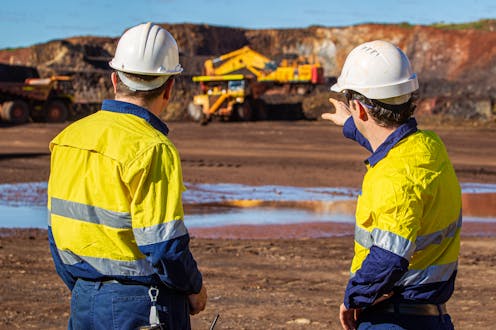
A battle is underway on the mine sites in Western Australia’s remote Pilbara region. Unions are keen to get back into the iron ore industry after decades on the outer. Mining companies are desperate to keep them out.
At Rio Tinto site Paraburdoo, where both residential and fly-in-fly-out (FIFO) workers are employed, the Western Mine Workers Alliance announced on Thursday it had the signatures necessary to demonstrate majority support for enterprise bargaining. Over 400 workers had signed on.
Once ratified by the Fair Work Commission, the company will be obliged to negotiate an enterprise agreement with the union.
This is huge news, as enterprise agreements have been rare in the industry for many decades. Workers are generally on individual common law contracts which pay higher than the award but lack transparency and have no guaranteed yearly pay rise.
Many workers are FIFO, working 12-hour work shifts. The two weeks on, one week off roster is known colloquially as the “divorce roster”.
Unions are campaigning at Paraburdoo, as well as other Rio Tinto and BHP sites, for the option of “even time” rosters of one week on, one week off. These rosters have lower pay, however, due to working fewer hours per week on average.
Workers want better conditions
Long hours, extended periods away from home and a lack of autonomy can be a poisonous cocktail.
According to a study prepared for the WA government, about 30% of WA mining workers have “high or very high levels of psychological distress”.
Another study of FIFO workers mainly from WA found the likelihood of workers experiencing high or very high levels of mental distress was increased by a factor of four when they felt “very or extremely stressed by their immediate supervisors”.
The problem with insecure work
Job insecurity affects a significant proportion of the workforce. Sexual harassment plagues the industry and in some cases is linked to insecure work.
Haul truck driver Astacia Stevens testified to a parliamentary inquiry that her supervisor told her “if you want your shirt [a permanent position], you have to get on your knees first”.
She refused and was later sacked. What Stevens characterised as an anti-union culture had made her “reluctant to join” her union.
There is now an historic class action against BHP and Rio Tinto, alleging “widespread and systemic sexual harassment and gender discrimination over the past two decades” nationwide.
Unionists are also campaigning on pay, saying recent pay rises haven’t kept up with inflation.
The rise and fall of union power in the Pilbara mines
The Pilbara iron ore industry today has few union members, but used to be a bastion of militant unionism. In its periods of strength and subsequent decline, from the 1970s to the 1990s, the story of Pilbara iron ore unionism mirrors that of Australian unionism more broadly, but in an exaggerated and time-compressed way.
Unions improved work in the 1970s. Low pay, long hours, and “soggy” food were the norm when the Pilbara iron ore industry started in the 1960s. Union pressure changed this. Shifts were reduced to eight hours and workers gained a say over the work process.
Across Australia, the union movement was confident and militant in the 1970s. Yet the Pilbara was particularly so.
While the average Western Australian worker in 1973 went on strike for a quarter of a day, the average Pilbara iron ore worker struck for just over 11 days in that year.
One union delegate, interviewed as part of my PhD research, recounted:
We had industrial muscle and we used it. There was no fear.
Workers’ meetings on site would decide what issues to take up, when to strike and for how long. Often, union officials would only be told afterwards.
While strikes often provoked the ire of management and politicians, they dramatically improved workers’ lives. Unionists campaigned on community issues and even set up a cooperative during the 1979 Hamersley Iron strike.
Workers lived in towns near mine sites, and socialised together after hours, some playing sport every night of the week.
The unions were pushed out
In 1986, Robe River (now owned by Rio Tinto) broke with the other iron ore companies and launched a full-frontal attack on unions. In spite of expectations, unions did not adopt a strike strategy to defend themselves and lost out.
Two years later, amid industrial action and a divided management, Mount Newman Mining (now part of BHP) tried and failed to do the same thing. That company did not de-unionise until 1999.
During the mining boom of the 2000s, the Pilbara mines were a union wasteland, despite rebuilding efforts.
What could a renewed union presence mean?
Just last year, BHP train drivers showed how a renewed union presence might address these issues. They are a rare example of unionisation in the industry today, as I write in my book.
On Monday February 12 2024, workers voted for a 24-hour strike on the Friday if their demands weren’t met. At 11am on the Thursday, BHP came to the table to avert the strike. Pay was increased by an initial 4%, and then 4% a year over the following four years.
Rosters are now the even time (two weeks on, two weeks off) roster the workers fought for. The agreement is based on an average 42-hour week, not the 56-hour average work week (for lower pay) that is standard for many across the industry.
This is the context in which hundreds of Pilbara workers are joining their unions and fighting for enterprise agreements.
Authors: Alexis Vassiley, Lecturer, School of Business and Law, Edith Cowan University


 Daily Bulletin


