

Australian women are wary of AI being used in breast cancer screening – new research
- Written by: Alison Pearce, Associate Professor, Health Economics, University of Sydney
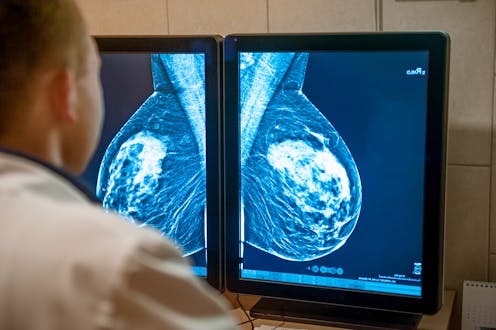
Artificial intelligence (AI) is becoming increasingly relevant in many aspects of society, including health care. For example, it’s already used for robotic surgery and to provide virtual mental health support.
In recent years, scientists have developed AI algorithms that can analyse mammograms for signs of breast cancer. These algorithms may be as good as or better at finding cancers than human radiologists, and save the health-care system money.
At the same time, evidence for the accuracy of AI in breast cancer screening is still emerging. And we need to ensure the benefits would outweigh the risks, such as overdiagnosis. This is where small cancers are detected that wouldn’t cause harm, resulting in unnecessary treatment.
In a new study, my colleagues and I wanted to understand how Australian women – who would be affected if AI were to be introduced into breast screening in the future – feel about the technology.
AI and breast cancer screening
Breast cancer screening programs reduce the number of women who die from breast cancer by finding cancer early.
In Australia, as in many countries around the world, two specially trained health professionals, usually radiologists, review each screening mammogram for signs of cancer. If the two radiologists disagree, a third is consulted.
This double reading approach improves cancer detection rates without recalling too many women for further testing unnecessarily. However, it’s resource intensive. And there’s currently a shortage of radiologists worldwide.
AI has been investigated to support radiologists, replace a radiologist, or as a triage tool to identify the mammograms at highest risk so these can be reviewed by a radiologist. However, there’s no consensus yet as to how to best implement AI in breast cancer screening.
Our study
The success of cancer screening programs depends on high rates of participation. While people are generally receptive to AI, in previous research, many have reported being unwilling to trust AI with their health care.
There are concerns introducing AI into breast cancer screening programs could jeopardise screening participation rates if people do not trust AI.
We asked 802 women if and how they thought AI should be implemented in breast cancer screening. Our sample was generally representative of the population of women in Australia eligible for screening.
We measured how their preferences were influenced by factors such as:
how the AI was used (whether it supplemented radiologists, replaced one or both radiologists, or was used for triage)
how accurate the AI algorithm was
who owned the AI algorithm (for example, the Australian government department of health, an Australian company or an international company)
how representative the algorithm was of the Australian population (for example, the algorithm may not work as well for people from some ethnic groups)
how privacy was managed
how long patients had to wait for the results of their mammogram.
We used the responses to assess which factors were most important and how the introduction of AI might influence participation in breast cancer screening.
Before the survey, we provided participants with information about AI and how it could be used in breast cancer screening. The information we provided may have changed participants’ beliefs and preferences around the use of AI in this context relative to the general population. This could be a limitation of our study.
What we found
Overall, we saw mixed reactions to the introduction of AI into breast cancer screening. Some 40% of respondents were open to using AI, on the condition it was more accurate than human radiologists. In contrast, 42% were strongly opposed to using AI, while 18% had reservations.
In general, participants wanted AI to be accurate, Australian-owned, representative of Australian women, and faster than human radiologists before implementation.
Notably, up to 22% of respondents reported they might be less likely to participate in breast cancer screening if AI was implemented in a way that made them uncomfortable.
It’s possible attitudes to AI may differ in contexts with different social values or existing screening practices to Australia. But our findings were broadly consistent with what we see in other countries.
Around the world, women are generally receptive to the benefits of AI in breast cancer screening. But they feel strongly that AI should supplement or support clinicians, rather than replace them.
We need to proceed carefully
AI holds promise for improving the effectiveness and efficiency of breast cancer screening in the future.
That said, these benefits may be offset if screening participation goes down. This is particularly concerning in Australia, where participation rates in BreastScreen are already relatively low (less than 50%).
Implementing AI without addressing community concerns around the accuracy, ownership, privacy and implementation model could undermine trust in breast cancer screening programs.
Policymakers should carefully consider community concerns about the implementation of AI technology in health care before proceeding. And breast cancer screening participants will need reliable information to understand the risks and benefits of AI in screening services.
If this is not done properly, and screening participation falls lower as a result, this could lead to more breast cancers being diagnosed later and therefore being harder to treat.
Authors: Alison Pearce, Associate Professor, Health Economics, University of Sydney


 Daily Bulletin


