

How do you put a tariff on movies? Here’s what Trump’s plan could mean for Australia
- Written by: Mark David Ryan, Professor, Film, Screen, Animation, Queensland University of Technology
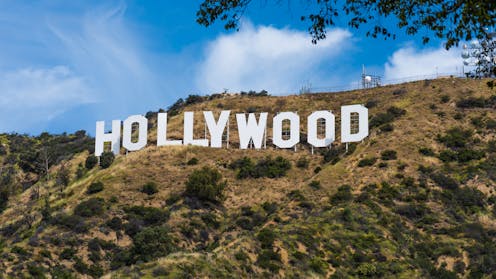
US President Donald Trump’s recent announcement of a plan to impose a 100% tariff on movies “produced in foreign lands” could have a massive impact on the global entertainment industry.
Film and television production is increasingly part of an interconnected global system. Hollywood’s major studios and global streaming giants use a diverse range of locations around the world, sometimes working across multiple countries for a single project.
Doing so allows them to leverage production incentives and tax shelters offered by different countries, take advantage of exchange rates to lower their production costs, and more.
They also film offshore, for example in China, as strategic co-productions and feature iconic locations and local actors to appeal to audiences in that specific national market.
Many countries have become important hubs in this global system of production. Australia is a significant player. So, how exactly might Trump’s tariffs work? And why is so much Hollywood film made internationally in the first place?
‘Movies made in America’
Trump made the announcement in a post on the social media network Truth Social. But his original statement is vague and lacks crucial detail.
Based on his post, this proposal could include any foreign movie imported into the United States. More likely, though, it refers to US movies filmed (in part or wholly) overseas.
Trump’s statement only singles out movies. He doesn’t mention television series for broadcasters, or specifically film and television programs made for streaming platforms.
This suggests a focus on movies made by Hollywood studios. It may or may not include content made by streamers such as Netflix.
Tariffs on tickets?
Movies are a kind of intellectual property. They’re intangible products or services, not physical goods. If a tariff was applied to movies, they’d become the first service in the current trade war to receive one.
So what tariffs or regulations could be applied?
One option would be a levy on distributors releasing US movies made overseas. Another option would be to adapt the French TSA model, which levies a tax on all cinema tickets. In France, this money is reinvested into the local industry. The US could impose such a tax on tickets for films with production components overseas.
Both options would pass the costs on to consumers. A drop in already fragile cinema attendance or revenues could simply cause studios to reduce the number of movies made for theatrical release.
Studios might instead concentrate on making movies and television series for their own streaming platforms, such as Disney+ and Paramount+.

Taxing production
Could the tax be imposed in other ways? Many US studio movies, and television programs, are at least partly, if not wholly, filmed internationally. But they are still US-controlled movies and still dominate the box office in many countries worldwide.
Could the revenue of Godzilla x Kong: The New Empire (2024), filmed on the Gold Coast in Australia, specifically be targeted and taxed for being made overseas, in contrast to a Hollywood movie made completely at home?
Would there be a sliding scale based on how much of a film is shot overseas? Would the tax apply to post-production or only production? The process of reviewing and enforcing this would be complex.
Another option may be taxing the portion of a movie’s production budget obtained from foreign tax incentives.
Major blockbusters filming in Australia are eligible for tax rebates and incentives, which can equate to almost half, or more, of the money they spend in Australia. But exactly how the US would review and regulate such a tax is again unclear.
Australia’s film industry
International film and television production expenditure in Australia now averages A$880 million each year. International movies alone account for about half of that figure.
And the number of movies and television series being filmed in Australia has increased dramatically since the outbreak of COVID.
Production expenditure here on both local and international productions jumped from just over $1 billion in 2019–20 to about $2.4 billion in 2022–23.
There are numerous reasons for this. Australia became a more popular international production hub after serving as a “production bubble” during the pandemic, as restrictions forced filming to shut down in many other countries. Relationships were forged between local producers, crews, film agencies and studios.
The reputation of places like the Gold Coast, known for talented crews and stunning filming locations, has also played an important role in continually luring studios back.
The biggest draw card
But the major reason is the strong pull of Australia’s tax incentives for filming content here.
In Australia, international film and television programs are eligible for a 30% “location offset” on eligible production expenditures. If a project qualifies, producers will receive a provisional certificate, and they can claim a fixed 30% rebate for expenses in an income tax return for the relevant year.
There’s also a 30% offset on eligible post-production and visual effects work. And these incentives can be “stacked” on top of an extra 10–15% in incentives from state screen agencies (such as Screen QLD).
Some combined federal and state-based production offsets amount to rebates of 50%, or more, of a project’s production spend in Australia.

Why Australia is worried
International productions, which are quite different to local film and television programs, generate employment for many local actors and technical professionals. The loss of this film production would dramatically reduce employment for local professionals.
If these levies are imposed only on movies that screen theatrically, then television series and streaming films and series could continue to film in Australia unaffected. That would lessen the impact on local industries. If the definition includes both, the impact could be dramatic.
Authors: Mark David Ryan, Professor, Film, Screen, Animation, Queensland University of Technology


 Daily Bulletin


