

NZ Budget 2025: anything less than a 5% increase in health funding amounts to merely standing still
- Written by: Tim Tenbensel, Professor of Health Policy, University of Auckland, Waipapa Taumata Rau
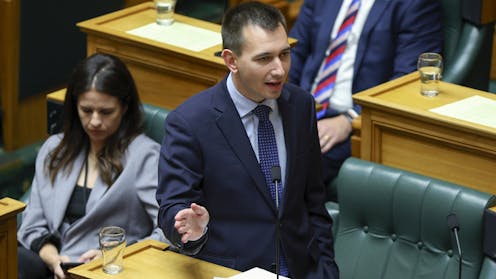
Minister of Health Simeon Brown claimed earlier this year that health funding in New Zealand has never been higher and that suggestions of underfunding are “fake news”.
On the bare statistics, Brown isn’t wrong. The allocation to Vote Health has indeed increased from NZ$18.2 billion in 2018-19 to $29.6 billion in the 2024-25 budget.
Yet for many working in the publicly-funded health system things have never seemed so bad, with daily stories of under-staffing and increasing levels of stress.
So, how much should the government be spending on health? Any answer needs to factor in the broader context of the health system, and where we sit historically and comparatively.
The health system is subject to significant cost pressures, few of which are unique to New Zealand. People are generally living longer, but more of that longer life span is spent in ill health.
At the same time, New Zealand’s population profile has changed significantly over the past 40 years. There is a lower proportion of working-age people paying income tax to support those who are older.
Technological advances, on balance, drive up health expenditure – more is possible, so more is expected. And compared with other parts of the economy, health services are labour-intensive.
Around two thirds of health expenditure is on staff, and health workforce shortages are a global problem (again, driven by demographic change). All these factors mean health costs rise faster than inflation.
Taking all of this into account, a recent health economics analysis calculated that to continue to deliver the same level of service in the United Kingdom (which has very similar health system characteristics to New Zealand), public spending on health would need to increase by 2.8% in real terms (above inflation) each year.
Then we need to factor in population growth, which has recently been between 1.5% and 2% per year in New Zealand. In this context, a 4-5% increase in Vote Health amounts to merely standing still.
Long-term deterioration
We also need to put our current situation in historical and international context.
The most appropriate indicator for international comparison is “publicly mandated health expenditure” (PMHE) as a percentage of GDP, as this excludes private expenditure (private health insurance and “out of pocket” payments).
Total health spending typically constitutes 10-12% of GDP in high-income countries, and PMHE is typically around 8%. In the 2010s, however, New Zealand’s PMHE dropped from 7.8% (2012) to 7% of GDP (2017). Meanwhile, Australia, Canada and the UK all remained at or above 8% during that time.
This represents a significant long-term deterioration which heightened the stress on our health system before and after the COVID pandemic.
Even when our PMHE as a percentage of GDP is comparable to Australia and other countries, our per-capita health expenditure is significantly less because our GDP per-capita is lower.
The most significant budget boost in recent years was in 2022. But this was largely soaked up by pay rises for health professionals that resulted from underfunding during the 2010s.
The current government finds itself in a very tight spot. This is partly because of international economic conditions and demographic trends, but also due to self-imposed constraints.
Even in such a large budget, there’ll be little room for major initiatives in health unless savings are found from existing areas. That is rarely feasible in health. As is true in most years, there could be up to three big-ticket items. If so, what should they be?
What Budget 2025 should include
First, the government needs to boost capital expenditure in health. A recent analysis by the UK Institute for Government shows that public service productivity, including in the health sector, fell sharply during and after the COVID pandemic. The New Zealand treasury reported similar productivity declines.
The UK report concluded these declines were primarily due to physical capacity constraints – clinical staff can’t be more productive when there is not enough physical space and diagnostic equipment.
Earlier this month, Prime Minister Christopher Luxon announced a $400 million increase in the annual capital allowance across all of government. Let’s see how much of the total $4 billion capital allowance is channelled into health.
A second priority should be primary healthcare. Here, the health minister has already announced a range of initiatives, headlined by $285 million of additional performance-based funding over three years. This is a welcome commitment, and the most significant boost in primary care funding since the mid-2000s.
However, it’s unlikely this will redress erosion over the past 20 years of primary care “capitation” funding (the amount a GP practice receives per enrolled patient).
This funding formula also needs to be modernised to better reflect where needs are highest and account for rising acuity and complexity of conditions in primary healthcare. This would relieve some pressures on hospital emergency departments and medical wards.
Third, investment to retain and attract health workers across the whole sector is vital. Given the demographic and epidemiological changes, proactively preparing for a mid-21st-century health workforce will require funding to support emerging models of health services, particularly in primary and community settings, including programmes such as Access and Choice and comprehensive primary and community care teams.
These priorities, and any government commitment to them in Budget 2025, must be understood against the backdrop of sustained historical underfunding.
The government is likely to claim health is a big winner in Budget 2025. Unless increases are significantly greater than 5%, such a claim will bring little respite to the health sector.
In any case, the race that counts is a marathon, not a sprint. New Zealand is well back in the field, struggling not to lose further ground.
Authors: Tim Tenbensel, Professor of Health Policy, University of Auckland, Waipapa Taumata Rau


 Daily Bulletin


