

Read The Times Australia

Daily Bulletin

What’s a ‘Strombolian eruption’? A volcanologist explains what happened at Mount Etna

  • Written by: Teresa Ubide, ARC Future Fellow and Associate Professor in Igneous Petrology/Volcanology, The University of Queensland
What’s a ‘Strombolian eruption’? A volcanologist explains what happened at Mount Etna

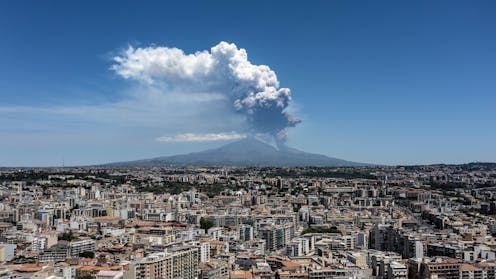
On Monday morning local time, a huge cloud of ash, hot gas and rock fragments began spewing from Italy’s Mount Etna.

An enormous plume was seen stretching several kilometres into the sky from the mountain on the island of Sicily, which is the largest active volcano in Europe.

While the blast created an impressive sight, the eruption resulted in no reported injuries or damage and barely even disrupted flights on or off the island. Mount Etna eruptions are commonly described as “Strombolian eruptions” – though as we will see, that may not apply to this event.

What happened at Etna?

The eruption began with an increase of pressure in the hot gases inside the volcano. This led to the partial collapse of part of one of the craters atop Etna.

The collapse allowed what is called a pyroclastic flow: a fast-moving cloud of ash, hot gas and fragments of rock bursting out from inside the volcano.

Two thermal images of a mountain.
Thermal camera images show the eruption and flows of lava down the side of Mount Etna. National Institute of Geophysics and Volcanology, CC BY

Next, lava began to flow in three different directions down the mountainside. These flows are now cooling down. On Monday evening, Italy’s National Institute of Geophysics and Volcanology announced the volcanic activity had ended.

Etna is one of the most active volcanoes in the world, so this eruption is reasonably normal.

What is a Strombolian eruption?

Volcanologists classify eruptions by how explosive they are. More explosive eruptions tend to be more dangerous, because they move faster and cover a larger area.

At the mildest end are Hawaiian eruptions. You have probably seen pictures of these: lava flowing sedately down the slope of the volcano. The lava damages whatever it runs into, but it’s a relatively local effect.

As eruptions grow more explosive, they send ash and rock fragments flying further afield.

At the more explosive end of the scale are Plinian eruptions. These include the famous eruption of Mount Vesuvius in 79AD, described by the Roman writer Pliny the Younger, which buried the Roman towns of Pompeii and Herculaneum under metres of ash.

Photo of glowing red lava against a black background.
In a Hawaiian eruption, like this one at Mauna Loa, lava flows along the ground and not a lot gets shot into the air. Bruce Omori / Paradise Helicopters / EPA

In a Plinian eruption, hot gas, ash, and rock can explode high enough to reach the stratosphere – and when the eruption column collapses, the debris falls to Earth and can wreak terrifying destruction over a huge area.

What about Strombolian eruptions? These relatively mild eruptions are named after Stromboli, another Italian volcano which belches out a minor eruption every 10 to 20 minutes.

In a Strombolian eruption, chunks of rock and cinders may travel tens or hundreds of metres through the air, but rarely further. The pyroclastic flow from yesterday’s eruption at Etna was rather more explosive than this – so it wasn’t strictly Strombolian.

Can we forecast volcano eruptions?

Volcanic eruptions are a bit like weather. They are very hard to predict in detail, but we are a lot better than we used to be at forecasting them.

To understand what a volcano will do in the future, we first need to know what is happening inside it right now. We can’t look inside directly, but we do have indirect measurements.

Photo of a cloud of ash rising from a volcano with fields in the foreground.
Highly explosive Plinian eruptions like that of Mount Pinatubo in 1991 can cause enormous destruction. Bullitt Marquez / AP

For example, before an eruption magma travels from deep inside the Earth up to the surface. On the way, it pushes rocks apart and can generate earthquakes. If we record the vibrations of these quakes, we can track the magma’s journey from the depths.

Rising magma can also make the ground near a volcano bulge upwards very slightly, by a few millimetres or centimetres. We can monitor this bulging, for example with satellites, to gather clues about an upcoming eruption.

Some volcanoes release gas even when they are not strictly erupting. We can measure the chemicals in this gas – and if they change, it can tell us that new magma is on its way to the surface.

When we have this information about what’s happening inside the volcano, we also need to understand its “personality” to know what the information means for future eruptions.

Are volcanic eruptions more common than in the past?

As a volcanologist, I often hear from people that it seems there are more volcanic eruptions now than in the past. This is not the case.

What is happening, I tell them, is that we have better monitoring systems now, and a very active global media system. So we know about more eruptions – and even see photos of them.

Monitoring is extremely important. We are fortunate that many volcanoes in places such as Italy, the United States, Indonesia and New Zealand have excellent monitoring in place.

This monitoring allows local authorities to issue warnings when an eruption is imminent. For a visitor or tourist out to see the spectacular natural wonder of a volcano, listening to these warnings is all-important.

Authors: Teresa Ubide, ARC Future Fellow and Associate Professor in Igneous Petrology/Volcanology, The University of Queensland

Read more https://theconversation.com/whats-a-strombolian-eruption-a-volcanologist-explains-what-happened-at-mount-etna-258060

Business News

Cost Savings and Benefits of Using Used Pallets in Logistics

In today’s competitive logistics and supply chain industry, businesses are constantly looking for ways to reduce operational costs without compromising efficiency and reliability. One of the most prac...

Daily Bulletin - avatar Daily Bulletin

How Fulfilment Services in Australia Help Businesses Scale Efficiently

The growth of e-commerce and modern retail has transformed customer expectations. Consumers now expect fast shipping, accurate order processing, and seamless delivery experiences regardless of where...

Daily Bulletin - avatar Daily Bulletin

Practical Ways Australian Workplaces Can Reduce Operating Costs

Reducing business costs doesn’t always mean cutting staff, shrinking services or making the workplace feel bare-bones. In many cases, the smarter savings are hiding in everyday operations: the light...

Daily Bulletin - avatar Daily Bulletin

Executive Recruitment Solutions That Help Organisations Secure Exceptional Leaders

Leadership has a direct impact on organisational performance, employee engagement, strategic growth, and long-term success. Businesses operating in increasingly competitive environments require experi...

Daily Bulletin - avatar Daily Bulletin

Why A WooCommerce Website Designer Matters For Online Growth

Running an online store today requires more than simply listing products and waiting for customers to arrive. Businesses need a website that is fast, reliable, easy to navigate, and designed to suppor...

Daily Bulletin - avatar Daily Bulletin

Turning Your Empty Tables into Revenue

The rise of AI demand tools in hospitality, the EatClub–CommBank partnership, and seven trends reshaping Australian dining  A growing number of Australian venues are turning to AI-powered demand ma...

Daily Bulletin - avatar Daily Bulletin

High-Impact Dental Marketing Strategies That Are Driving Real Practice Growth Today

The landscape of dental practice growth in Australia has shifted dramatically over recent years. Standard, broad-spectrum advertising campaigns no longer yield the return on investment they once did. ...

Daily Bulletin - avatar Daily Bulletin

How Telematics Helps Australian Companies Improve Productivity

Operating a commercial fleet in Australia is a uniquely demanding endeavour. Between the sprawling urban sprawl of cities like Sydney and Melbourne and the immense, unforgiving stretches of the Outb...

Daily Bulletin - avatar Daily Bulletin

Inside the Icon: The BridgeMuseum Officially Opens at the Sydney Harbour Bridge

A bold new way to experience one of Australia’s most recognisable landmarks has arrived, with BridgeClimb Sydney officially opening the all-new BridgeMuseum.  Located inside the Sydney Harbour Bridge...

Daily Bulletin - avatar Daily Bulletin

The Daily Magazine

Traffic Light System Solutions For Safer And More Efficient Traffic Management

Modern cities and growing communities rely heavily on effective traffic management to ensure safety...

Gold Migration Lawyers in Liquidation: How the Closure Affects Your ART Appeal

If your appeal was with Gold Migration Lawyers, a recent change to how the Tribunal decides cases ...

The pressure cooker: life in urban Australia in 2026

Australian cities have always been demanding. Long commutes, rising housing costs, busy schedules a...

What Actually Makes a Good Criminal Lawyer in Melbourne

Most people only think about this question once. That is usually too late. Most people charged wi...

Why Working With A Chatswood Tutor Can Improve Academic Performance

Academic expectations continue increasing for students across primary school, high school, and senio...

Is It Worth Getting Solar Panels in Melbourne?

The real question is not whether solar works in Melbourne. It works. The question is what it is co...

How A Diploma Of Project Management Builds Practical Skills For Modern Work Environments

Developing the ability to plan, execute, and deliver outcomes efficiently is a key requirement in to...

How to Choose the Right Football for Every Level

Choosing a football may seem straightforward, but the right option depends on who will be using it a...

What to Ask a Wedding Photographer Before You Book

Booking a wedding photographer can feel deceptively simple: you like the photos, you like the vibe...