

How Australia’s first outback mosque was built 600km north of Adelaide, 150 years ago
- Written by: Ismail Albayrak, Professor of Islam and Catholic Muslim Relations, Australian Catholic University
From 1860 to 1930, an estimated 3,000 people came to Australia from Afghanistan, Baluchistan, Punjab, Sindh and the northern part of Pakistan. Still more came from different parts of the Ottoman Empire.
The arrival of these “Afghans”, and the camels that came with them, was a new phase in Australian history described as the “camel era” of exploration and transport.
In Hergott Springs, now known as Marree, an outback crossroads town about 600 kilometers north of Adelaide, they established one of the first of their settlements called Ghantowns – and built Australia’s first outback mosque.
The isolated outback
Afghans proved themselves skilled in camel driving in deserted inland areas, developing small “mobile emporiums”.
Hergott Springs was at the crossroads between the Oodnadatta Track crossing outback South Australia and on the Overland Telegraph Line from Adelaide to Darwin, and another crossroads continuing towards the goldfields of Victoria. The water at the springs was used as a camel station on this vital link.
The Afghans planted date trees near the spring as a mark for their settlement. The town was segregated along racial lines, with the Afghans and Aboriginal people living on the north side of the town, while the Europeans lived on the south.

Accounts vary, but the first Marree Mosque was built in 1865 or 1882 by Abdul Kadir, a camel breeder and Afghan settler. It was a simple earthen structure with a timber-framed gabled roof.
It included a small pulpit and a designated washing area, fronted by a large hole filled with hot water from an artesian bore, where worshippers performed their ritual ablution (wudu), the call to prayer (adhan) and prayers. Between 40 to 50 Muslims would pray there, and it operated regularly until the last living Afghans of the first generation passed away.
A cameleer named Assim Khan was an imam in one of the Marree mosques in the early 20th century. Members of or visitors to the small community included Bejah Dervish, a leading figure in the 1896 Lawrence Wells exploration; Dadleh Balooch, a well-known pioneering cameleer; and brothers Faiz and Tagh Mahomet, camel owners and carriers and merchants from an aristocratic family.
By the 1920s, up to 50 people still prayed regularly in Marree’s mosques.

The first two mosques of earthen construction in Marree were lost to the desert, one lost around 1910. The third mosque in Marree, the northern mosque made of galvanised iron, also began to decline.
Bejah Dervish, a devout Muslim cameleer, seeing the old galvanised iron mosque had fallen into disrepair, offered it for sale for £50 some time in the late 1940s or early 1950s. Several years later, the mosque was offered for sale for £40. It was demolished in 1956 by its elderly caretaker, Syed Goolamdeen, who could no longer maintain it, since many descendants of the Afghans no longer practised Islam.
Only post stubs of one of the mosques remain, in an echo of the past.
Settling across Australia
Following the first mosques in Marree, Afghan settlers built around 36 mosques across the Australian outback. They built mosques in Broken Hill, New South Wales; Coolgardie (famously described in Inquirer and Commercial News in 1894 as the “Mecca of the West”), Leonora and Kalgoorlie in Western Australia; and Cloncurry, Queensland.
They also built mosques in the capital cities of Brisbane, Perth and Adelaide.
The impacts of the White Australia Policy and subsequent community decline means few of these original mosques exist today. One of the few that has survived is the City Mosque, or the Afghan Mosque, between Little Gilbert Street and Logan Street in Adelaide. It was the first permanent mosque in Australia, built in 1888.
In 1930, some Afghans brought carpets from the Marree Mosque to Adelaide Mosque.
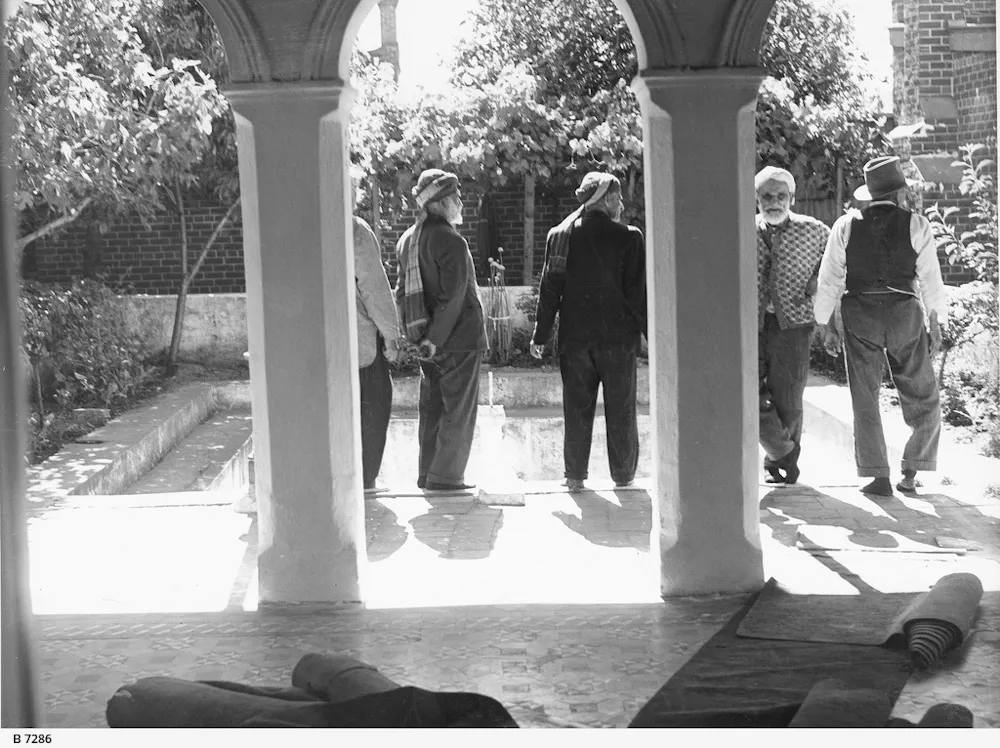 The City Mosque or Afghan Mosque was built on Little Gilbert Street, Adelade, in 1888. Here, men gather in 1937.
State Library South Australia
The Perth Mosque, completed in 1907 with government-backed funding, became a central place of worship, housing Qur’ans, English and Urdu magazines, and beautiful ornaments and carpeted floors.
Between the world wars, larger Muslim populations in Sydney and Melbourne had only makeshift temporary mosques in the form of houses or prayer rooms.
New migration
The first post-war wave of Muslim immigrants moved to Australia from 1948 and the early 1950s, most notably Albanians, Bosnians and Turkish Cypriots. They revitalised old mosques and built new ones.
In the history of Islam and Muslims in Australia, this period was described by a visiting great Islamic scholar Ali Kettani as a “humble beginning and new renaissance”.
Albanians in Shepparton built that town’s first mosque in 1960. The Surry Hills Mosque was established by a multi-ethnic Muslim community in 1966 in Sydney. The Preston Mosque was established by multi-ethnic Muslim community in 1976 in Melbourne. The Turkish ethnic community built the Faith Mosque in 1976, also in Melbourne. The Lebanese ethnic community erected the Lakemba Mosque in Sydney in 1977 – and so on.
Today, Australia has approximately 600 mosques.
The cameleers’ descendants still evoke memories about the Marree Mosque and also organised the first “Afghan Reunion in Marree” in 2005, at the Marree camel races.
To commemorate Australian Muslim heritage, a replica of the Marree Mosque was built. There are also various festivals in and around Marree, including Afghan prayer at the replica mosque, that still commemorate the contributions of the Afghan cameleers in Australia.
Authors: Ismail Albayrak, Professor of Islam and Catholic Muslim Relations, Australian Catholic University


 Daily Bulletin


