

Disaster after disaster: do we have enough raw materials to ‘build back better’?
- Written by: Missaka Nandalochana Hettiarachchi, Adjunct Professor in Disaster Management, James Cook University
This Christmas Day marks 21 years since the terrifying Indian Ocean tsunami. As we remember the hundreds of thousands of lives lost in this tragic event, it is also a moment to reflect on what followed. How do communities rebuild after major events such as the tsunami, and other disasters like it? What were the financial and hidden costs of reconstruction?
Beyond the immediate human toll, disasters destroy hundreds of thousands of buildings each year. In 2013, Typhoon Haiyan damaged a record 1.2 million structures in Philippines. Last year, earthquakes and cyclones damaged more than half a million buildings worldwide. For communities to rebuild their lives, these structures must be rebuilt.
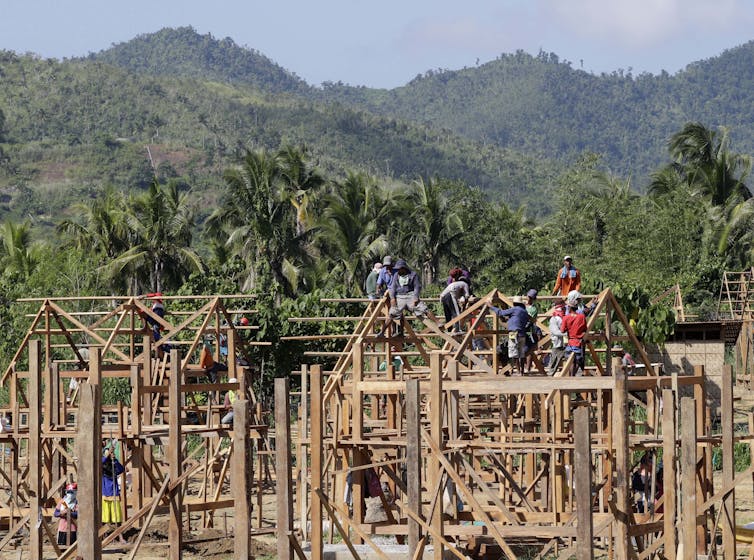
While governments, non-government agencies and individuals struggle to finance post-disaster reconstruction, rebuilding also demands staggering volumes of building materials. In turn, these require vast amounts of natural resource extraction.
For instance, an estimated one billion burnt clay bricks were needed to reconstruct the half-million homes destroyed in the Nepal earthquake. This is enough bricks to circle the Earth six times if laid end to end. How can we responsibly source such vast quantities of materials to meet demand?
Demand causes problems
Sudden spikes in demand have led to severe shortages of common building materials after nearly every major disaster over the past two decades, including the 2015 Nepal earthquake and the 2019 California wildfires. These shortages often trigger price hikes of 30–40%, which delays reconstruction and prolongs the suffering of affected communities. Disasters not only increase demand for building materials but also generate enormous volumes of debris.
For example, the 2023 Turkey–Syria earthquake produced more than 100 million cubic meters of debris – 40 times the volume of the Great Pyramid of Giza.
Disaster debris can pose serious environmental and health risks, including toxic dust and waterway pollution. But some debris can be safely transformed into useful assets such as recycled building materials. Rubble can be crushed and repurposed as base for low-traffic roads or turned into cement blocks .
The consequences of poor post-disaster building materials management have reached alarming global proportions. After the 2004 Indian Ocean Tsunami, for example, the surge in sand demand led to excessive and illegal sand mining in rivers along Sri Lanka’s west coast. This caused irreversible ecological damage to two major watersheds, devastating the livelihoods of thousands of farmers and fisherpeople.
Similar impacts from the overextraction of materials such as sand, gravel, clay and timber have been reported following other major disasters, including the 2008 Sichuan earthquake in China and Cyclone Idai in Mozambique in 2019. If left unaddressed, the social, environmental and economic impacts of resource extraction will escalate to catastrophic levels, especially as climate change intensifies disaster frequency.
Urgent need for action
This crisis has yet to receive adequate international attention. Earlier this year, several global organisations came together to publish a Global Call to Action on sustainable building materials management after disasters.
Based on an analysis of 15 major disasters between 2005 and 2020, it identified three key challenges: building material shortages and price escalation, unsustainable extraction and use of building materials, and poor management of disaster debris.
Although well-established solutions exist to address these challenges, rebuilding efforts suffer from policy and governance gaps. The Call to Action urges international bodies such as the United Nations Office for Disaster Risk Reduction to take immediate policy and practical action.
Building back better and safer
After a disaster hits, it leaves an opportunity to build back better. Rebuilding can boost resilience to future hazards, encourage economic development and reduce environmental impact. The United Nations’ framework for disaster management emphasises the importance of rebuilding better and safer rather than simply restoring communities to pre-disaster conditions.
Disaster affected communities should be rebuilt with capacity to cope with future external shocks and environmental risks. Lessons can be learned from both negative and positive experiences of past disasters. For example, poor planning of some reconstruction projects after the Indian ocean Tsunami (2004) in Sri Lanka made the communities vulnerable again to coastal hazards within a few years. On the other hand, the community-led reconstruction approach followed after the Bhuj earthquake, India (2001), has resulted in safer and more socio-economically robust settlements, standing the test of 24 years.
As an integral part of the “build back better” approach, authorities must include strategies for environmentally and socially responsible management of building materials. These should encourage engineers, architects and project managers to select safe sustainable materials for reconstruction projects.
At the national level, regulatory barriers to repurposing disaster debris should be removed, whilst still ensuring safe management of hazardous materials such as asbestos. For example, concrete from fallen buildings was successfully used as road-base and as recycled aggregate for infrastructure projects following the 2004 tsunami in Indonesia and 2011 Tohoku Earthquake in Japan.
This critical issue demands urgent public and political attention. Resilient buildings made with safe sustainable material will save lives in future disasters.
Authors: Missaka Nandalochana Hettiarachchi, Adjunct Professor in Disaster Management, James Cook University


 Daily Bulletin


