

Gaza’s cultural sites have been decimated. UNESCO’s muted response sets a dangerous precedent
- Written by: Benjamin Isakhan, Professor of International Politics, Deakin University
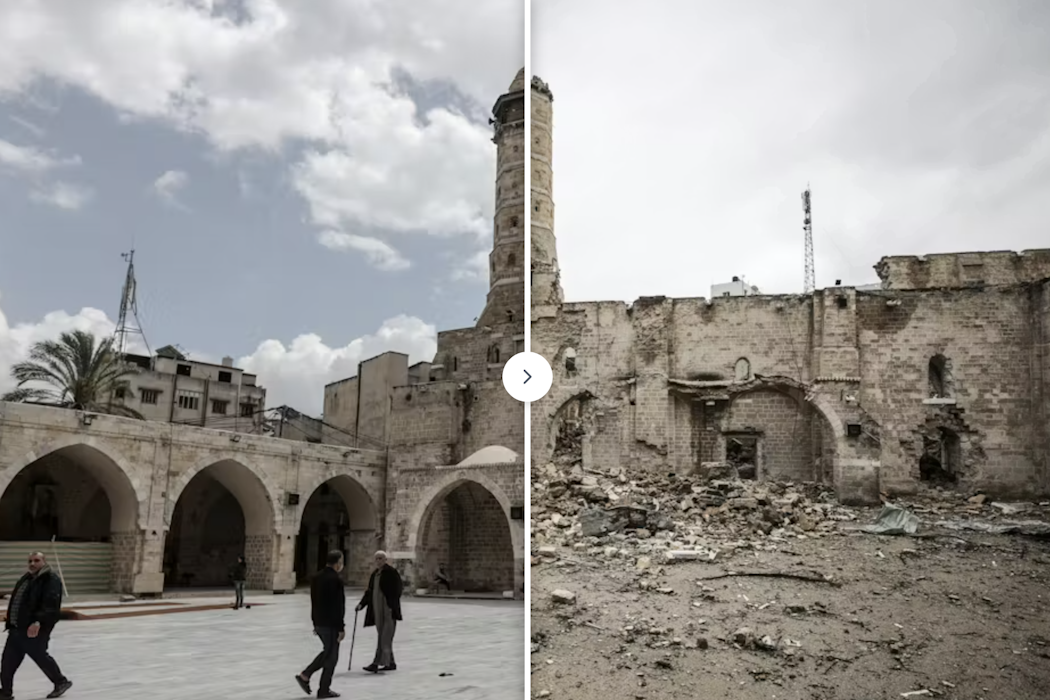
Since October 2023, Israel’s war in Gaza has caused mass human suffering. But it has also brought devastation to the cultural heritage of the Palestinian people.
In our recent article in the International Journal of Heritage Studies, we documented the extent of heritage destruction in Gaza and analysed the strikingly limited response by the United Nations Educational, Scientific and Cultural Organization (UNESCO).
We argue that UNESCO’s failures have consequences beyond Gaza, as they weaken deterrence of attacks on heritage sites globally and risk normalising impunity for these types of crimes in conflict.
Heritage destruction in Gaza
Gaza has a rich and layered heritage, with archaeological traces dating to at least 1300 BCE. It has long sat at the crossroads of many cultures, and has been controlled by the ancient Egyptians, Greeks and Romans.
Gaza is also home to historical sites important to the three main faiths of the region – Judaism, Christianity and Islam.
Much of this cultural heritage now lies in ruin. UNESCO’s Gaza damage assessment list includes 150 sites that have been damaged or destroyed since the war began.
Some of these are globally significant sites. Two are on UNESCO’s World Heritage Tentative List:
Other damaged or destroyed sites include:
the Greek Orthodox Saint Porphyrios Church, which dates to 425 CE and is sometimes referred to as the third-oldest church in the world
the seventh-century Great Omari Mosque, thought to be the first mosque in Gaza, along with its 13th-century library containing rare Islamic manuscripts
the Qasr al-Basha, a fortress also known as Pasha Palace, which was built in the mid-13th century by the Mamluk sultanate and had been turned into an archaeological museum
a Roman cemetery (Ard-al-Moharbeen), thought to have at least 134 tombs dating back to 200 BCE.
UNESCO’s failures
Apart from creating this list, UNESCO has been relatively muted in its response, compared with the role the agency has played in other conflicts.
This doesn’t mean it’s been completely silent. It has issued several statements condemning the destruction in Gaza and calling on “all involved parties to strictly adhere to international law”.
It has also elevated one heritage site to its List of World Heritage in Danger – the Saint Hilarion Monastery. Taking this step strengthens the protections around the site, with potential penalties for intentional damage.
Yet, despite these efforts, we question whether UNESCO has truly met the moment. Our analysis identifies a pattern of omission and understatement that is difficult to reconcile with UNESCO’s own mandate and the legal architecture that exists to protect cultural property in armed conflict.
For example, UNESCO has failed to publicly invoke the 1954 Hague Convention in relation to Gaza, which aims to protect cultural sites during conflict. The agency has cited it in virtually every major conflict since its ratification.
It also didn’t seek urgent action from the UN Security Council or the UN General Assembly to protect cultural sites. The agency did this in response to the Islamic State’s acts in Syria and Iraq (including the desecration of the World Heritage site of Palmyra). In 2017, for instance, the security council passed a resolution backed by UNESCO that laid out a number of steps to help protect cultural heritage in conflict.
Similarly, UNESCO has not worked with the International Criminal Court or the International Court of Justice to initiate proceedings against Israel or Israeli officials for the destruction of heritage in Gaza. The agency did this after conflicts in the Balkans and Mali. These trials established the intentional destruction of cultural property during conflict as a war crime.
Finally, UNESCO has not taken its usual approach of explicitly naming Israel as the perpetrator of cultural destruction in Gaza. It has taken this step in many recent conflicts. This includes Ukraine, where is has frequently named and condemned Russia as the perpetrator.
Why has UNESCO been so cautious?
One explanation offered by critics is geopolitical constraint. UNESCO has increasingly been criticised for an overdependence on voluntary state contributions. This can make the agency reluctant to confront powerful countries for fear of alienating supporters.
This dynamic is certainly evident in UNESCO’s long and strained relationship with Israel and the US. Both formally withdrew from UNESCO in 2019 because the agency had described Israel as an occupying power in Gaza and the West Bank, and condemned its destruction of Palestinian heritage.
But we argue there’s something more troubling occurring – the erosion of UNESCO’s willingness and capacity to activate the legal and normative tools it helped build.
Once a mighty advocate for the protection of culture worldwide, UNESCO has slowly withered into a largely ineffective and technocratic agency that sidesteps complex issues and is hamstrung by internal division.
UNESCO’s response
In response to the arguments raised here, UNESCO sent a detailed email explaining its actions on heritage protection in Gaza. These are some of the points raised by a UNESCO spokesperson:
On citing the 1954 Hague Convention:
Across different conflicts, UNESCO sometimes explicitly cites the 1954 Hague Convention […] and in other instances use the broader formulation “international law”.
UNESCO also communicates with the concerned Member States bilaterally […] This has been done on several occasions through correspondence addressed to the authorities of Israel, for example to remind Israel of its obligations under the 1954 Hague Convention.
On explicitly naming Israel as a perpetrator:
UNESCO is not a judiciary body, therefore its role is not to assign responsibility. In specific case of Ukraine, there are several Security Council and/or UNESCO governing bodies decisions that may explain specific statements.
On the lack of willpower to use its tools and resources on Gaza:
UNESCO activates its legal, normative and programmatic tools within the remits of its mandate and available funds. The needs are enormous, and we take this opportunity to renew UNESCO’s call in support of the people of Gaza.
Why Gaza matters
UNESCO’s limited response to the destruction in Gaza matters. Heritage protection is not only about salvaging damaged sites and trying to rebuild them. It’s also vital for defining unacceptable conduct and deterring future violations.
When the world’s foremost body on the protection of cultural heritage limits itself to cautious generalities, it fosters a permissive environment. It allows this destruction to be treated as regrettable collateral damage of war, rather than an actionable crime. This undermines UNESCO’s credibility.
It can also set a dangerous precedent. If the large-scale destruction of heritage occurs in full view of the world, with no repercussions, future belligerents may believe the costs of heritage crimes will be tolerated.
Authors: Benjamin Isakhan, Professor of International Politics, Deakin University


 Daily Bulletin


