

The new National Defence Strategy feels written for a bygone era – and ignores the elephant in the room
- Written by: Peter Layton, Visiting Fellow, Strategic Studies, Griffith University
Sometimes new government strategies really aren’t newsworthy. The 2026 National Defence Strategy (NDS) is like that.
The biggest headline from the document is the additional defence spending of $53 billion over the next decade, which the government claims (with some accounting sleights of hand) will reach 3% of GDP.
While this technically meets US President Donald Trump’s demands for America’s allies in NATO and elsewhere to spend more on their militaries, there’s more to it than that. In particular, NATO measures are based on how much cash is spent annually, rather than the future spending laid out in long-term plans.
In terms of actual strategy, though, the main takeaway appears rather muted: there’s been “significant progress in implementing the 2024 National Defence Strategy”. That’s reassuring but surely that was the intent of that earlier document – to be implemented.
In being a warmed-up version of the 2024 strategy, the 2026 document seems to ignore what’s happened since – and that’s been considerable.
Over the last two years, there’s been a worsening war in Ukraine, an expanded conflict in the Middle East that has encompassed the entire region and sent shockwaves through the global economy, and many unpredictable American military adventures.
At times, the strategy is backward-looking to a bygone era, lacking courage and confidence.
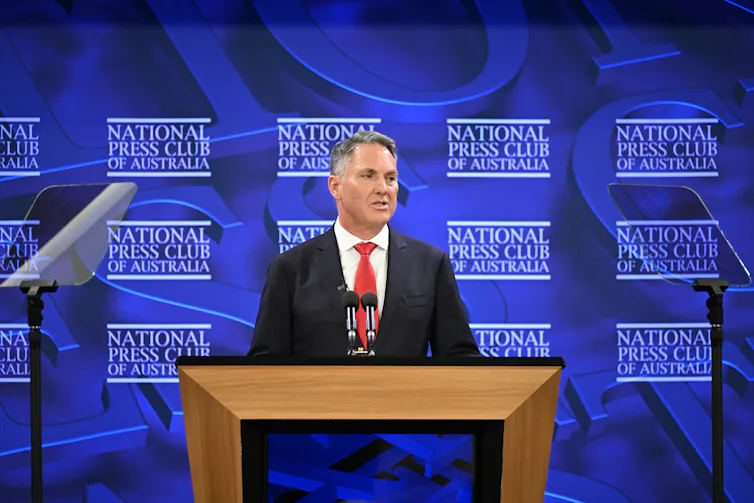
What does the strategy promise?
The 2026 NDS keeps in place Australia’s strategy of denial, that is, a defensive strategy that seeks to prevent an adversary from taking military action against Australia.
Even though the funding provided to Defence is somewhat increased, we will likely see higher inflation as a result of the US-Israel war against Iran. The planned allocations for operating and crewing the Australian Defence Force’s (ADF) current ships, aircraft and vehicles is unlikely to be enough.
Money to make up this shortfall may mean less is spent than planned on buying new equipment. What matters is what you get for your money, not how much is spent.
However, there are two notable investments mentioned in the strategy, even if they are relatively small compared to many other Defence projects.
The ADF will finally be getting a medium-range surface-to-air missile system able to shoot down incoming ballistic missiles.
Such threats might once have seemed remote, but missile attacks have become routine. In the last year, ballistic missiles have been fired by Russia, Iran and the Houthis in Yemen.
However, the ADF’s defensive missiles probably won’t enter into service for several years, as other nations are already in the shopping queue ahead of Australia.
The ADF will also be getting a range of autonomous uncrewed systems (drones in the air and water), such as the Air Force’s Ghost Bat and the Navy’s Ghost Shark and Speartooth. And in a boost to our national resilience, these are manufactured in Australia even if some of the parts are imported.
Read more: What Australia must learn from Ukraine about drone technology and the future of warfare
The recent wars in Ukraine and the Middle East have highlighted the importance of these systems, the strategy notes. And it adds, the future of warfare will involve both autonomous uncrewed systems and artificial intelligence (AI).
Disappointingly, though, compared to the huge spends on traditional crewed warships, submarines and armoured vehicles, there hasn’t been much allocated to these systems or the AI wave of the future.
Where else is missed?
Because this is a steady-as-she-goes document, it misses an important opportunity to convince an increasingly doubtful public of the wisdom of the hugely expensive purchases of nuclear submarines under the AUKUS program.
Dennis Richardson, a former secretary of the Defence Department, recently argued these vessels “are only worth having if they’re a net addition to defence capability.” The implication is the submarines are nice to have, but not essential, unlike other equipment.
The 2026 NDS could have placed the submarines into a coherent strategic framework, alongside the rest of Defence, and provided a clear and compelling reason for acquiring them. Or, as they say in defence speak: a strategic narrative. It didn’t.
The absence of Prime Minister Anthony Albanese, who is in Asia securing fuel shipments for Australia, from the strategy’s launch highlights another big miss.
The strategy’s title includes the word “national”, yet the nation is largely missing in it. This document, and the previous NDS, rightly declare that defending Australia involves a whole-of-nation approach that goes far beyond just the defence forces. But how this is approach is meant to work is only briefly noted.
The current fuel crisis suggests there is much to be done. Spending money on military hardware may be pointless if there is insufficient fuel to operate it. This was made clear in 2018 when a major air exercise in Darwin was apparently disrupted due to a tanker from Singapore being delayed.
The NDS does note the investments Defence has made in recent years to improve fuel security to remediate shortfalls. It has done trials on low-carbon, sustainable aviation fuels, but there are no plans yet to produce these on a large-scale for military use.
So far, it seems Defence is just nibbling at the edges of fuel security and resilience.
A changed America
Lastly, there is an elephant in the room: the Americans.
One can sympathise with the government wanting to keep a low profile when it comes to Australia’s major alliance partner. However, this alliance in an increasingly unstable world is arguably of overriding importance.
Earlier this year, the US released its own National Defence Strategy that called on regional allies to help defend the “first island chain”, running from the Philippines to Taiwan to the Japanese islands.
Through this America First, commonsense lens, America’s alliances and partners have an essential role to play – but not as the dependencies of the last generation. […] For too long, allies and partners have been content to let us subsidise their defence.
The Australian NDS discusses the alliance in the pre-Trump language of shared strategic interests, with just a nod to the importance of “upholding Australian sovereignty and increasing our self-reliance”.
The 2026 NDS needed to explain where an unreliable and unruly America now fits into Australian defence thinking, or does not.
Authors: Peter Layton, Visiting Fellow, Strategic Studies, Griffith University


 Daily Bulletin


