Studying Down syndrome might help us understand Alzheimer's disease better
- Written by: The Conversation
 The brain changes associated with Alzheimer's are more easily mapped in people with Down syndrome. People via www.shutterstock.com.
Alzheimer’s disease is the most common form of dementia in older adults. At the moment there is no cure, but many clinicians feel that the earlier one is diagnosed, the better the possibilities are for treatment or slowing the disease.
But developing treatments or prevention approaches for Alzheimer’s disease is difficult. There is no biomarker (for example a blood test) or definitive medical test for it and there is no set age where people develop memory impairments and dementia.
Indeed, people can develop Alzheimer’s disease as young as 30 or well into old age. This is a real challenge for diagnosing Alzheimer’s in its early stages.
But in people with Down syndrome there is an age-dependent progression of changes associated with Alzheimer’s disease. This makes it much easier to map when and what kinds of changes happen in the brain in the early stages of the disease.
If we can understand how and when changes in the brain start to happen in people with Down syndrome, that could help us find ways to slow or prevent Alzheimer’s disease in this vulnerable group and for others with Alzheimer’s.
Adults with Down syndrome may provide insights for Alzheimer’s
The lifespan of people with Down syndrome has dramatically improved from 25 years in 1983 to over 60 years today although some minority groups still have lower lifespans.
Although many people with Down syndrome remain healthy as they get older, most are vulnerable to the development of Alzheimer’s disease.
Virtually all people with Down syndrome over 40 years old develop Alzheimer’s disease. It is estimated that over 70% in their 60’s and older also have dementia. This is a much higher rate than people without Down syndrome.
 An image of beta-amyloid plaques in a 67-year-old patient with Down syndromeElizabeth Head, Author provided
Over 95% of people with Down syndrome have a full extra copy of chromosome 21. There are two other causes of Down syndrome that include partial trisomy 21 where only a piece of chromosome 21 and associated genes are triplicated. The third type of Down syndrome is called mosaicism, where not all of the cells in the body have a fully extra copy of chromosome 21.
The gene for amyloid precursor protein, which is thought to be important for Alzheimer’s disease, is located on chromosome 21.
This amyloid precursor protein is cut into smaller pieces and the smaller protein, called beta-amyloid, is toxic to the cells in our brain or neurons. It collects into structures called beta-amyloid plaques, which are a hallmark of Alzheimer’s in all people. The plaques make it hard for neurons to communicate.
In people without Down syndrome there are normally two copies of this gene. In people with Down syndrome there are three copies of the gene because of the extra copy of chromosome 21. That means from an early age people with Down syndrome are making more of the beta-amyloid protein.
Beta-amyloid plaques are consistently observed in the brains of those with Down syndrome in their 30s, but they have also been reported in people eight- to 15 years old.
How does the brain change in people with Down syndrome as they get older?
 Neurofibrillary tangles.Elizabeth Head, Author provided
The second feature of Alzheimer’s disease is neurofibrillary tangles. These are made up of a protein called tau that builds up inside of neurons in the brain and prevents them from functioning properly.
For people without Down syndrome, these neurofibrillary tangles can start to develop anywhere from age 30 to over 100 years. But for people with Down syndrome these tangles do not start to accumulate until they are over 40 years old. This is another example of how it may be easier to understand Alzheimer’s disease in people with Down syndrome because we know the ages at which neurofibrillary tangles begin.
 Cerebrovascular pathology.Elizabeth Head, Author provided
Other changes that are common in Alzheimer’s disease also happen with age in Down syndrome including increasing brain inflammation, oxidative damage and loss of proteins in synapses, which are the connections between nerve cells of the brain. All of these features may lead to impaired brain function.
When we learn more about when these changes happen, we can also start to think about ways to prevent or reverse them.
What does dementia look like in people with Down syndrome?
Many people are aware of the early warning signs of Alzheimer’s disease and that the loss of short-term memory is one of the key features.
For people with Down syndrome the evidence suggests similar changes may also happen in cognition and behavior as in the development of Alzheimer’s disease. Memory and thinking changes also appear in dementia with Down syndrome, but are more difficult to observe because of the nature of the intellectual disability.
But other changes, like social withdrawal, mood changes (including anxiety and depression), aggressive behavior, lack of interest in usual activities, change in sleep pattern and irritability, are easier to detect in Down syndrome. Similar changes also happen in people without Down syndrome who develop dementia in the moderate to severe stages of the disease.
What changes can we see in the brain by imaging?
The brains of people with Down syndrome have some differences compared to people of a similar age without Down syndrome. For example, in people in their 40s, the hippocampus of someone with Down syndrome may already show signs of atrophy (getting smaller) signaling early Alzheimer’s disease, a change we do not usually see in people without Down syndrome.
 MRI showing atrophy in hippocampus indicated with arrows.David Powell
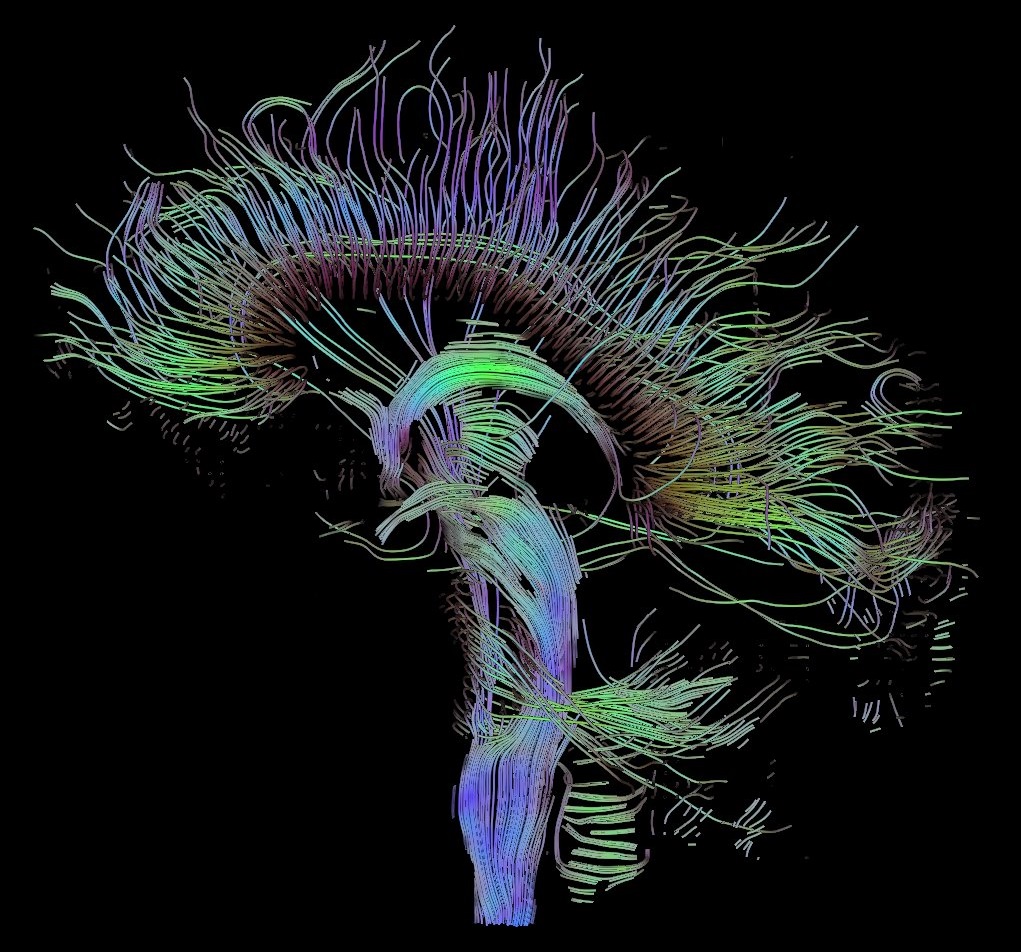
Our research group has been studying the connections between different brain structures by measuring white matter integrity – which is how well the long axons, the threadlike parts of neurons that connect to other neurons, are functioning. We do this by measuring how water molecules move along axons in people with Down syndrome.
We have found that the frontal lobes in people with Down syndrome may become increasingly disconnected from other parts of the brain. Similar changes in the white matter connections happen in Alzheimer’s disease in general.
 Tractographic reconstruction of the neural connections.Thomas Schultz via Wikimedia Commons, CC BY-SA
In our study we see these changes in people in their late 30s, when we typically do not see these changes at all in people without Down syndrome.
If we can understand the predictive value of these images then we can determine what age is best to intervene and prevent the development of Alzheimer’s disease not only in Down syndrome but also in the general population.
Not everyone with Down syndrome develops Alzheimer’s disease
Some older adults with Down syndrome never develop dementia despite a genetic vulnerability to the disease. Because of this, we may get some fascinating new leads on ways to promote healthy brain aging in people with Down syndrome that may also be translated to the larger population.
Following people with Down syndrome as they age will provide exciting new approaches to promote brain health in this vulnerable group of individuals. To facilitate aging studies in Down syndrome, the National Institutes of Child Health and Development has taken the initiative to launch a Down Syndrome Registry that will help connect families with researchers and resources – and hopefully benefit people with Down syndrome by identifying ways to enrich their development and reduce risk of disease.
Elizabeth Head receives funding from the National Institutes on Aging.
Frederick Schmitt receives funding from the National Institutes of Health. He is serving on a Data Safety Monitoring Board for a pharmaceutical clinical trial.
Authors: The Conversation


 Daily Bulletin