Still standing: how an ancient clock tower survived Italy's deadly earthquake
- Written by: Brendan Duffy, Lecturer in Applied Geoscience, University of Melbourne
Of the many devastating pictures to come out of central Italy after last week’s deadly earthquake, the clock tower of Amatrice standing defiantly amid the rubble of the town has become an iconic image.
The clock tower was reportedly built in the 13th century and its solid stance defies us to understand how this remarkable structure has evaded destruction at least twice in the past 800 years.
But perhaps surprisingly, it’s not unusual for tall, ancient structures to survive earthquakes.
Unlikely survivors
 Nepal’s Dharawara tower in 2013, before it was destroyed in the 2015 earthquake.
KATHMANDU NEPAL FEB 2013, CC BY-SA
Nepal’s Dharawara tower in 2013, before it was destroyed in the 2015 earthquake.
KATHMANDU NEPAL FEB 2013, CC BY-SA
Similar towers are relatively commonplace in Italy and part of the country’s charm. The town of San Gimignano, about 200km from the centre of the Amatrice earthquake, has 14 towers that date as far back as the 12th century – and have consequently survived many earthquakes big and small. Other towers can be seen in Alba in northern Italy.
Further afield, a memorable image of the Izmit earthquake in Turkey in 1999 was of the tower of the Golcuk Mosque standing forlornly among the ruins.
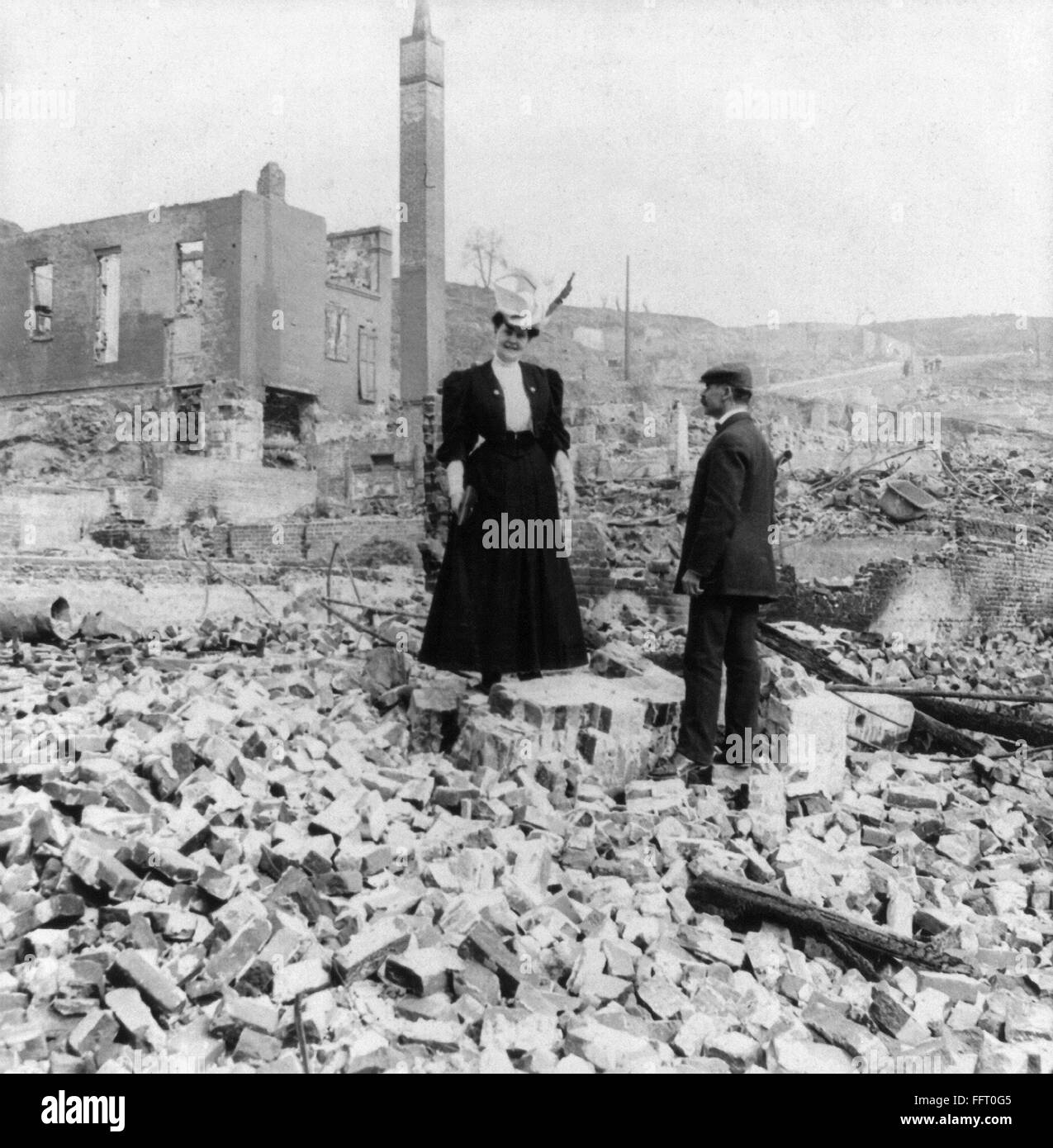
Photos from the 1906 San Francisco earthquake show a slender tower and an array of chimneys standing in the rubble of the city.
In many instances, however, the towers fall, as happened to the Dharahara tower during the magnitude-7.8 Nepal earthquake in April 2015.
Why do some of these slender icons survive repeated earthquakes and others fall? An article in The Economist suggested that the clock tower was better constructed than the surrounding buildings, pointing out that it even survived better than a modern school and hospital. The L'Aquila experience suggests that this is probably one part of the story.
However, the reality is more complex. Other factors can and do contribute to the resilience of buildings.
 The Dharawara tower collapsed during the 2015 earthquake in Nepal. It is being rebuilt.
EPA/NARENDRA SHRESTHA
The Dharawara tower collapsed during the 2015 earthquake in Nepal. It is being rebuilt.
EPA/NARENDRA SHRESTHA
On shaky ground
It is very likely that the clock tower’s survival was influenced by the relationship between the frequency of the earthquake waves and the natural resonance of the building. To understand why, we have to consider how earthquakes interact with buildings.
Earthquakes generate seismic waves that pass through the ground. Like ocean waves, they have peaks and troughs. The frequency of the wave is related to its “period” – the time taken for one complete waveform (including a peak and a trough) to pass.
A building has a natural period that causes it to vibrate back and forth. Think of a child on a swing – a swing with short ropes will complete a full cycle much more quickly than a long swing.
The same is true of buildings with different heights. A building is effectively an upside-down pendulum and taller buildings have longer natural periods of oscillation (swinging back and forth).
The ground also has a preferred period at which it oscillates. Soft sediment in a river valley will oscillate over longer periods, and hard bedrock over shorter ones.
High-frequency (short period) earthquake waves are therefore amplified in bedrock, such as the site of Amatrice, and are the dominant frequency radiated by small to moderate and shallow earthquakes such as last week’s.
Low-frequency (long period) earthquake waves are amplified in sediment and form a greater part of the seismic energy radiated by larger earthquakes, such as the Tohuku earthquake in Japan and the Nepal quake that felled the Dharahara tower.
When the resonant frequency of the ground coincides with the resonant frequency of the building, the structure will undergo its largest possible oscillations and suffer the greatest damage. The rigidity and distribution of mass along the height of a building also have a big effect on the likely damage sustained in a given earthquake, as this governs the way the induced forces are distributed.
You can try this for yourself by experimenting with a broom handle and a 30cm ruler. Held vertically, the top of the broom handle will do little if you vigorously shake its base with small movements, whereas the ruler will oscillate under the same shaking.
Slow the shaking down and the handle will begin to whip back and forth while the ruler settles down. Place a large mass on the end of either the ruler or the broom handle and the characteristics will change.
The concept is beautifully demonstrated in a video by Robert Butler of the University of Oregon.
A resonant problem
Of course, real structures and real earthquakes are far more complex. Real structures have many natural frequencies, and earthquakes vibrate across a spread (or spectrum) of frequencies.
Destruction occurs when any of a buildings’s natural frequencies coincide with any of the dominant frequencies of the earthquake. In some situations, there may be just a few structures that avoid this dangerous combination, such as the clock tower at Amatrice, or the chimneys of San Francisco.
The characteristics of shaking at Amatrice have not yet been published, but it is highly likely that the tower is standing not only because it was built well in the first instance, but also because it is just the right size and shape to survive the frequency of shaking that occurs during Italy’s moderate-magnitude earthquakes.
This process is equally important in other regions. The magnitude-6.8 Myanmar earthquake on August 24 damaged many historic temples in the Irrawaddy Valley, but none appears to have collapsed. These high-but-squat structures are susceptible to high-frequency shaking, whereas the passage of earthquake waves through alluvium is likely to have amplified mainly low-frequency earthquake waves.
 Many of Myanmar’s iconic temples were damaged during the recent quake, but not destroyed.
EPA/HEIN HTET
Many of Myanmar’s iconic temples were damaged during the recent quake, but not destroyed.
EPA/HEIN HTET
Notably, much of the damage to the temples seems to have occurred as a result of the collapse of recent cheap “restorations”.
Building practices are extremely important in mitigating the effect of shaking on buildings. Modern buildings are commonly fitted with devices to reduce the effects of resonance. Engineered solutions are available to retrospectively enhance the performance of unreinforced masonry buildings, with little impact on their aesthetics.
In Italy, this retrofitting needs to be done as quickly as possible before the next earthquake. This will be a costly exercise. Even apparently resilient medieval towers may require retrofits, because they have commonly accumulated a degree of damage.
However, Italy is a globally important cultural and tourism hub, and her earthquake-prone buildings, like those in Myanmar, are part of our collective heritage. Italy should not be left to struggle alone with the management of earthquake-prone building hazards.
Authors: Brendan Duffy, Lecturer in Applied Geoscience, University of Melbourne


 Daily Bulletin


.jpg)