

Where art meets industry: protecting the spectacular rock art of the Burrup Peninsula
- Written by: Jo McDonald, Director, Centre for Rock Art Research + Management, University of Western Australia
Murujuga, also known as the Burrup Peninsula, on the mid-west coast of Western Australia, is a special place. Home to over one million Indigenous engravings on piles of ancient boulders, the landscape is of great cultural significance to the Ngarda-Ngarli – people speaking Ngarluma, Injabarndi, Mardudunhera, Yaburara and Wong-Goo-Tt-Oo languages.
Some of this rock art, or petroglyphs, may demonstrate the first use of this arid landscape by people arriving over 45,000 years ago, when these hills were more than 100 km from the coast. Others show us the bountiful lifestyle of hunter-fisher-gatherers along this coastline before the arrival of historic explorers, pastoralists, pearlers and miners.
The art province, as the Dampier Archipelago (including Burrup Peninsula), was recognised on the National Heritage list in 2007.
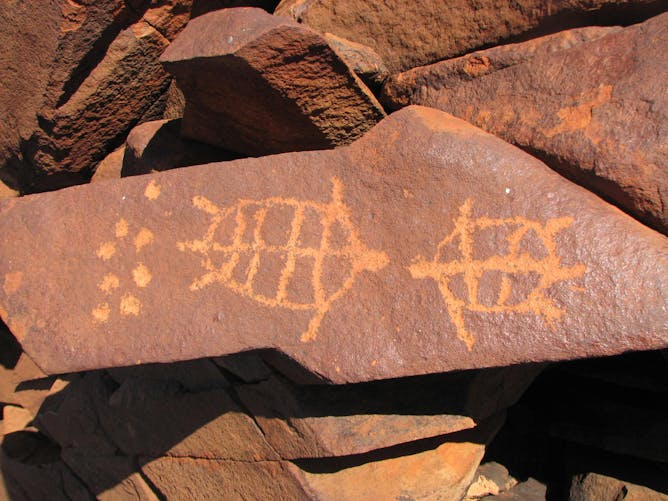 Burrup recent engravings of turtles - one with eggs.
Ken Mulvaney
Burrup recent engravings of turtles - one with eggs.
Ken Mulvaney
The Burrup Peninsula is also home to intensive mining, shipping, and industrial processing, coexisting uneasily with the artworks. One of the major concerns is the impact of industrial pollution - gas and particulate emissions - on the art. Adding to this concern were reports this week claiming that the committee charged with monitoring the effects of industry on the art has used scientifically-flawed data.
This casts doubt on the governments’ ability to assess the impact of industry, and regulations based on this monitoring.
When the Dampier region was first selected for industrialisation in the 1960s and 1970s, the heritage value of the site was effectively unknown. But, even now that its cultural and scientific significance is known, the WA government continues to play down Murujuga’s heritage value.
This cannot be because of ignorance. In 2006 premier Colin Barnett said he had “no doubt” that the Burrup rock art would get National Heritage listing and probably World Heritage listing too. He tweeted the same in late 2016. But his government has not nominated Murujuga to the tentative World Heritage list (as recently occurred for Victoria’s Budj Bim eel farms).
These concerns and others will be aired as part of an ongoing senate enquiry into the protection of the Murujuga rock art, with public hearings in Canberra this week and a report to be completed in March. The enquiry will consider industrial pollution, and also the state and federal government’s role in protecting the site.
Pollution and politics
Apart from rock art, the Burrup Peninsula is home to the town of Dampier; Woodside’s LNG processing plant; Rio Tinto iron ore’s leases and railhead; the Dampier Port Authority and shipping for gas, iron ore and salt exports; Dampier Salt; a liquid ammonia plant and linked fertiliser plant (almost operational); the Maitland Strategic Industrial area; and the Holcrim Quarry. Pre-existing industries were excluded from the 2007 national heritage listing.
There are also a further 15 square kilometres of land zoned for industrial use within the boundaries of the national heritage listing. Resources infrastructure had impacted around 16% of the landmass of the Burrup by 2006.
 The Burrup Peninsula. Note that some industrial zones are within the national heritage listing (red line)
Marujuga Aboriginal Corporation
The Burrup Peninsula. Note that some industrial zones are within the national heritage listing (red line)
Marujuga Aboriginal Corporation
Murujuga National Park, declared in 2013, covers a bit under half of the peninsula and lies entirely within the heritage listing. The site’s heritage values are managed by state and federal legislation. Both levels of government have been involved in developing processes to monitor impacts.
The Murujuga Aboriginal Corporation also manages this country as part of a 2003 agreement between the WA government and Aboriginal groups. This agreement provided certainty for the state’s development interests, but meant the Ngarda-Ngarli people ceded native title in return for the creation of the national park.
The agreement committed the state to funding for inventory studies for rock art across the Burrup Peninsula in and outside future industrial sites.
Most of the existing industrial estate was surveyed prior to development, although most of the rock art in these areas was destroyed as part of the development process. The state has funded heritage inventory surveys in all the industrial zoned land, but only one study in the national park (at Deep Gorge) has been funded.
Yet the annual rock art field school (involving the Murujuga Aboriginal Corporation, the University of Western Australia, and Rio Tinto) has documented more than 15,000 previously undocumented petroglyphs in lands outside the national park over the last three years. This suggests there may be countless other artworks still to be documented all over the peninsula.
Balancing art and industry
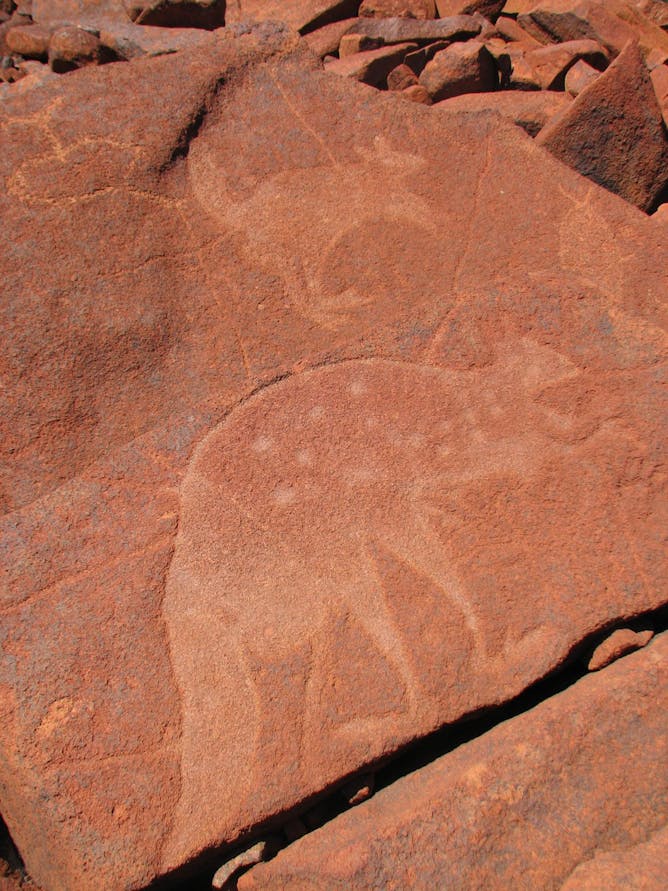 Burrup Kangaroos of an early style.
Ken Mulvaney
Burrup Kangaroos of an early style.
Ken Mulvaney
The state government also agreed to a fund a knowledge centre on the peninsula (which will also be supported by Woodside). But the centre remains to be built, with a decision on the siting yet to be made.
Two years of planning and consultation with traditional owners identified a suitable site at Hearson Cove: a public beach, easily accessible by sealed road and close to the Deep Gorge rock art gallery, which is open to the public.
In submission to the senate enquiry from WA parliamentarian Robin Chapple, it is noted that Premier Barnett indicated that the Hearson Cove site is not the government’s preferred site because of “unacceptable risk to public health and safety”. This was due to the site’s proximity to the ammonia and fertiliser plants.
It seems incongruous that the plants pose a risk to public health and safety, but not to the rock art. It is assumed that the risks referred to relate to serious ammonia leaks and (in the worst-case scenario) explosions.
We do not know exactly how much rock art is within the zone around the two plants. The plants’ federal approval requires monitoring of heritage values and surveying rock art sites within 2 km of the project site. But to my knowledge this component has not been done, and appears not to have been enforced by the federal government.
This raises the question of how the federal government is ensuring the coexistence of industry and art. A basic precept of managing cultural resources is knowing that they are there.
Premier Barnett’s preferred site for the knowledge centre is at Conzinc Bay on the northern Burrup Peninsula. It seems - to the wary - to be a highly cynical exercise. The area includes zoned industrial estate, which has so far been protected because there is no vehicle access to this part of the peninsula. Opening this part of the Burrup Peninsula to tourism and industry seems a likely consequence of this site selection.
Meanwhile, the site at Hearson Cove would limit the impact on heritage values as well as meeting access, cultural considerations and tourism requirements. Admittedly, the proximity of unsightly industry could detract from the ambience of this heritage experience.
But surely this is an opportunity to educate the public both about the remarkable heritage of Murujuga – as well as the need for modern society to balance progress with respect for the past.
Authors: Jo McDonald, Director, Centre for Rock Art Research + Management, University of Western Australia


 Daily Bulletin


