

Home prices tell us the value the public puts on green spaces
- Written by: Shanaka Herath, Vice-Chancellor’s Postdoctoral Research Fellow, University of Wollongong
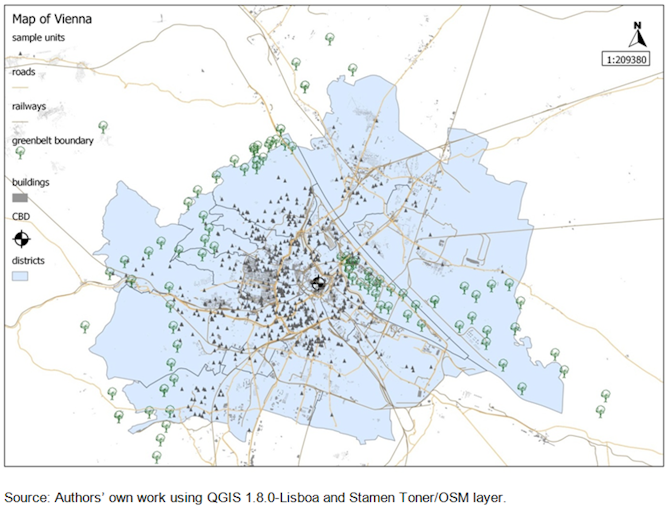
Homes near green amenities are more desirable and more expensive because residents are willing to pay higher prices to gain the many benefits of green spaces. Our research has confirmed, for instance, that apartments near to the greenbelt in Vienna, Austria, are more expensive compared to otherwise similar apartments in that city.
Similar findings have been reported for cities in England, Ontario in Canada, and the South Korean capital, Seoul.
Green spaces have well-known environmental benefits. Green neighbourhoods also have social benefits – such as less aggression and violence, and fewer incidents of youth crimes and domestic violence – and health benefits, including reduced risk of cardiovascular disease, certain cancers and certain types of diabetes.
However, Australia’s growing cities face a shortage of urban parks. Often, the provision of parks is seen only as planning compliance or an accessory.
There have been calls for developers and councils to make adequate contributions toward improving and maintaining existing parks, rather than just leveraging the benefit for financial gain with new development projects.
However, the unparalleled population growth in our cities and increasing inner-city density mean we will need not only to protect existing green spaces, but also to plan new, better-quality green amenities.
What higher prices near green amenities mean
Our study in Vienna found the price of a constant-quality (taking into account other differences) apartment drops by 0.13–0.26% with every 1% increase in distance from the greenbelt. This suggests that proximity to the greenbelt is a significant location-related predictor of Viennese apartment prices.
If there is higher demand for this type of amenity and a lack of supply, prices of houses located close to greenbelts will go up. And, if green amenities are provided in areas accessible to low- and middle-income households, the social and health benefits can be promoted across cities.
 Author
Some argue that saving the greenbelts results in higher house prices, leads to satellite cities and creates negative consequences such as increased car-dependence. Lost economic profit due to restricted development is also a concern.
To ease these pressures, “unproductive” greenbelt land and privately owned greenbelt land with intensive farming could be exempted from this protection.
A history of failed planning attempts
Greenbelts are a special type of open space consisting of natural, agricultural or largely undeveloped land around urban areas. These areas typically outline the edge of the urban fringe and are known as “urban growth boundaries” in such cases.
Greenbelts are an outcome of the containment policy; they limit the physical expansion of the urbanised area and protect a compact urban form. They can also be an outcome of a policy intended to preserve green spaces for environmental and recreation purposes.
Green wedges are similar to greenbelts but may run through an urban area rather than around it. Urban parks are different: they may have diverse features like gardens, playgrounds, running trails and walking paths, and are spread across a city.
The idea of a greenbelt for Sydney was formally proposed as early as 1948. This became an example of the failure of planning for greenbelts due to lack of support by state government agencies, property owners and developers.
The federal government’s refusal to provide funding due to unexpected immigration numbers ultimately led to the project’s demise. Most of Sydney’s inner-area greenbelt was eventually used for urban expansion.
In Melbourne, green wedges remained an established part of planning until the early 1990s. Since the liberalisation of the proposed restrictions on urban uses in Melbourne 2030, new residential, tourist and commercial developments are continuing in and beyond the greenbelt.
By 2010, urban growth boundaries in Melbourne’s north and west had moved. Consecutive governments have regarded open space as commercially expendable and as a free input to public and private projects.
Brisbane has introduced urban growth boundaries and reinforced the protection of non-urban areas bordering the city through strong regulatory planning controls. Current debates about the greenbelt in Brisbane show the challenging nature of managing conflicting interests.
There is widespread support for preserving the greenbelt between Brisbane and the Sunshine Coast, but an increasing level of approval for developments within the Brisbane to Gold Coast greenbelt.
Which way ahead?
Cities are growing fast and the current supply of urban parks is not sufficient. So, governments need to take radical steps to protect existing greenbelts.
Greenbelts generate large-scale environmental services compared to their smaller counterparts (like urban parks). It will be a point of no return once the greenbelts are sacrificed to development.
In a new world where high-density development is widely endorsed, a bit of nature in the city fringe seems like a sensible policy. A stronger greenbelt policy can only come with political leadership – and cities such as Paris are bravely putting in greenbelts. Australian cities should follow these examples.
Author
Some argue that saving the greenbelts results in higher house prices, leads to satellite cities and creates negative consequences such as increased car-dependence. Lost economic profit due to restricted development is also a concern.
To ease these pressures, “unproductive” greenbelt land and privately owned greenbelt land with intensive farming could be exempted from this protection.
A history of failed planning attempts
Greenbelts are a special type of open space consisting of natural, agricultural or largely undeveloped land around urban areas. These areas typically outline the edge of the urban fringe and are known as “urban growth boundaries” in such cases.
Greenbelts are an outcome of the containment policy; they limit the physical expansion of the urbanised area and protect a compact urban form. They can also be an outcome of a policy intended to preserve green spaces for environmental and recreation purposes.
Green wedges are similar to greenbelts but may run through an urban area rather than around it. Urban parks are different: they may have diverse features like gardens, playgrounds, running trails and walking paths, and are spread across a city.
The idea of a greenbelt for Sydney was formally proposed as early as 1948. This became an example of the failure of planning for greenbelts due to lack of support by state government agencies, property owners and developers.
The federal government’s refusal to provide funding due to unexpected immigration numbers ultimately led to the project’s demise. Most of Sydney’s inner-area greenbelt was eventually used for urban expansion.
In Melbourne, green wedges remained an established part of planning until the early 1990s. Since the liberalisation of the proposed restrictions on urban uses in Melbourne 2030, new residential, tourist and commercial developments are continuing in and beyond the greenbelt.
By 2010, urban growth boundaries in Melbourne’s north and west had moved. Consecutive governments have regarded open space as commercially expendable and as a free input to public and private projects.
Brisbane has introduced urban growth boundaries and reinforced the protection of non-urban areas bordering the city through strong regulatory planning controls. Current debates about the greenbelt in Brisbane show the challenging nature of managing conflicting interests.
There is widespread support for preserving the greenbelt between Brisbane and the Sunshine Coast, but an increasing level of approval for developments within the Brisbane to Gold Coast greenbelt.
Which way ahead?
Cities are growing fast and the current supply of urban parks is not sufficient. So, governments need to take radical steps to protect existing greenbelts.
Greenbelts generate large-scale environmental services compared to their smaller counterparts (like urban parks). It will be a point of no return once the greenbelts are sacrificed to development.
In a new world where high-density development is widely endorsed, a bit of nature in the city fringe seems like a sensible policy. A stronger greenbelt policy can only come with political leadership – and cities such as Paris are bravely putting in greenbelts. Australian cities should follow these examples.
Authors: Shanaka Herath, Vice-Chancellor’s Postdoctoral Research Fellow, University of Wollongong
Read more http://theconversation.com/home-prices-tell-us-the-value-the-public-puts-on-green-spaces-71872


 Daily Bulletin


