

Contested spaces: who belongs on the street where you live?
- Written by: Cate MacMillan, PhD Candidate, University of the Sunshine Coast
This is the second article in our Contested Spaces series. These pieces look at the conflicting uses, expectations and norms that people bring to public spaces, the clashes that result and how we can resolve these.
Our neighbourhoods need to be safe and inclusive places – safe for even the most vulnerable in our community. This includes the 668,100 Australians living with intellectual disability.
With the right support, these adults, who account for 2.9% of the population (up from 2.6% in 2009), can have independent and meaningful lives in a regular house or apartment. The main issue is not the type of accommodation, but its location. The neighbourhood, its design, and the community of people who live there are all significant factors for supporting safety and inclusion.
Yet neighbourhoods are complex and contested spaces. Communities and individuals assemble sets of exclusionary values and expectations of the kinds of people and behaviours within them. Our perceptions of desirable streets are now so intertwined with property values and social status that we have very little tolerance of change.
This collective socialisation and the strength or relative weakness of a neighbourhood’s social networks all influence the environment and outcomes for existing and new residents.
Expectations of the physical and social desirability of a street include perceived qualities such as privacy, parking, like-mindedness, spacious, healthy, clean and so on. These expectations can have a significant impact on who is welcome.
Without a tolerance of difference and a diversity of demographics, ages, cultures and housing type, neighbourhoods will always struggle to be welcoming and safe.
A neighbourhood that is stigmatised as poor or rough is as likely as one deemed well-off to subject susceptible people to ongoing disadvantage. Research shows that people with disabilities are at greater risk of bullying when living in economically disadvantaged or socially similar communities.
We need new understandings of what makes a neighbourhood a safe and inclusive place. We cannot ignore this issue. As medical and social care advances, adults with intellectual disability are outliving their parents.
This is wonderful news. But it is creates a concern for their families and support services. Where will these adults live independent and productive lives beyond the care of their parents?
What is the ideal neighbourhood?
Our research seeks to explore and describe the complexity of establishing the ideal neighbourhood “system” that will provide safe, inclusive and accessible places for adults with intellectual disability. We focused on adults aged between 18 and 40 who have mild and moderate intellectual disability as the primary disability. That’s upwards of 172,500 Australians.
We asked intellectually impaired adults, their parents and carers, as well as urban development and disability sector decision-makers, about the “ideal” neighbourhood.
Our outcomes consider the planning, design and engineering requirements of neighbourhoods. We also look at how to draw on the social capital of a community to make a local neighbourhood safer and more inclusive.
Our approach includes ideas of a “Just City”. This is about delivering places that are socially inclusive. By this we mean difference is not just tolerated, but treated with recognition and respect.
What has our research found?
Preliminary results indicate that three crucial high-level functions need to be established when designing or refurbishing a neighbourhood:
actual and perceived safety within the street and neighbourhood
access to services and amenities via walking, cycling or public transport
inclusion in community life and local neighbourhood activity.
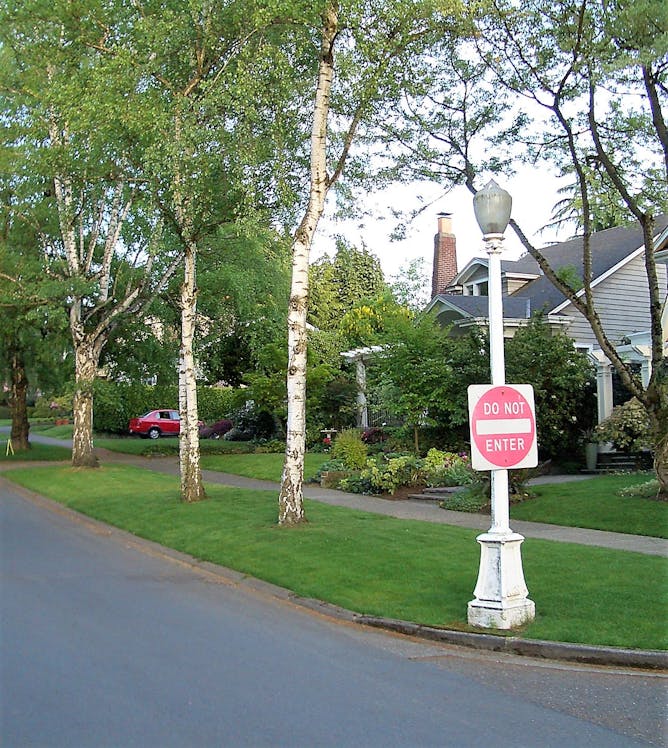 An ‘exclusive neighbourhood’ has become a selling point, but may actually be less
safe and supportive because of its lack of diversity.
Vmenkov/Wikimedia, CC BY-SA
An ‘exclusive neighbourhood’ has become a selling point, but may actually be less
safe and supportive because of its lack of diversity.
Vmenkov/Wikimedia, CC BY-SA
A safe neighbourhood has a mix of residents who “keep an eye” on each other. Diversity in a neighbourhood can help minimise the vulnerability of adults with intellectual disability to abuse, or to their corruption and exploitation to behave illegally.
Neighbourhood diversity includes the types, scale and intensity of buildings, ensuring a variety of residential accommodation and commercial uses. This mix is important: it enables a range of activity and people across the neighbourhood day and night.
The challenge of accessibility is recognised from two aspects. The first involves access to health, employment and community services – or accessible transport to those services. The second issue is how close the independent living is to family and friends.
Inclusive locations have opportunities for recreation and social activities that all residents value. In some existing neighbourhoods, community education and introduction to diversity may be needed to enhance inclusiveness.
Cul-de-sacs, long considered by planners as inhibitors of (auto) connectivity, are emerging as preferred solutions for many families. A cul-de-sac offers residents a community within a community. Calmed traffic and greater opportunities for knowing your neighbours happen in cul-de-sacs.
So how do we assess ‘ideal’ neighbourhoods?
We are identifying the key features of neighbourhoods that offer community life, work and recreational opportunities for residents and visitors. We are taking a human factors and ergonomics sociotechnical systems perspective.
We look at the roles that, for instance, streets, trees, recreational opportunities, employment, transport, diversity and tolerance play as part of an entire neighbourhood “system”.
This allows us to develop a framework that shows the relationships between the features of a neighbourhood and safe, accessible and inclusive outcomes for residents. The framework helps planning and social housing decision-makers to identify and explore potential locations for independent living.
Importantly, we recognise that the values used in this approach to designing community neighbourhoods match the values we seek for equitable, ecological and economically viable built environments.
With this human factors approach we consider:
people as assets in the system
technology as a tool to assist people
promotion of quality of life
respect for individual differences
responsibility of all stakeholders.
These considerations underpin what makes neighbourhoods safe, accessible and inclusive. And understanding the requirements of a neighbourhood that is good for adults with intellectual disability helps create places that are good for everyone.
You can read other pieces in the series as they are published here.
Authors: Cate MacMillan, PhD Candidate, University of the Sunshine Coast
Read more http://theconversation.com/contested-spaces-who-belongs-on-the-street-where-you-live-72660


 Daily Bulletin


